A yantra is a diagram for the mind to rest on: a point, triangles, lotus petals and a square gate. What each one is made of, shape by shape.
0yantras
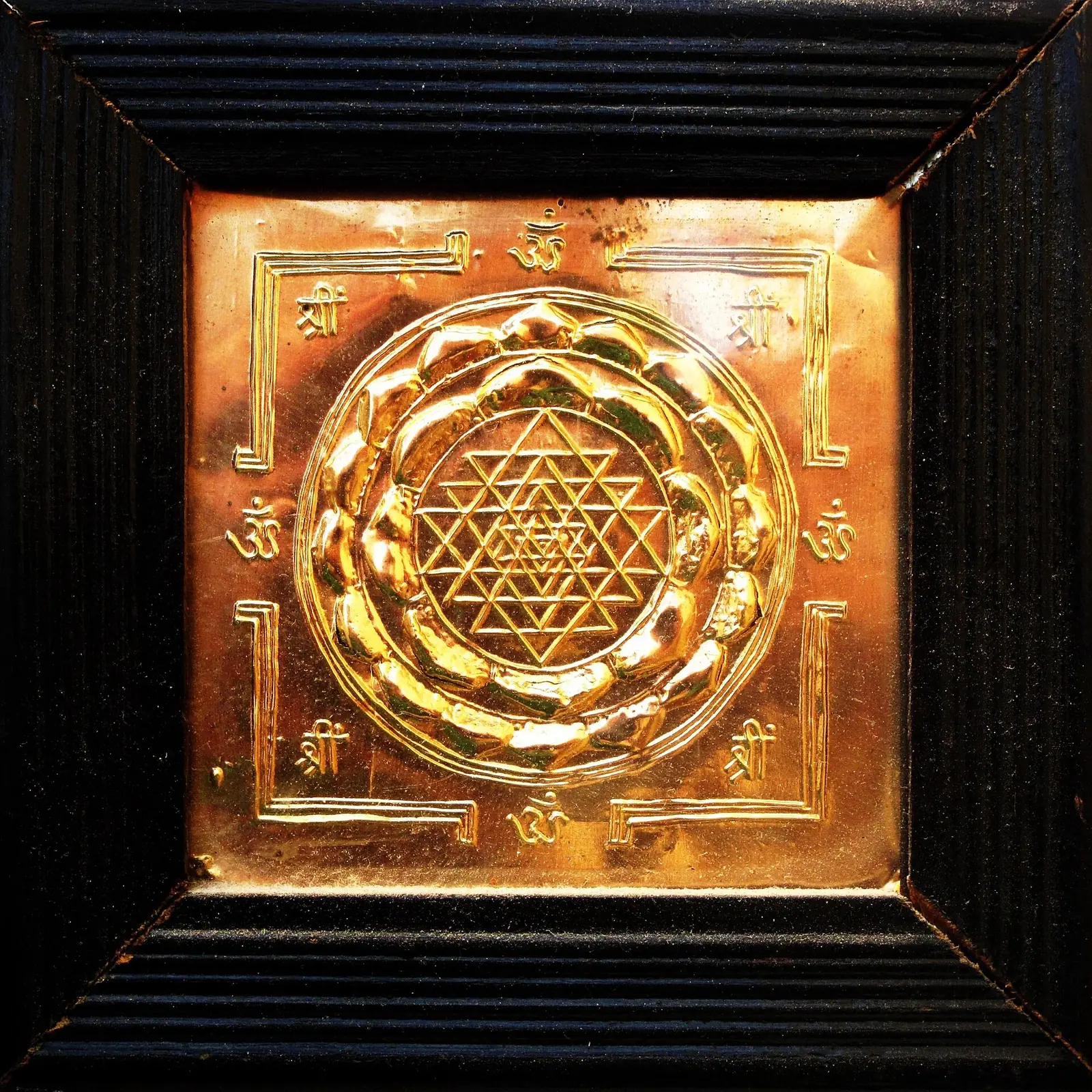
श्री यंत्र · Lalita TripurasundariShri Yantra
Nine interlocking triangles round a point: the seat of Mata Lalita. Four triangles point up and five point down, and their crossing makes 43 small triangles round the central bindu. Two rings of lotus petals, eight and sixteen, enclose them, and a square with four gates holds it all. Shri Vidya worship moves through its nine circuits from the gates to the bindu.
Bindu; 4 upward and 5 downward triangles forming 43 small triangles; 8-petal and 16-petal lotuses; circles; square with four gatesमहा मेरु · Lalita TripurasundariMaha Meru
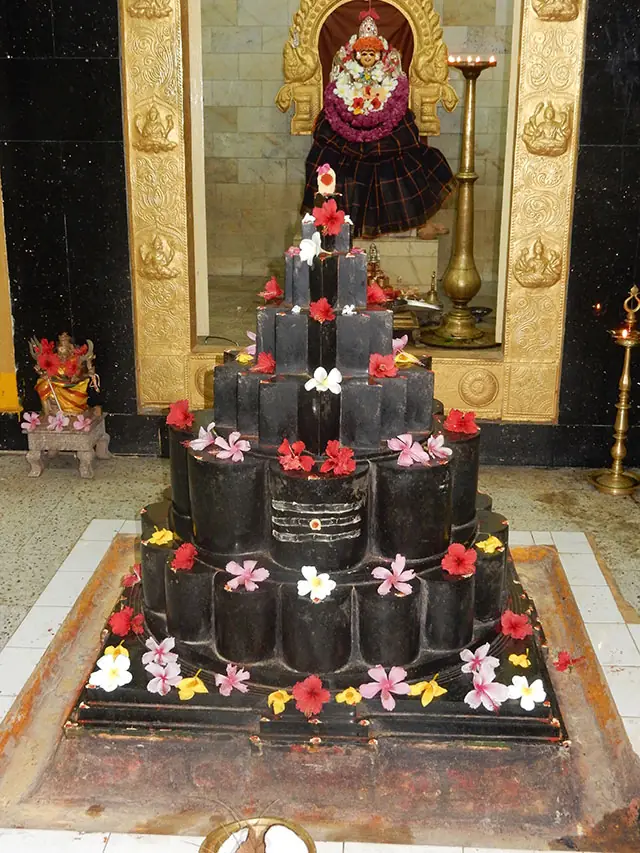
The Shri Yantra raised into a mountain, its circuits rising in tiers to a peak. When the Shri Chakra is built in three dimensions it is called Meru, after the mountain at the centre of the worlds. Each circuit becomes a level, so the bindu sits at the summit. Many Shri Vidya homes and temples keep one in metal or stone.
Shri Yantra in three dimensions: circuits as stepped tiers, bindu at the apexषट्कोणShatkona
Two triangles, one up and one down, laid over each other in a six-pointed star. The upward triangle stands for Shiva, the downward for Shakti, and the star for their union. The shatkona sits inside many other yantras, Ganesha's and Sudarshana's among them. In South India it is also the sign of Murugan.
Hexagram of two equilateral triangles, often with a bindu at the centreकाली यंत्र · Mata KaliKali Yantra
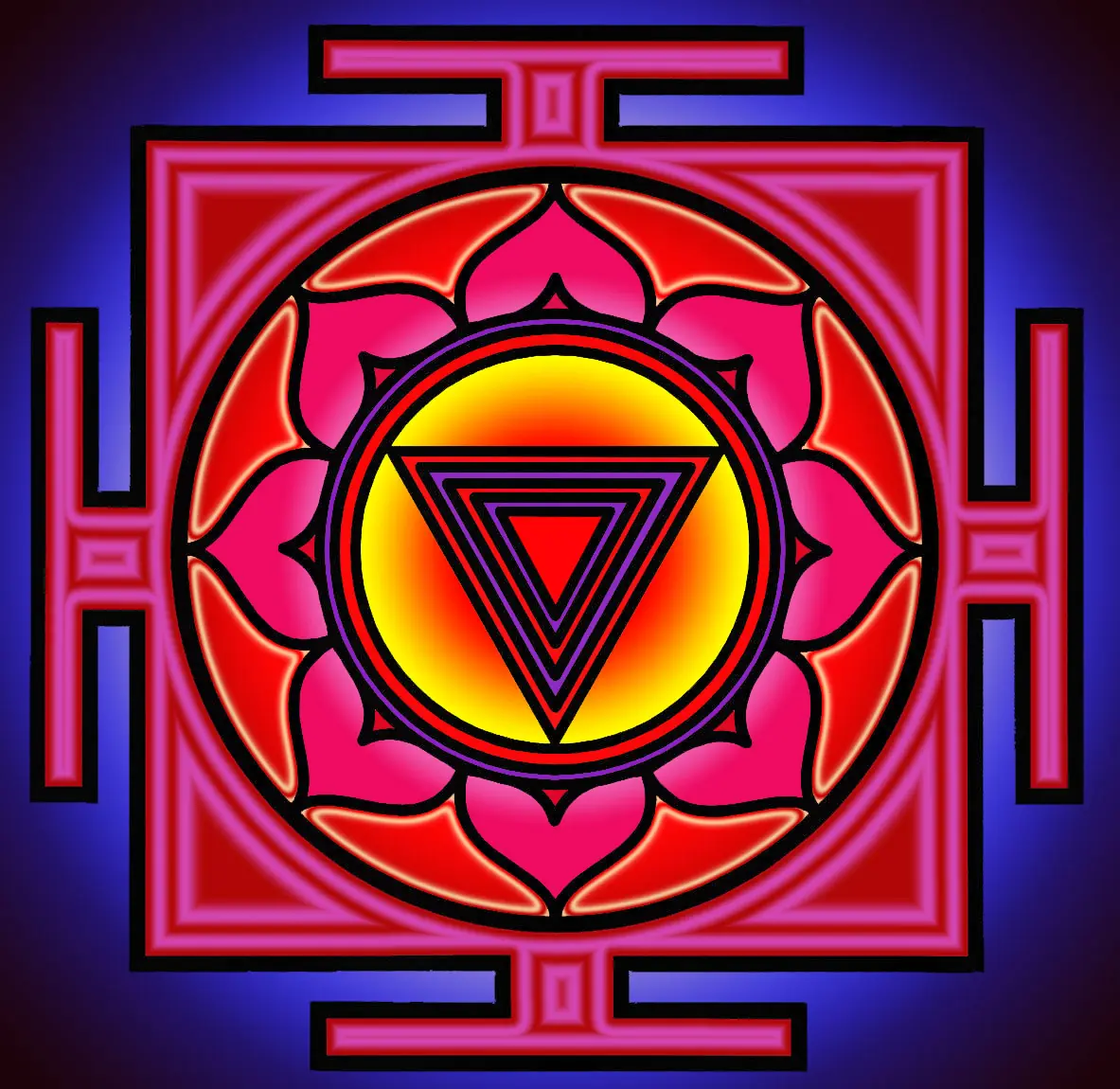
Five downward triangles nested one inside another, inside eight petals and a gated square. The Kali yantra sets five concentric downward triangles round the bindu, giving fifteen corners. Around them sit two circles, a ring of eight petals, and the bhupura square with four gates. Downward triangles are Shakti's sign, and here there is nothing else at the centre.
Bindu; 5 concentric downward triangles; 2 circles; 8 petals; square with four gatesदुर्गा बीसा यंत्र · Mata DurgaDurga Bisa Yantra
A yantra of numbers, named for twenty, the total each line adds up to. Bisa is Hindi for twenty. The Durga Bisa yantra writes numbers in a figure so that each line totals twenty, and the name of Durga is set with them. Printed versions differ in layout, some triangular, some in a grid.
Numbers set in a triangle or grid so that each line sums to 20गणेश यंत्र · Shri GaneshGanesha Yantra
Eight petals round a six-pointed star, with Gam, the seed sound of Ganesha, at the centre. Common Ganesha yantras draw a square with four gates, then a ring of eight lotus petals, then a shatkona or a triangle. The bija Gam is written at the heart. The eight petals are often read as eight forms of Ganesha.
Square with four gates; 8 petals; hexagram or upward triangle; bija "Gam" at centreसूर्य यंत्र · Bhagwan SuryaSurya Yantra
The numbers one to nine in a three-by-three square, every line making fifteen. Surya's yantra in the Navagraha set is a magic square of nine cells. Each row, column and diagonal adds to 15, the total of the numbers one to nine divided by three.
3 × 3 grid of the numbers 1–9; every line totals 15नवग्रह यंत्र · The nine grahasNavagraha Yantra
Nine number squares in one frame, one for each of the nine grahas. The Navagraha yantra gathers nine magic squares in one frame, each with its own total. It is often kept with a Navagraha shrine or installed during a graha shanti puja.
Nine 3 × 3 magic squares, one per graha, each with its own sumकुबेर यंत्र · KuberaKubera Yantra
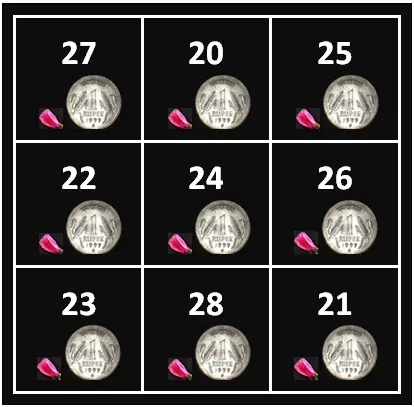
Nine numbers from twenty to twenty-eight, every line totalling seventy-two. The Kubera square uses the numbers 20 to 28 in a three-by-three grid so that each row, column and diagonal adds to 72. In South Indian homes it is drawn on the floor in rice flour as the Kubera kolam.
3 × 3 grid of 20–28; every line totals 72लक्ष्मी चौंतीसा यंत्र · Mata LakshmiLakshmi Chautisa Yantra
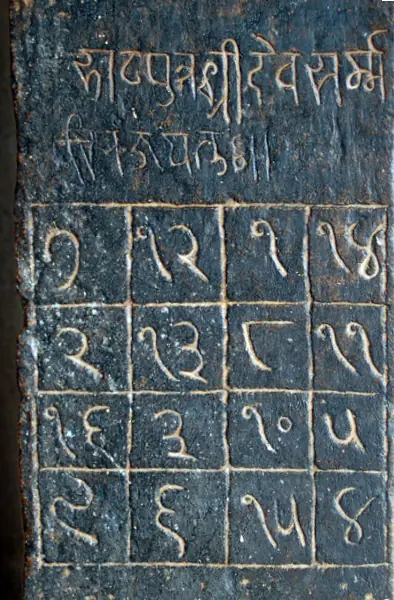
Sixteen numbers in a four-by-four square, each row, column and diagonal making thirty-four. Chautisa means thirty-four. The yantra fills a four-by-four grid with the numbers 1 to 16 so that rows, columns, diagonals and many smaller groups all total 34. A square of the same kind is cut into the Parshvanatha temple at Khajuraho.
4 × 4 grid of 1–16; rows, columns, diagonals and 2 × 2 blocks total 34सरस्वती यंत्र · Mata SaraswatiSaraswati Yantra
A yantra kept by students and musicians, with Aim, Saraswati's seed sound, at the centre. Printed Saraswati yantras differ by lineage. Most set a triangle or hexagram inside rings of lotus petals and a gated square, with the bija Aim written at the centre. Students often keep one where they study.
Triangle or hexagram; lotus petals; square with four gates; bija "Aim" at centre (forms vary)हनुमान यंत्र · Shri HanumanHanuman Yantra
Forms differ widely; many show Hanuman himself within petals and a gated square. There is no single Hanuman yantra. Printed ones often place his figure or Shri Rama's name at the centre, inside a hexagram or lotus petals, framed by a square with four gates. It is commonly installed on a Tuesday or Saturday.
Central figure or name; hexagram or petals; square with four gates (forms vary)बगलामुखी यंत्र · Mata BagalamukhiBaglamukhi Yantra
A downward triangle inside a six-pointed star, drawn in turmeric yellow. Bagalamukhi is one of the ten Mahavidyas, and yellow is her colour. Her yantra is traditionally drawn in turmeric or saffron: a downward triangle with a red bija at its centre, set within a yellow hexagram, often with petals and a gated square around.
Downward triangle with bija at centre; hexagram; often petals and a gated squareमहामृत्युंजय यंत्र · Bhagwan Shiva as MrityunjayaMaha Mrityunjaya Yantra
Shiva's yantra for the Tryambakam mantra, built from a triangle, a hexagon, eight petals and a gated square. One Tantric description lists its parts in order from the centre: bindu, triangle, hexagon, circle, eight lotus petals, three circles, and the earth square. The eight petals are often linked to Shiva's eight forms. The Tryambakam mantra of the Rig Veda is recited with it.
Bindu; triangle; hexagon; circle; 8 petals; 3 circles; square with four gatesसुदर्शन यंत्र · Sudarshana (Chakrathazhwar)Sudarshana Yantra
The discus of Vishnu drawn as a hexagram inside a wheel of flame. In Sri Vaishnava temples Sudarshana is worshipped as Chakrathazhwar, a many-armed figure inside a hexagram and a flaming wheel. Yoga Narasimha is often set on the back of the same image. The yantra on paper follows the same plan.
Hexagram within a circle of spokes or flames; Narasimha on the reverse in temple imagesवास्तु पुरुष मंडलVastu Purusha Mandala
The square grid under every temple, with Brahma at the centre and devatas on every square. Vastu Shastra lays out a temple or house on a square divided into 64 or 81 cells. The Vastu Purusha lies face down across it, and each cell belongs to a devata. In a house the central Brahmasthana is left open; in a temple the sanctum sits over it.
Square divided 8 × 8 (64) or 9 × 9 (81); central Brahmasthana; devatas on each cell

 श्री यंत्र · Lalita TripurasundariShri Yantra
 महा मेरु · Lalita TripurasundariMaha Meru
 काली यंत्र · Mata KaliKali Yantra
 कुबेर यंत्र · KuberaKubera Yantra
 लक्ष्मी चौंतीसा यंत्र · Mata LakshmiLakshmi Chautisa Yantra