
Floor art of India
Every morning, millions of women draw on the ground at the door: rice flour in the South, coloured powder in the West, rice paste in Bengal. It is fed to ants and birds by noon, and drawn again tomorrow.
- Kolam Tamil Nadu · dots joined by one unbroken line
- Rangoli Maharashtra, Gujarat · coloured powders
- Alpana Bengal · white rice paste, drawn with the fingers
- Mandana Rajasthan · white lime on red earth
Kolam
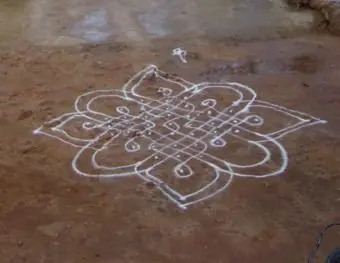
Before sunrise, the women of a Tamil house sweep the doorstep, sprinkle it with water and draw a kolam in rice flour.
Most kolams begin with a grid of dots (pulli), round which a single line loops without lifting the hand. Rice flour feeds ants and birds, so the first act of the day is a gift. In the month of Margazhi kolams grow to fill the street.
Material: Rice flour, or white stone powder; coloured powders on festival days · When: Every morning, Margazhi month, Pongal, Weddings and housewarmings
- Sweep the threshold and sprinkle it with water or diluted cow dung.
- Lay a grid of dots in rice flour.
- Let the flour run from between thumb and forefinger in loops round the dots.
- Close every line; an open kolam is thought incomplete.
Rangoli
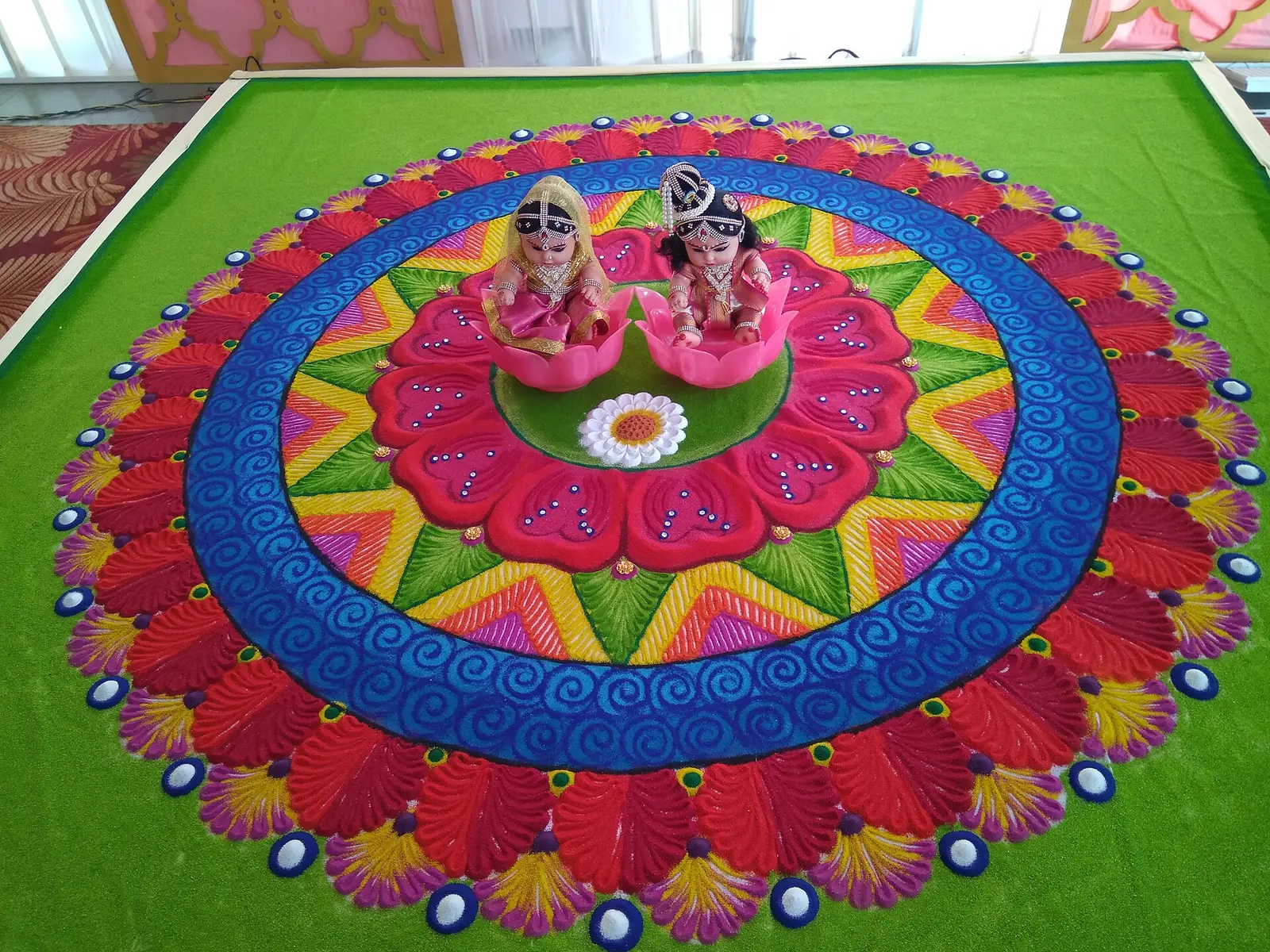
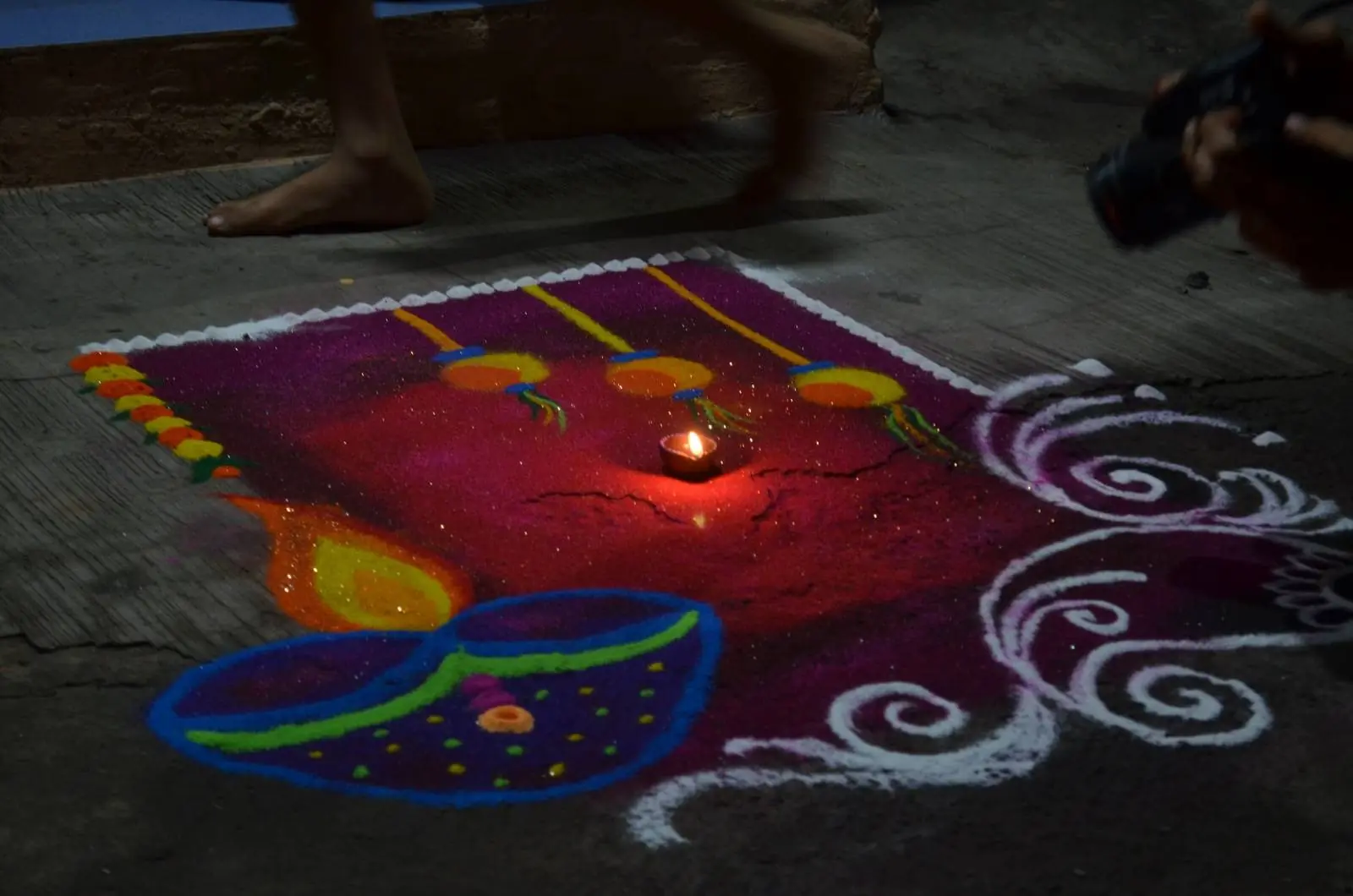
In Maharashtra the rangoli is drawn in white stone powder at the door and filled with colour for Diwali.
The base is a fine white powder of ground stone, let fall from the fingers in dots and lines. Lamps are set on and round it on Diwali nights. Lotus, swastika, Lakshmi's footprints and the kalash are the oldest motifs.
Material: Ground white stone (calcite) and coloured powders · When: Diwali, Gudi Padwa, Weddings and naming days, Daily, at the threshold
- Clean and smooth the floor.
- Lay out dots or a light outline in white powder.
- Join and fill with colours, working from the centre out.
- Set diyas or flowers on the finished design.
Rangavalli
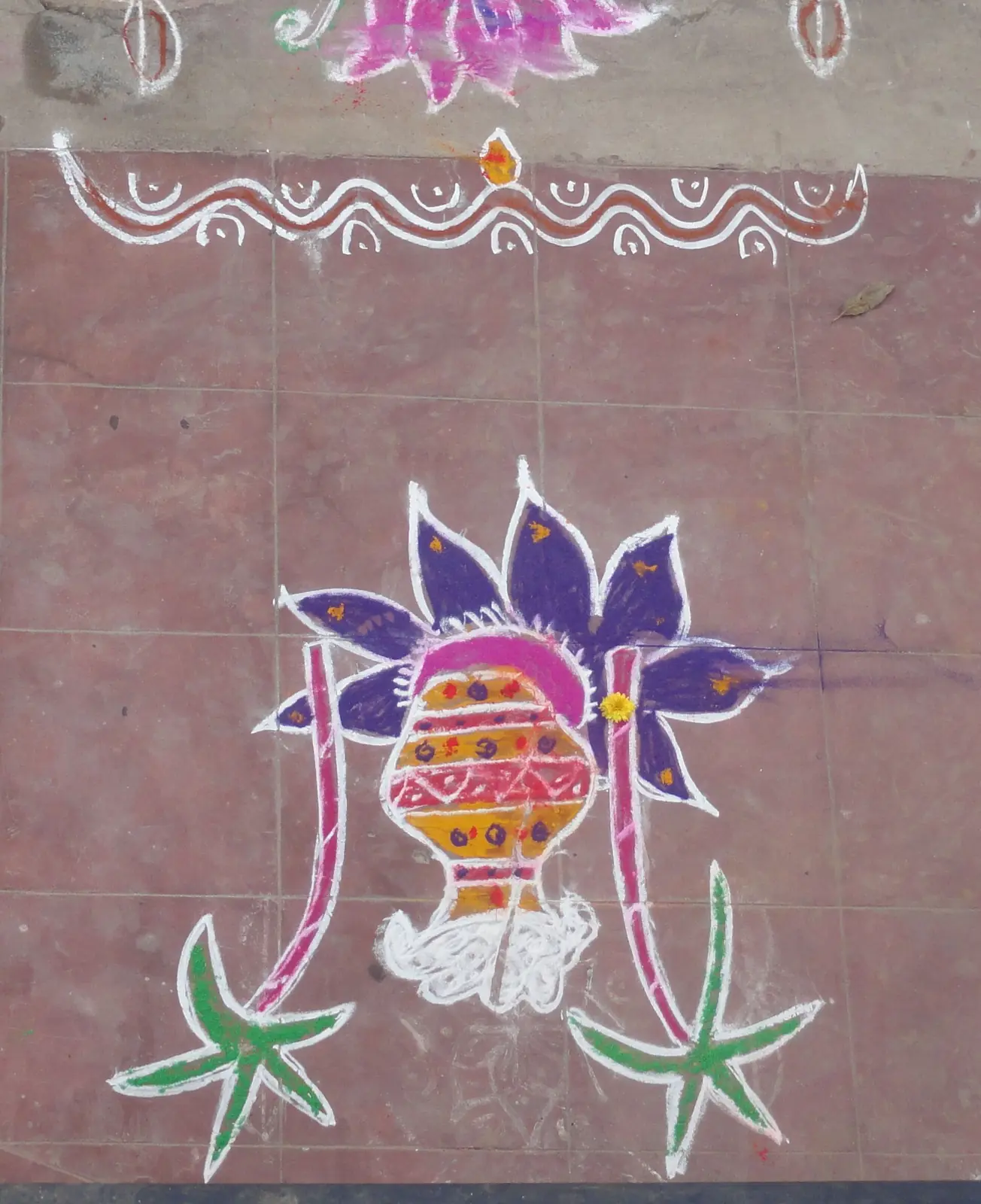
In Karnataka the doorstep design is called rangoli or rangole, from the old Sanskrit word rangavalli.
Kannada homes draw it daily with dots and lines, much like the kolam and muggu of their neighbours. For Sankranti and Deepavali the designs grow large and coloured, with chariots, lamps and lotuses.
Material: White stone powder and colours · When: Daily, Makara Sankranti, Deepavali, Gowri-Ganesha festival
- Wash the doorstep.
- Set a grid of dots in white powder.
- Draw lines and curves round the dots.
- Fill with colour on festival days.
Muggulu
Muggu is the Telugu doorstep design, drawn most grandly in the month before Sankranti.
The yard is first washed with cow-dung water so the white lines shine against the dark. At Sankranti, girls set gobbemmalu, small cones of cow dung topped with flowers, on the muggu and sing round them.
Material: Rice flour or white stone powder, on a floor washed with cow dung · When: Dhanurmasa, the month before Sankranti, Sankranti, Daily
- Sprinkle the yard with cow-dung water.
- Lay the dot grid.
- Draw the loops and fill with colour.
- At Sankranti, place gobbemmalu on the design.
Alpana
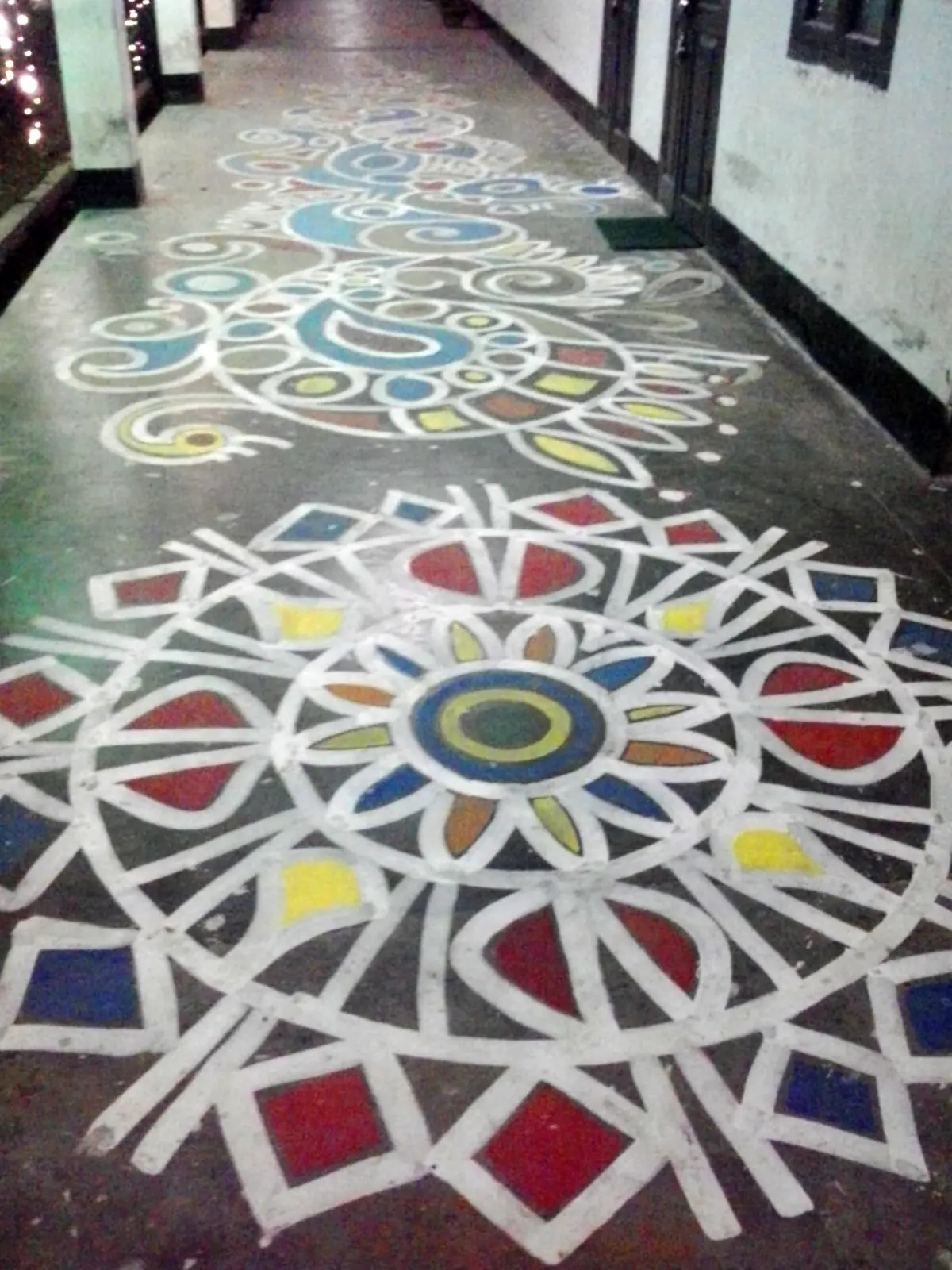
Alpana is painted with a finger or a twist of cloth dipped in white rice paste.
For Lakshmi puja, small footprints of the Devi are painted from the door to the shrine, with paddy sheaves and the lotus. It is drawn for Durga Puja, Kali Puja and Saraswati Puja, at weddings round the bride's seat, and under the pidi on which she sits.
Material: Rice soaked and ground into a white paste (pithuli) · When: Kojagari Lakshmi Puja, Durga Puja, Saraswati Puja, Weddings
- Soak rice and grind it to a thin paste.
- Dip a finger or a cloth pad in it.
- Paint lotus, conch, paddy and Lakshmi's feet.
- Let it dry white on the floor.
Mandana
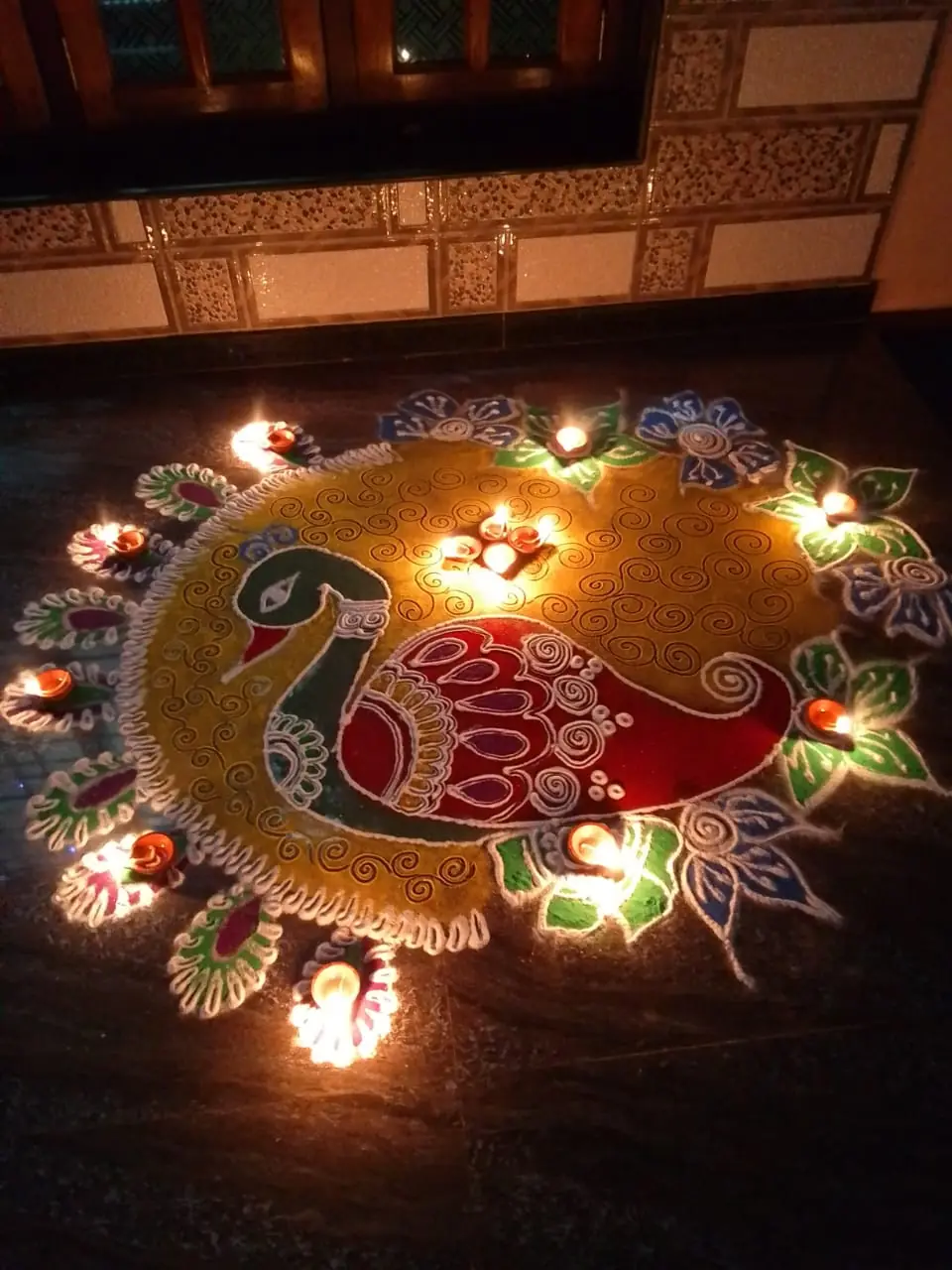
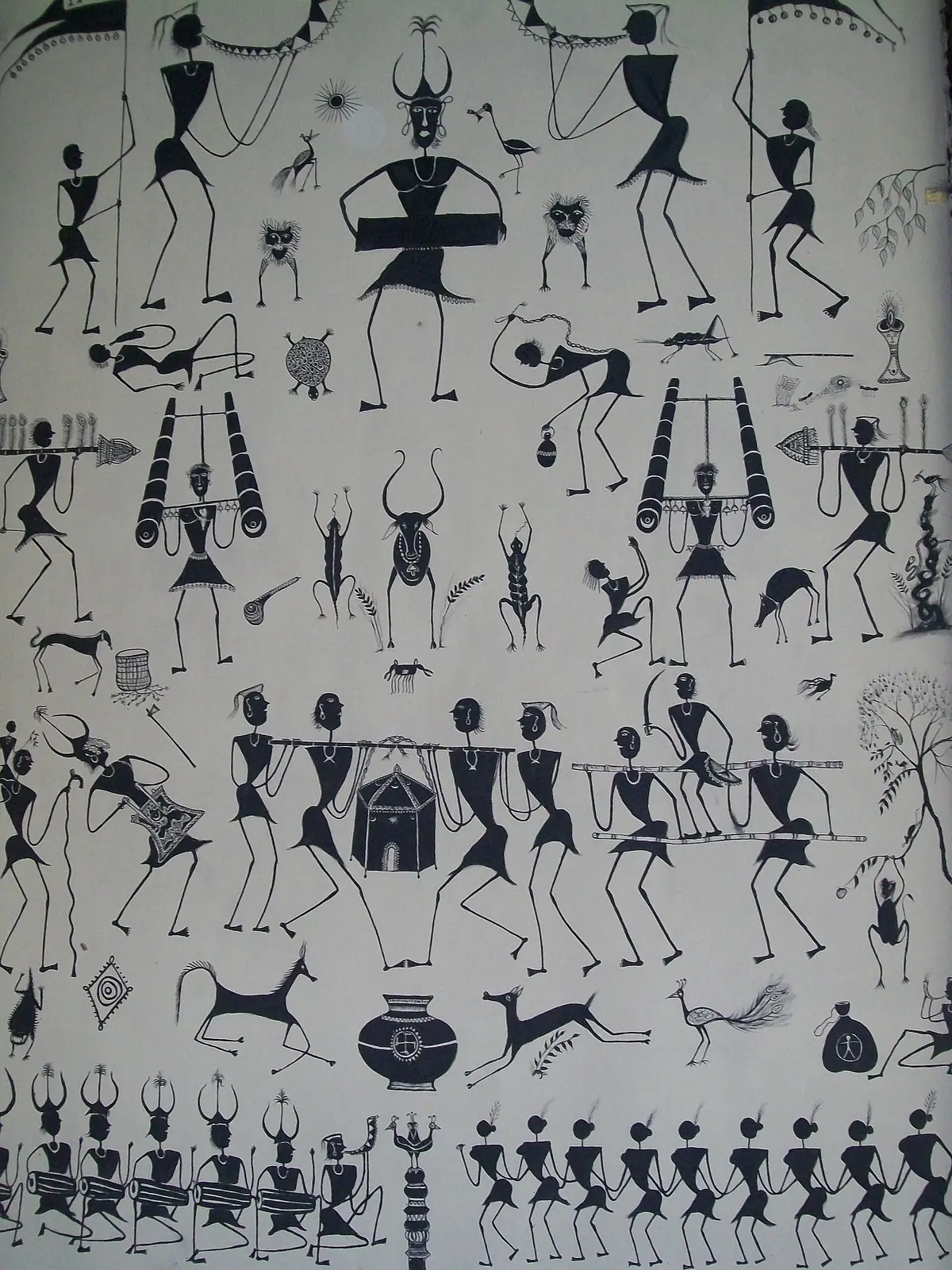
Mandana is white chalk drawing on red earth, done by Rajasthani women on floors and walls.
The floor or wall is plastered with cow dung and clay, washed red with geru, and drawn in white khadiya with a tuft of hair or cloth. Each festival and room has its pattern, with peacocks, lamps, footprints and squares.
Material: White khadiya chalk and red geru on a floor plastered with cow dung and clay · When: Diwali, Holi, Weddings, Births
- Plaster the ground with cow dung and clay.
- Wash it with red geru.
- Draw in white chalk paste with a brush of hair, cloth or a twig.
- Repeat for each festival as the old one wears.
Aripan
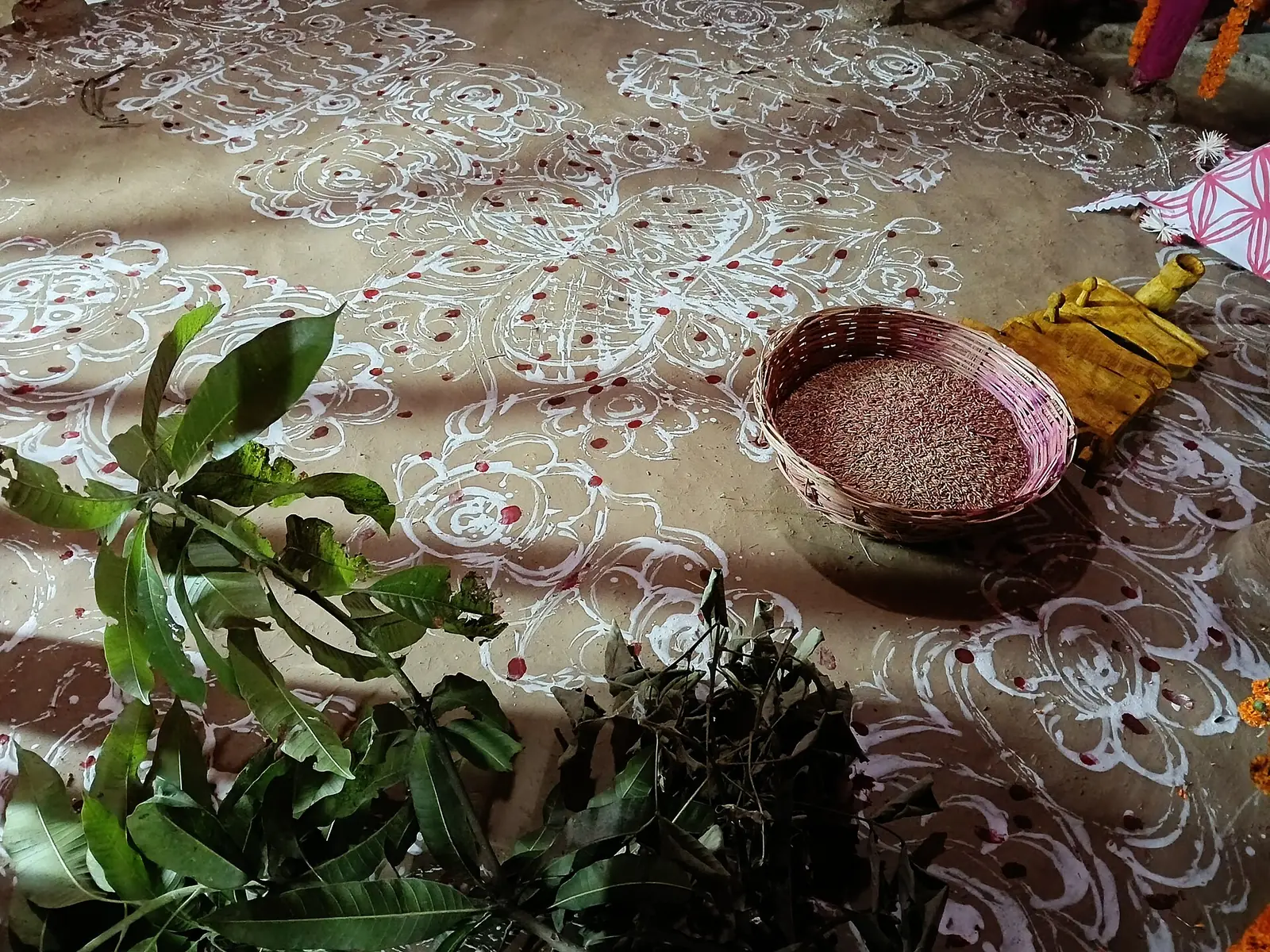
Aripan is the rice-paste floor drawing of Mithila, made for every samskara and vrata.
Women paint it with the fingers, then dot it with sindoor and haldi. Different aripan belong to different rites: the upanayana, the wedding, Kojagara and many vratas. The same hands paint the Madhubani walls.
Material: Rice paste (pithar), with vermilion and turmeric · When: Upanayana, Weddings, Kojagara, Vratas and pujas
- Grind soaked rice into pithar.
- Draw the design with the fingers on the clean floor.
- Add dots of sindoor and turmeric.
- Set the kalash or the seat on it.
Aipan
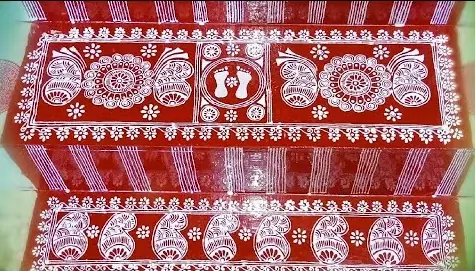
Aipan is drawn in white rice paste with three fingers on a ground of red earth.
It began in Almora and spread through Kumaon. Each design starts and ends with a dot. Doorsteps, puja places and wooden seats (chowki) are painted for festivals and samskaras. Uttarakhand Aipan was registered as a GI in 2021.
Material: Red geru base and white biswar, a paste of ground rice · When: Diwali, Weddings, Janeu, Naming ceremonies
- Wash the surface with geru.
- Grind soaked rice to make biswar.
- Draw with three fingers, beginning and ending with a bindu.
- Paint Lakshmi's footprints from the door inwards.
Chowk purana
"Filling the chowk" means drawing the sacred square where the kalash, the deity or the couple will sit.
Before a puja, a Satyanarayan katha or a wedding, a square is drawn in flour and filled with patterns and colours. In Chhattisgarh the same design is called chaook and is drawn for good fortune.
Material: Wheat flour, rice flour, turmeric and kumkum · When: Satyanarayan katha, Weddings, Griha pravesh, Diwali
- Clean the place of puja.
- Draw a square in flour.
- Fill it with lines, swastika and lotus.
- Set the chowki or kalash on it.
Saathiya
Saathiya, or gahuli, is the Gujarati rangoli drawn at the door for Diwali and the new year.
The name is also used for the swastika, which is drawn at the centre of many designs and on account books at Chopda Pujan. On Bestu Varas, the Gujarati new year, every doorway has one.
Material: Coloured powders, sometimes flowers · When: Diwali, Bestu Varas, Weddings
- Wash the threshold.
- Draw the swastika or outline.
- Fill with colour.
- Set diyas around it.
Jhoti and chita
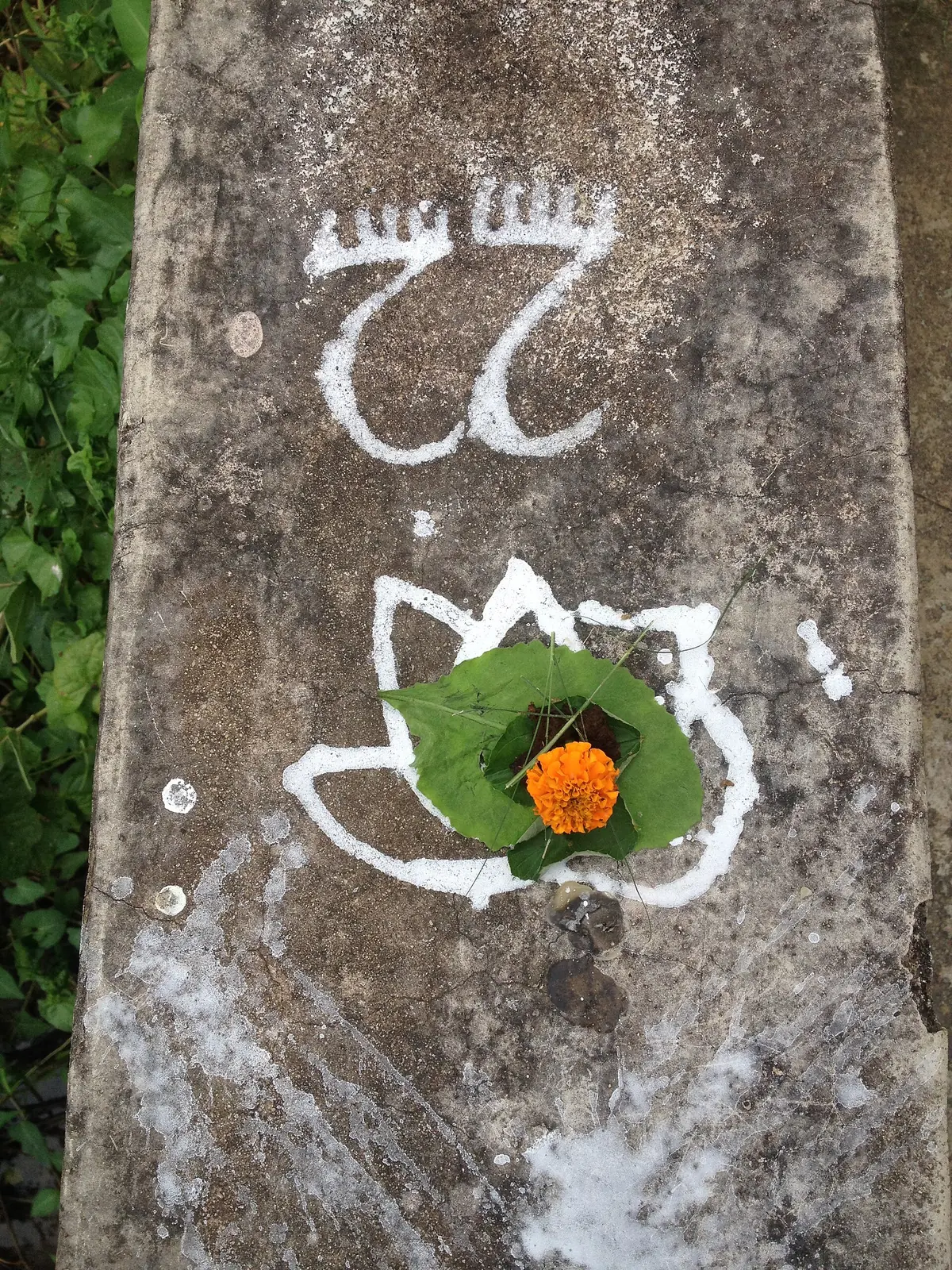
Jhoti is the Odia rice-paste drawing, made above all for Mata Lakshmi on the Thursdays of Margashirsha.
On Manabasa Gurubar, women draw Lakshmi's footprints and the paddy measure (mana) from the door to the shrine, inviting her in. Chita is the small mark on walls and grain stores. Unlike rangoli, jhoti is wet paste, not dry powder.
Material: Rice paste on a floor or wall washed with red earth or cow dung · When: Manabasa Gurubar, Lakshmi puja, Weddings, Village festivals
- Wash the floor or wall with red earth or cow dung.
- Dip a finger or a cloth in rice paste.
- Draw lotus, conch, footprints and creepers.
- Leave it to dry white.
Murja
Murja is the dry-powder design drawn before the tulsi plant through the month of Kartik.
Women draw it every day of Kartik in the courtyard before the tulsi, ending on Kartik Purnima. Most designs honour Shri Krishna and Shri Jagannath.
Material: Dry coloured powders · When: The month of Kartik, Kartik Purnima
- Clean the courtyard before the tulsi.
- Draw the outline in white.
- Fill with coloured powders.
- Light a lamp before the tulsi.
Pookalam
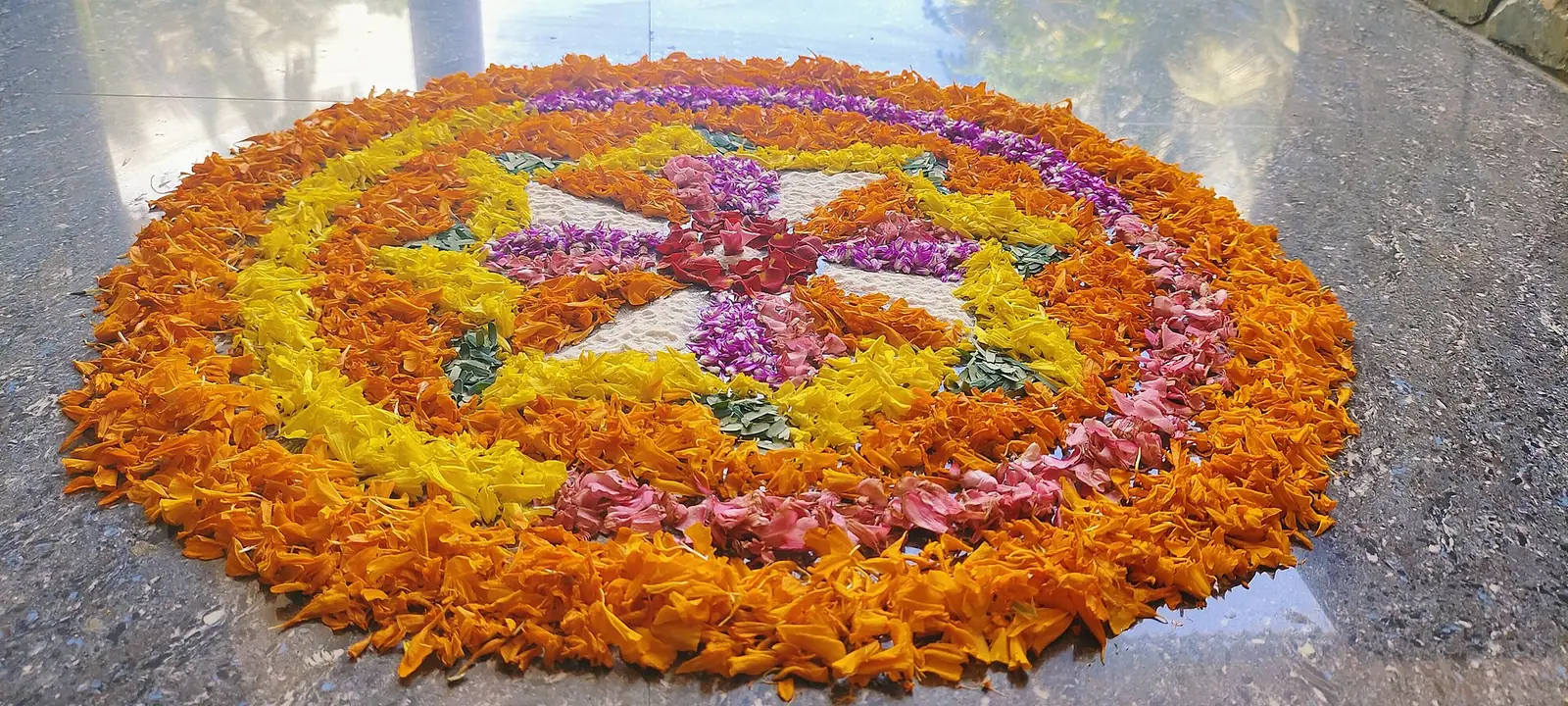
The pookalam is a carpet of flowers laid at the door for each of the ten days of Onam.
It begins small on Atham and grows larger every day until Thiruvonam. The little white thumba flower is the most loved, with marigold, chethi and leaves. Families say the pookalam welcomes King Mahabali on his yearly visit.
Material: Fresh flowers and leaves · When: Onam, Atham to Thiruvonam
- Clear the courtyard.
- Mark circles with a string or chalk.
- Fill rings with petals, colour by colour.
- Add a ring each day until Thiruvonam.
Sanjhi
In the temples of Braj, sanjhi is laid at dusk through stencils cut by hand with small scissors.
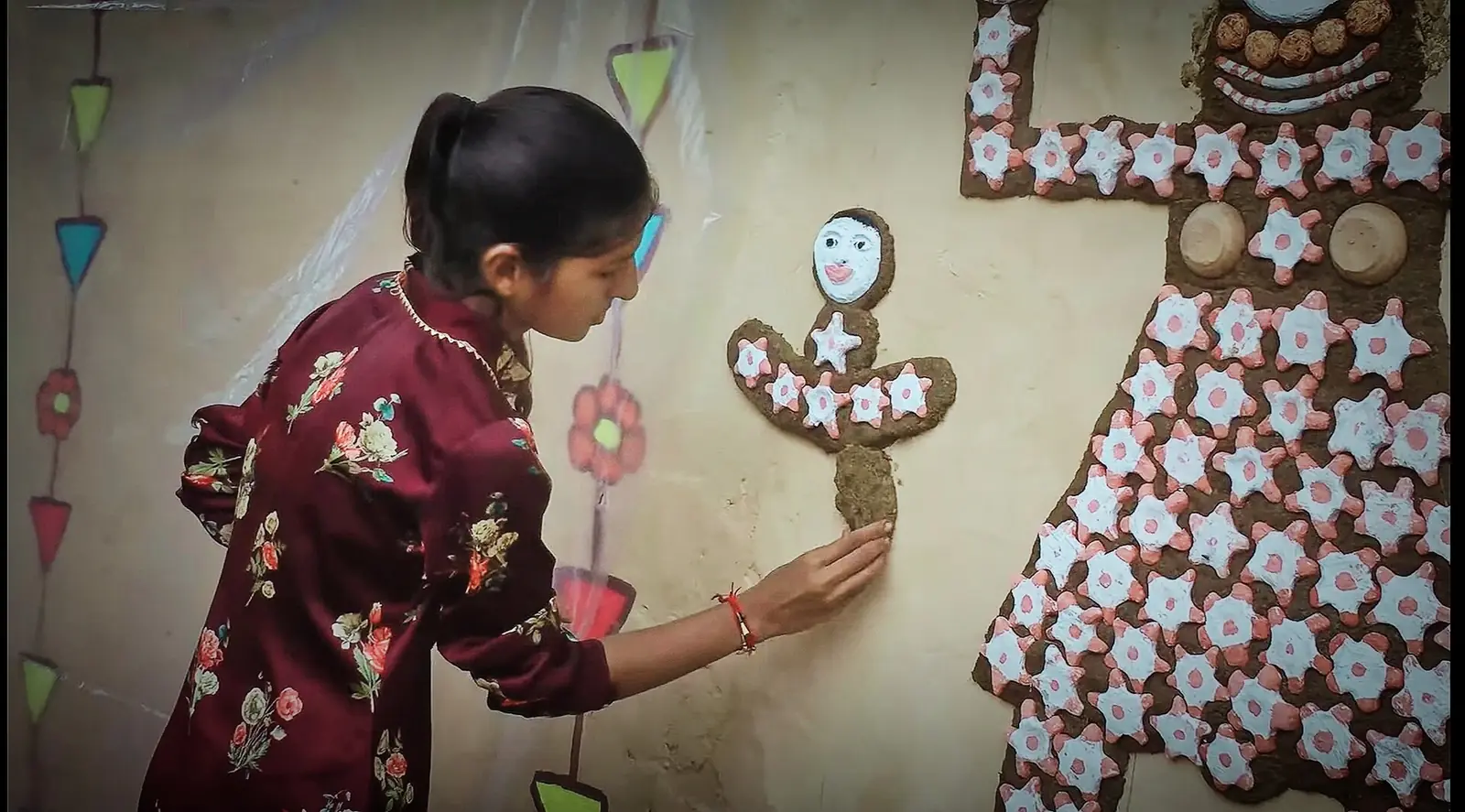
Sanjhi means dusk. By one katha Radha made the first designs to call Krishna. In the Ashvin fortnight of Pitru Paksha, temples lay colour through overlapping paper stencils on a raised vedi, or float it on water (jal sanjhi). Haryana and Punjab keep a separate folk Sanjhi of clay images for Navaratri.
Material: Hand-cut paper stencils and dry colours; in villages, clay and cow dung · When: Pitru Paksha in Braj temples, Navaratri in Haryana and Punjab
- Draw the design on paper.
- Cut the stencil with fine scissors.
- Lay it on the vedi and fill it with dry colour.
- Lift the paper to reveal the picture.
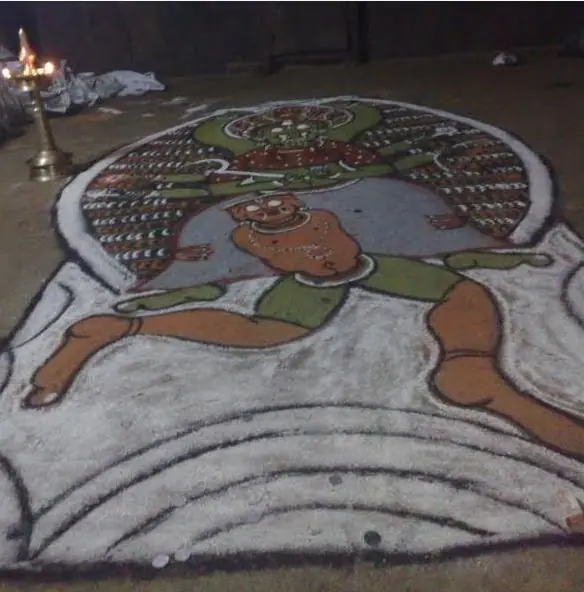
Kalamezhuthu
Kalamezhuthu is a large image of Bhagavathy, Ayyappa or the Nagas drawn on the temple floor in five natural powders.
Rice gives white, burnt paddy husk black, turmeric yellow, turmeric with lime red, and powdered leaves green. Hereditary artists such as the Kurups draw it with their fingers while songs are sung, and the kalam is wiped away when the ritual ends.
Material: Five natural powders: rice, burnt husk, turmeric, turmeric with lime, and dried leaves · When: Bhagavathy temple festivals, Ayyappan vilakku, Sarpam thullal for the Nagas
- Mark the outline on the temple floor.
- Sprinkle the five powders by hand, filling the deity's form.
- Sing the kalampattu before the finished image.
- Erase the kalam at the close of the rite.