हिंदी

Ragas and instruments

संगीत

A raga is a mood with a time of day, a season and a rasa. Here are the great ragas on a 24-hour clock, and the instruments that sing them.

  • 0ragas
  • 0instruments

Dawn6 ragas

Bhairava Raga, Chunar Ragamala, 1591भैरव · hindustaniBhairav

Dawn · Shanta, bhakti

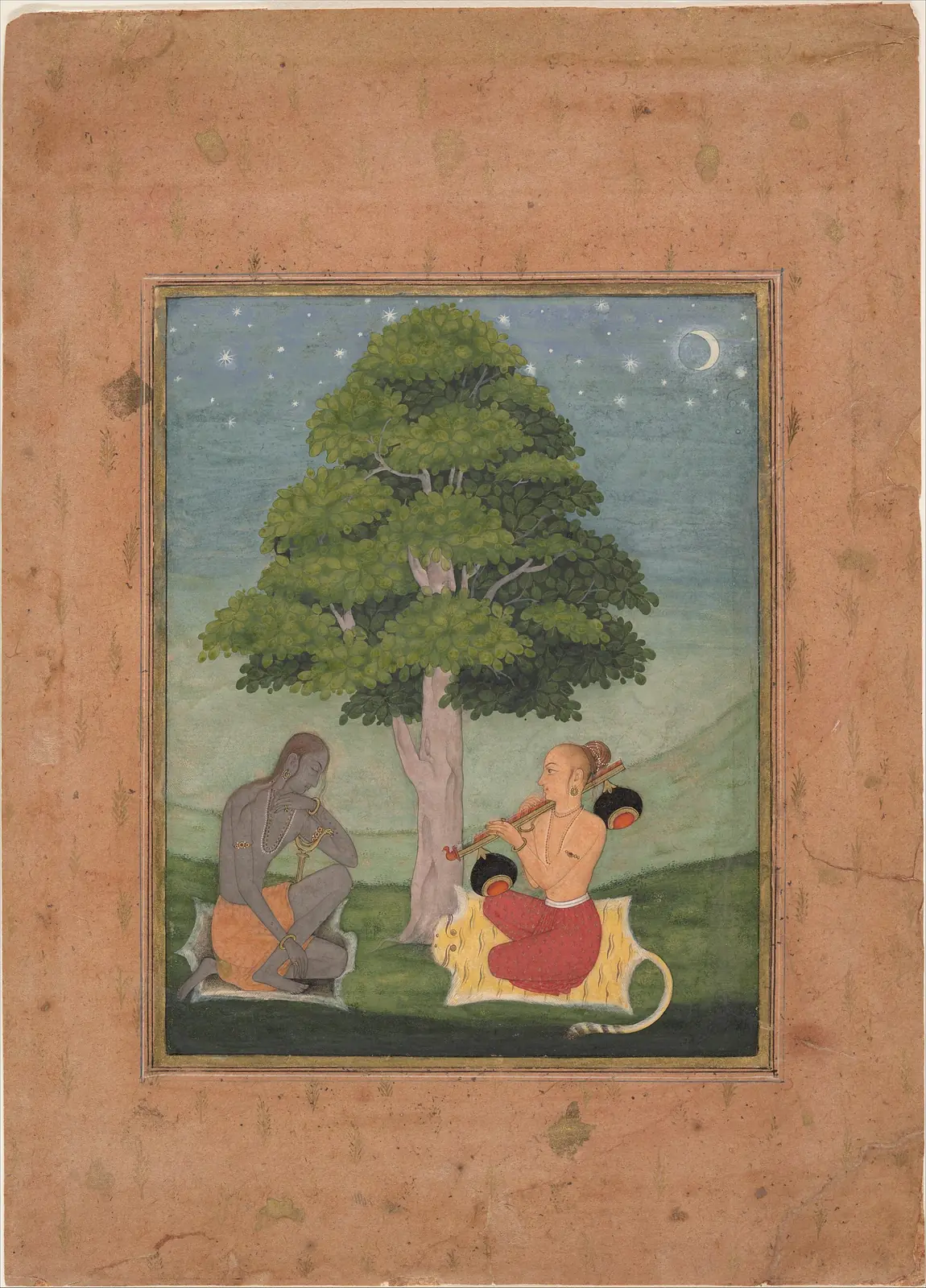
Named for Bhagwan Shiva as Bhairava, the raga that traditionally opens the day. Komal re and komal dha are sung with a slow swing, andolan, which gives Bhairav its grave, prayerful sound. It heads its own thaat. In the old Ragamala scheme it is one of the six principal ragas, painted as an ascetic Shiva.

अहीर भैरव · hindustaniAhir Bhairav

Early morning · Bhakti, tenderness

Bhairav in the lower half, Kafi in the upper: a soft, warm morning raga. The komal re of Bhairav meets the komal ni of Kafi. Its scale matches the Carnatic Chakravakam. Many morning bhajans and film songs are set in it.

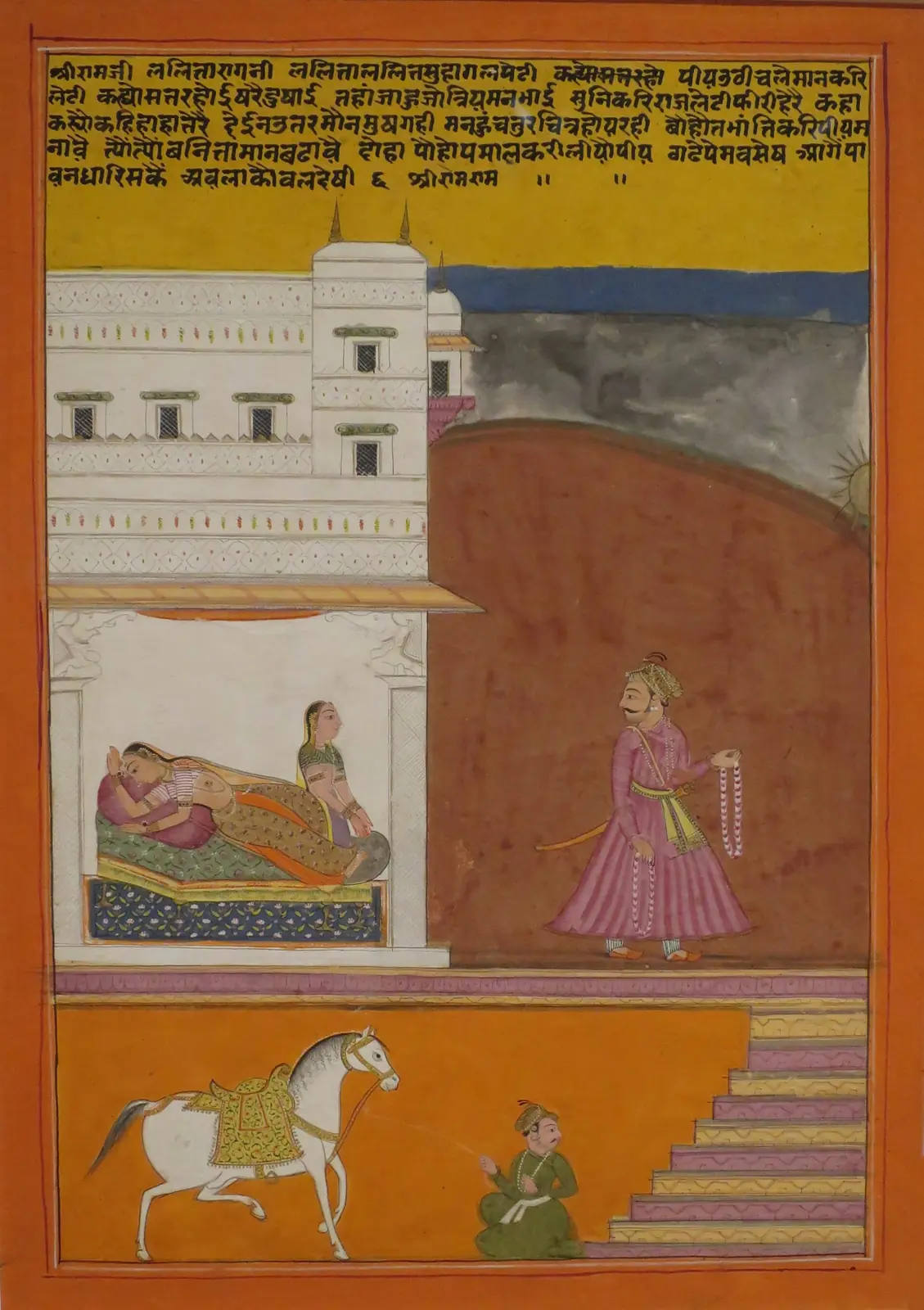
Lalit Ragini, by Chetan Dasललित · hindustaniLalit

Before dawn · Longing, bhakti

A raga of the last hour of night, with both madhyams sung one after the other. Lalit has no pancham. Shuddha and tivra ma are sung side by side, giving it an uneasy, searching quality, the mind waking before the body. In Ragamala paintings Lalit is a lover leaving at dawn.

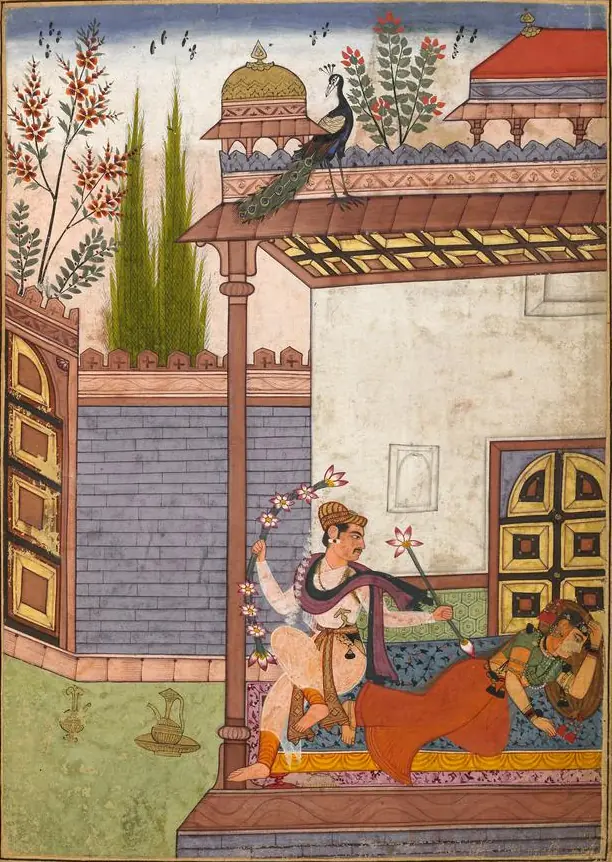
Vibhasa Ragini, Manley Ragamala, c. 1610विभास · hindustaniVibhas

Dawn · Shanta

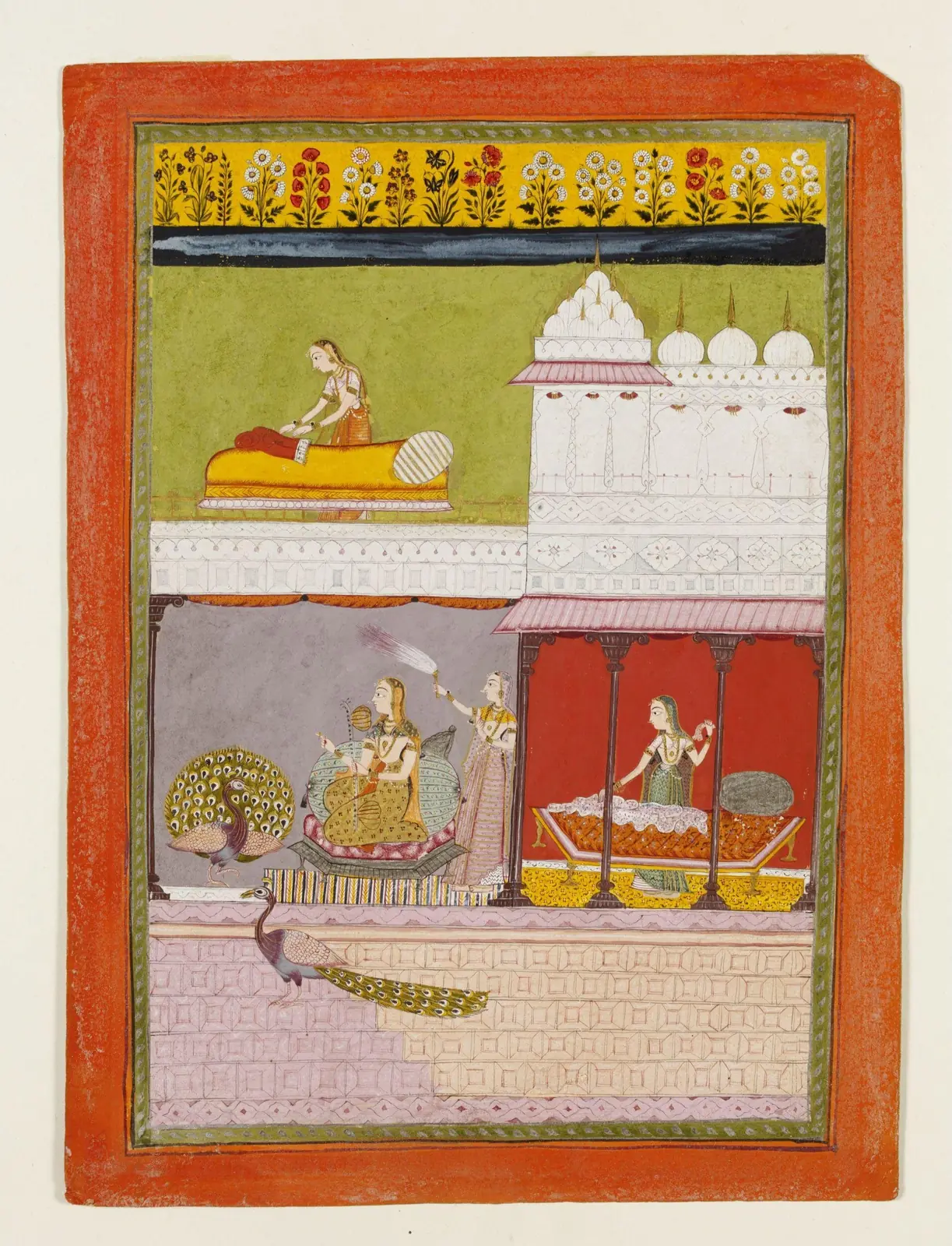
A five-note dawn raga of the Bhairav family, named for the first light. Vibhas means brightness. Sung with re and dha komal and without ma and ni, it is short and clear like daybreak. Ragamala pages show a couple waking in a palace at dawn.

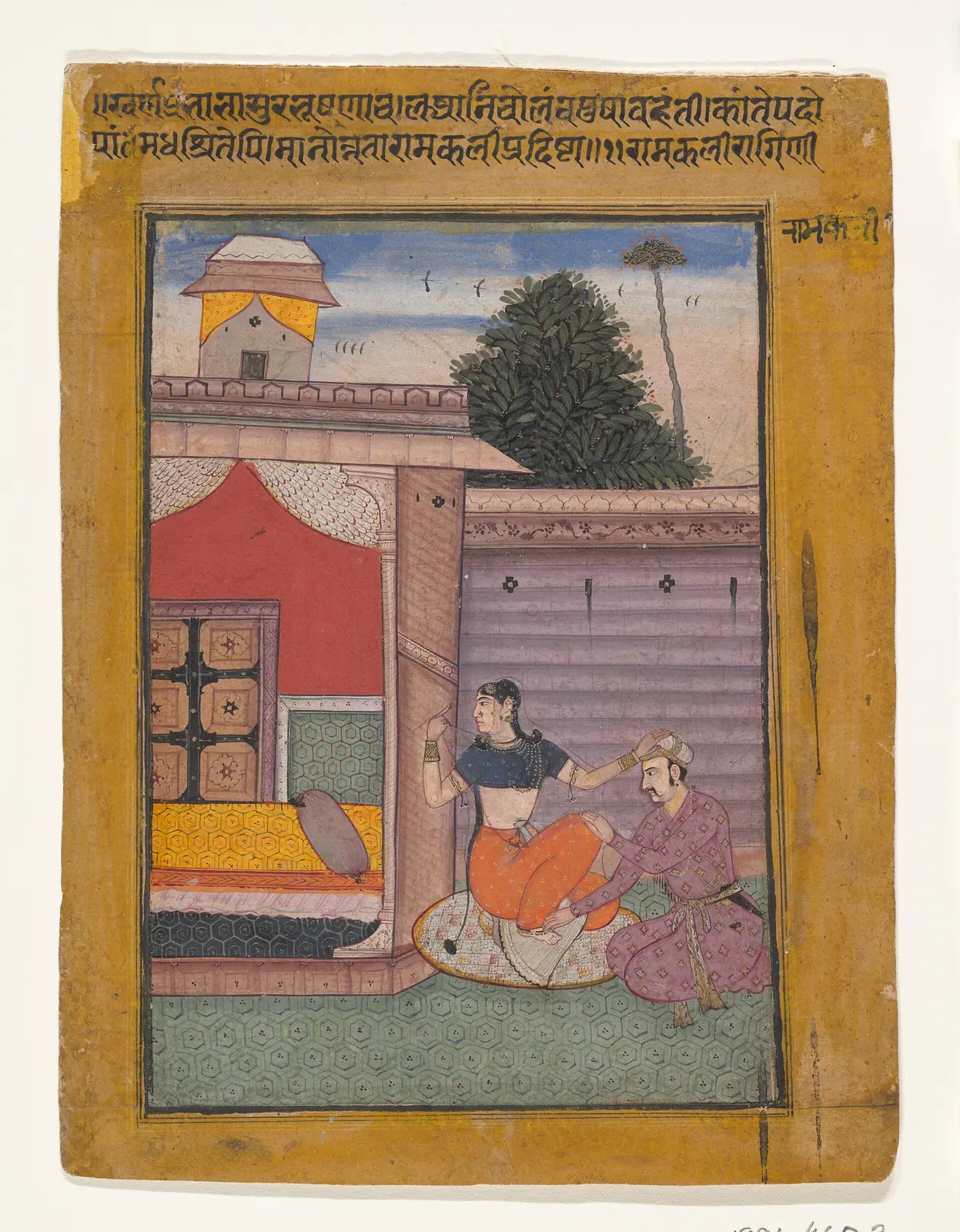
Ramkali Ragini, Berlin Ragamalaरामकली · hindustaniRamkali

Dawn · Bhakti

A Bhairav-family raga of early morning, often heard in temple and gurdwara singing. Close to Bhairav, Ramkali brings in tivra ma and komal ni in its descending phrases. It is traditionally sung just after sunrise.

भूपालम् · carnaticBhupalam

Before dawn · Shanta

A pre-dawn raga born from Todi, with five notes and no ma or ni. Bhupalam is gentle and quiet. Its notes are sa, komal ri, ga, pa and komal dha.

Morning12 ragas

Todi Ragini, Bundi, 1591तोड़ी · hindustaniTodi

Late morning · Karuna

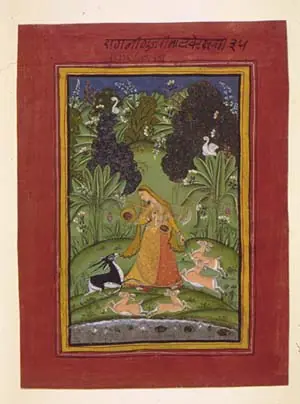
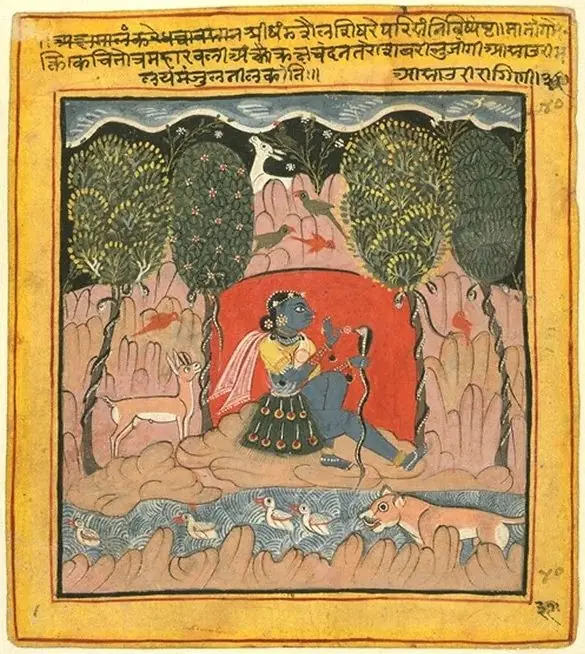
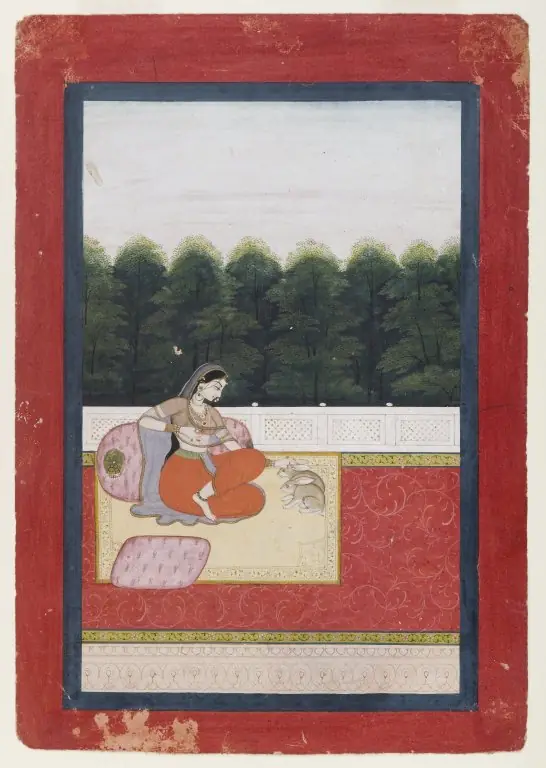
A deep, pleading raga of late morning, the head of its own thaat. Komal re, ga and dha with tivra ma. Miyan ki Todi is the common form. In Ragamala paintings Todi is a woman alone in a forest playing the veena while deer gather to listen.

Gujari Ragini, a Ragamala pageगुजरी तोड़ी · hindustaniGujari Todi

Morning · Karuna

Todi without the pancham, plaintive and searching. Leaving out pa makes Gujari Todi sound more unsettled than Miyan ki Todi. The Ragamala Gujari Ragini is a woman with a veena waiting for her beloved.

Bhairavi Ragini, Bundiभैरवी · hindustaniBhairavi

Morning; also a closing raga · Bhakti, karuna

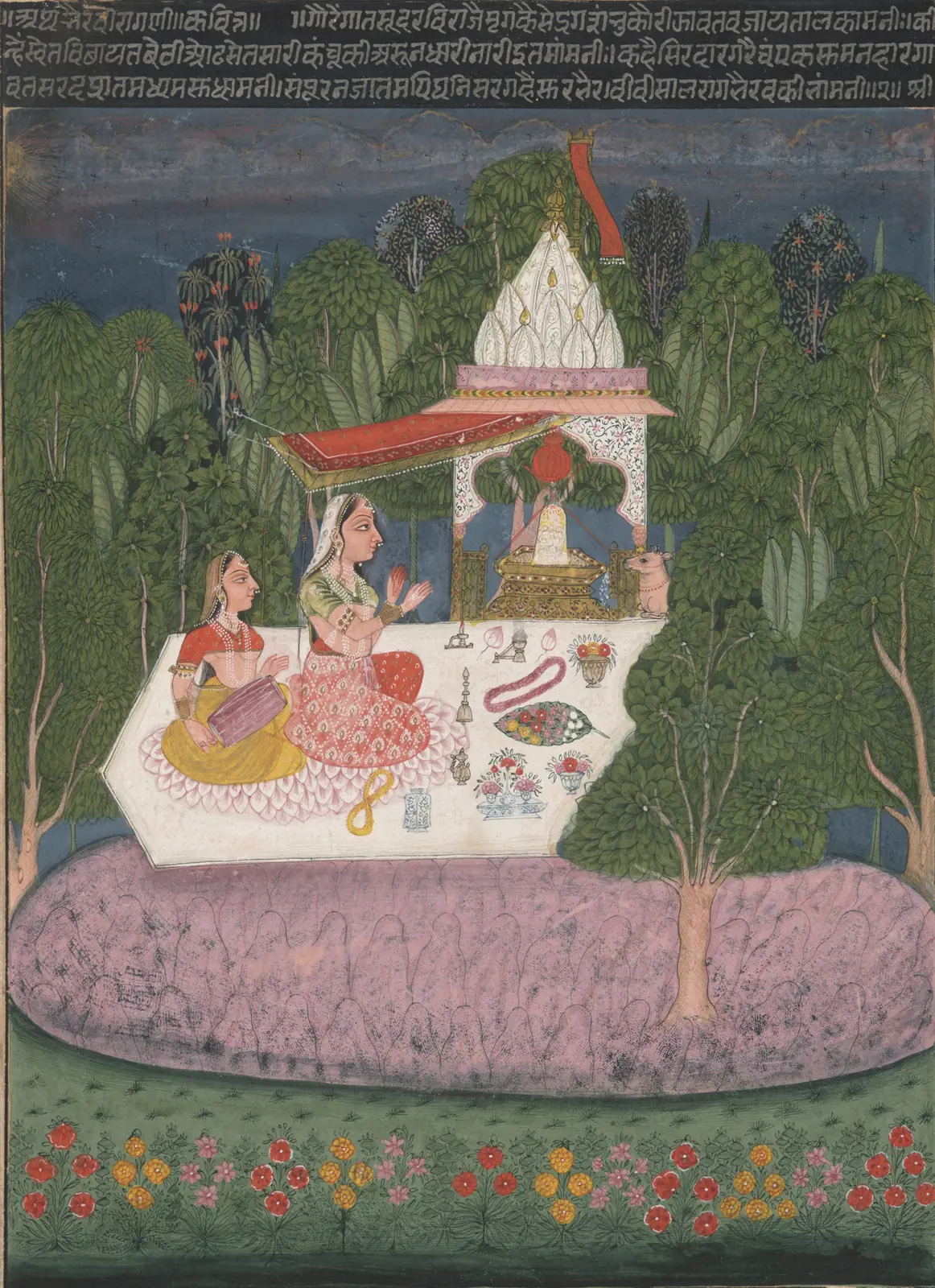
The raga of the Devi as Bhairavi, and by custom the last piece of a Hindustani concert. All four variable notes are komal. Strictly a morning raga, Bhairavi is sung at the end of a concert at any hour, often as a bhajan or thumri. Ragamala pages show a woman worshipping Shiva at a shrine.

Bilaval Ragini, Jaipur Ragamalaबिलावल · hindustaniBilawal

Late morning · Joy, shanta

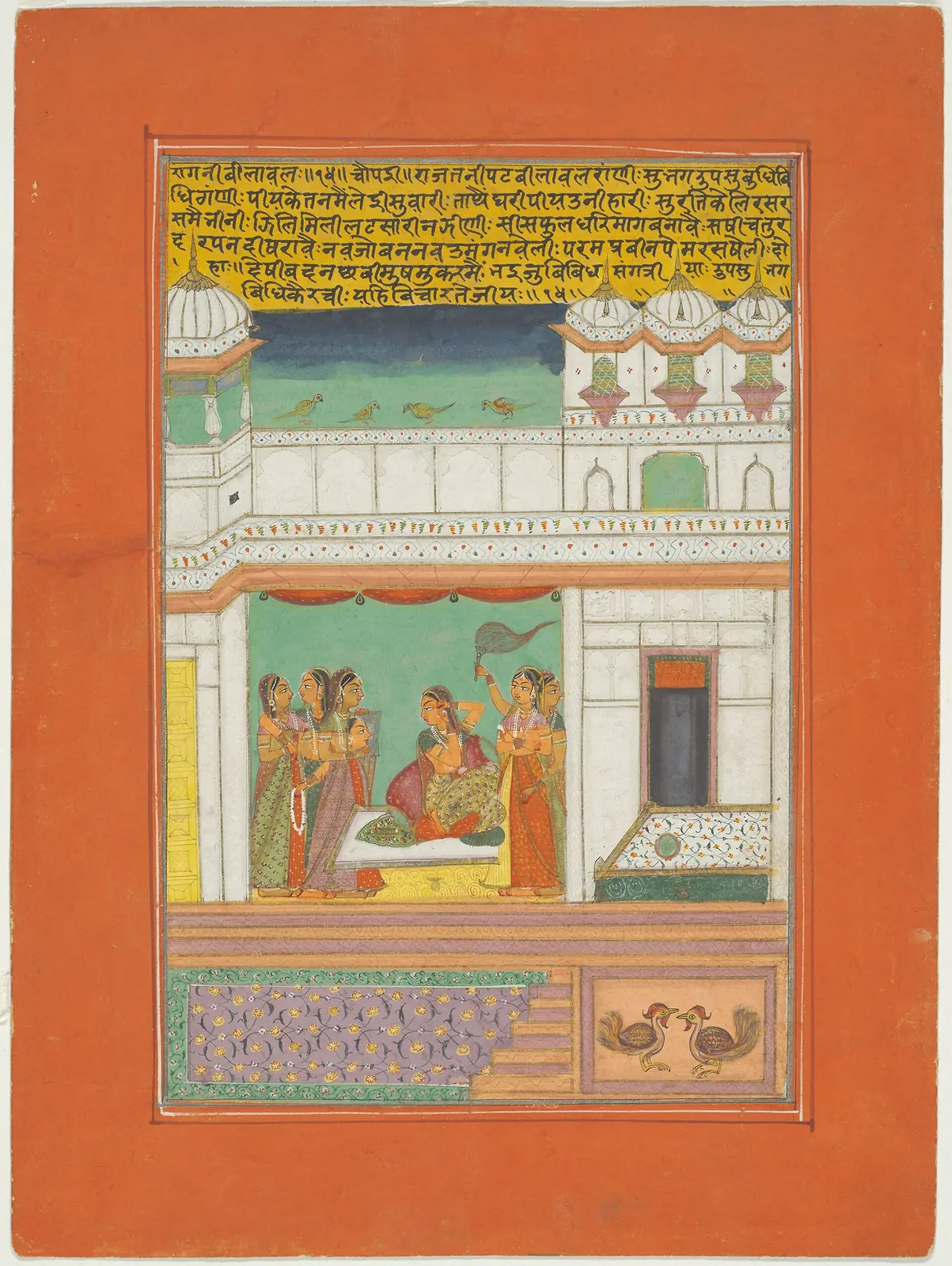
All seven notes shuddha: Bilawal is the reference scale of Hindustani music. Bhatkhande made Bilawal thaat the base from which the others are counted. Its scale matches the Carnatic Shankarabharanam. Alhaiya Bilawal is the form most often sung.

Asavari Ragini, Ragamala, 1610आसावरी · hindustaniAsavari

Late morning · Karuna

A late-morning raga with komal ga, dha and ni, painted in the Ragamala as a snake-charmer in the hills. Asavari gives its name to a thaat. In the Ragamala paintings Asavari is a tribal woman seated on a hill, charming snakes with her music.

जौनपुरी · hindustaniJaunpuri

Late morning · Karuna, shringara

A close cousin of Asavari, sung through the late morning. Jaunpuri leaves out ga in the ascent; ga, dha and ni are komal. It is among the first serious ragas students learn after the basic thaats.

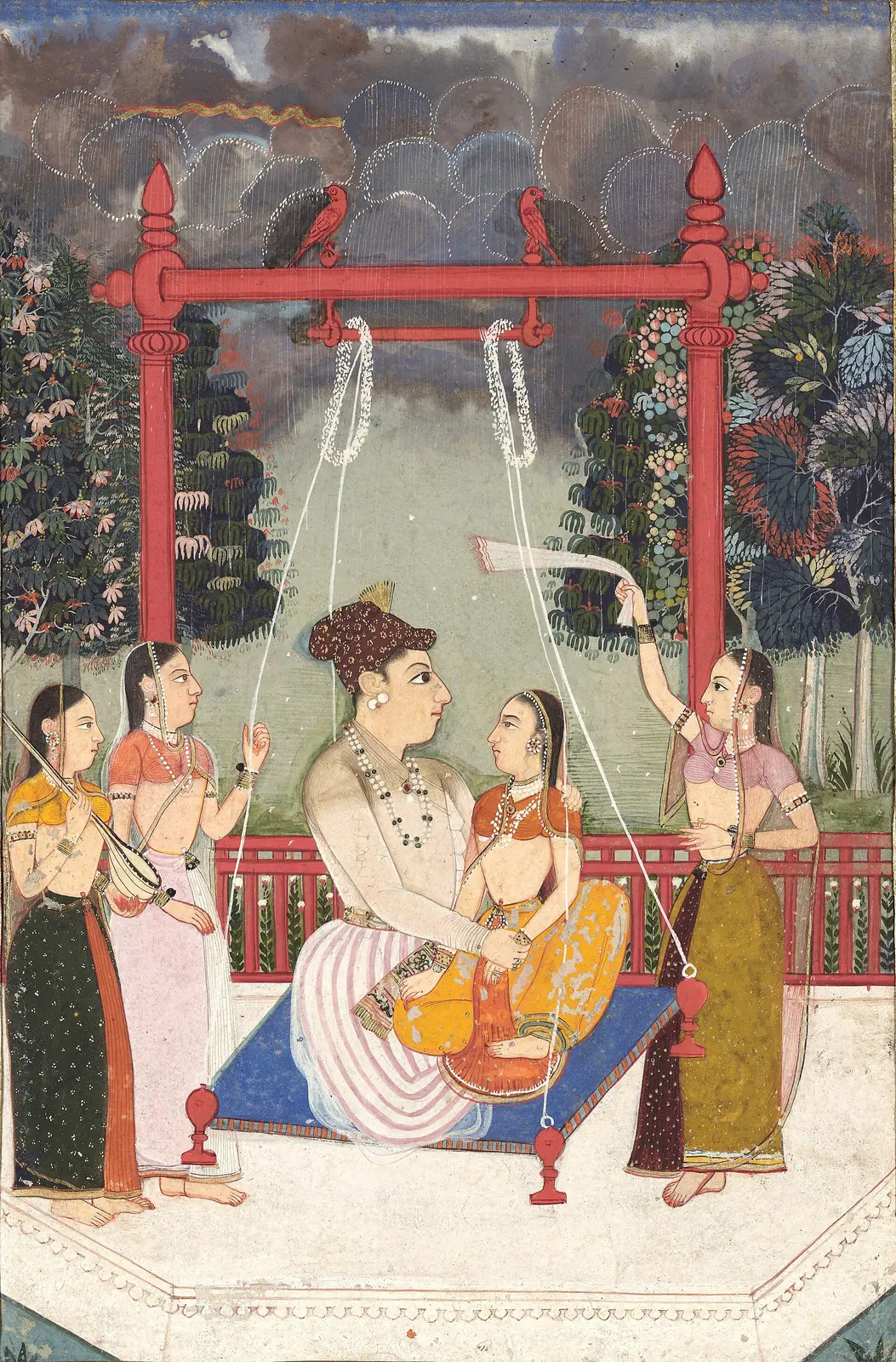
Hindola Raga, National Museum, New Delhiहिंडोल · hindustaniHindol

Morning · Vasant, spring · Shringara, joy

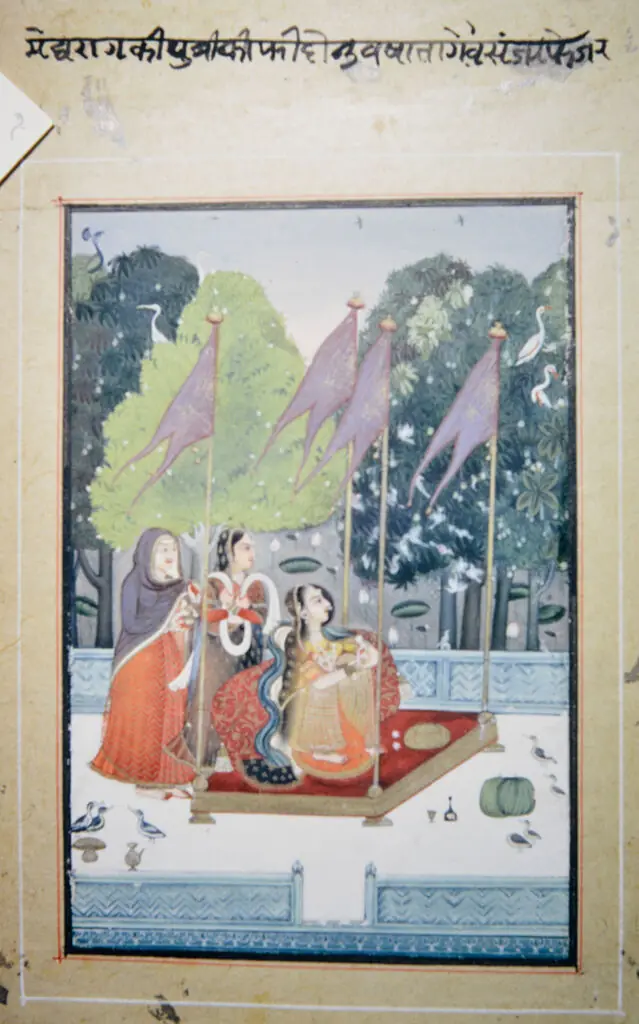
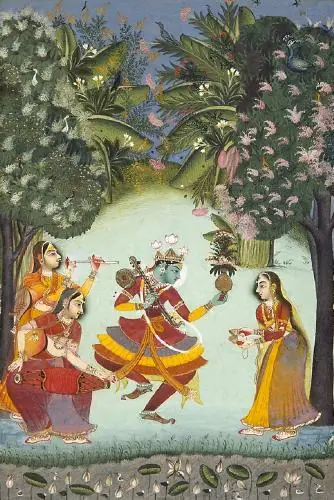
The swing raga, one of the six principal ragas, painted as Krishna on a swing. Hindol leaves out re and pa and uses tivra ma. The Ragamala paintings show Krishna and Radha on a garden swing pushed by the gopis.

मायामालवगौळ · carnaticMayamalavagowla

Morning · Bhakti, shanta

The 15th melakarta, in which every Carnatic student sings the first lessons. Purandara Dasa, called the father of Carnatic music, set the basic exercises, sarali varisai and others, in this raga. Its scale matches Hindustani Bhairav.

हनुमतोडी · carnaticTodi (Hanumatodi)

Morning · Karuna, bhakti

The 8th melakarta, one of the great ragas of Carnatic music, heavy with gamakas. Carnatic Todi has the scale of Hindustani Bhairavi, though the two sound different. Its slow, deep oscillations make it a test of a singer.

गौळ · carnaticGowla

Morning · Bhakti

One of the five ghana ragas, for Tyagaraja’s second Pancharatna kriti, Dudukugala. Gowla is born from Mayamalavagowla. Its sound is set by a special inflection of the rishabha.

आरभि · carnaticArabhi

Morning · Veera, joy

A bright raga born from Shankarabharanam, of the third Pancharatna kriti, Sadhinchene. One of the five ghana ragas, suited to brisk tanam playing on the veena.

सावेरी · carnaticSaveri

Morning · Karuna, bhakti

A morning raga born from Mayamalavagowla, full of pathos. Saveri drops ga and ni in the ascent. It is sung in the morning and is much used for padams of longing.

Afternoon3 ragas

भीमपलासी · hindustaniBhimpalasi

Afternoon · Shringara, longing

A warm afternoon raga of the Kafi family, full of longing. Re and dha are dropped going up and return coming down. Ga and ni are komal. It is traditionally sung in the third prahar of the day.

मुलतानी · hindustaniMultani

Late afternoon · Karuna, gravity

A heavy, serious raga of the late afternoon, in Todi thaat. Multani shares notes with Todi but stresses pa and ni, and leaves out re and dha in the ascent. It is sung as the light begins to fail.

Dhanashri Ragini, a Ragamala pageधनाश्री · hindustaniDhanashri

Afternoon · Shringara

An afternoon raga of the Kafi family, named among the raginis of the Ragamala. In the Ragamala tradition Dhanashri is a woman painting a portrait of her absent beloved. Today it is a lighter Kafi-family raga.

Dusk and evening11 ragas

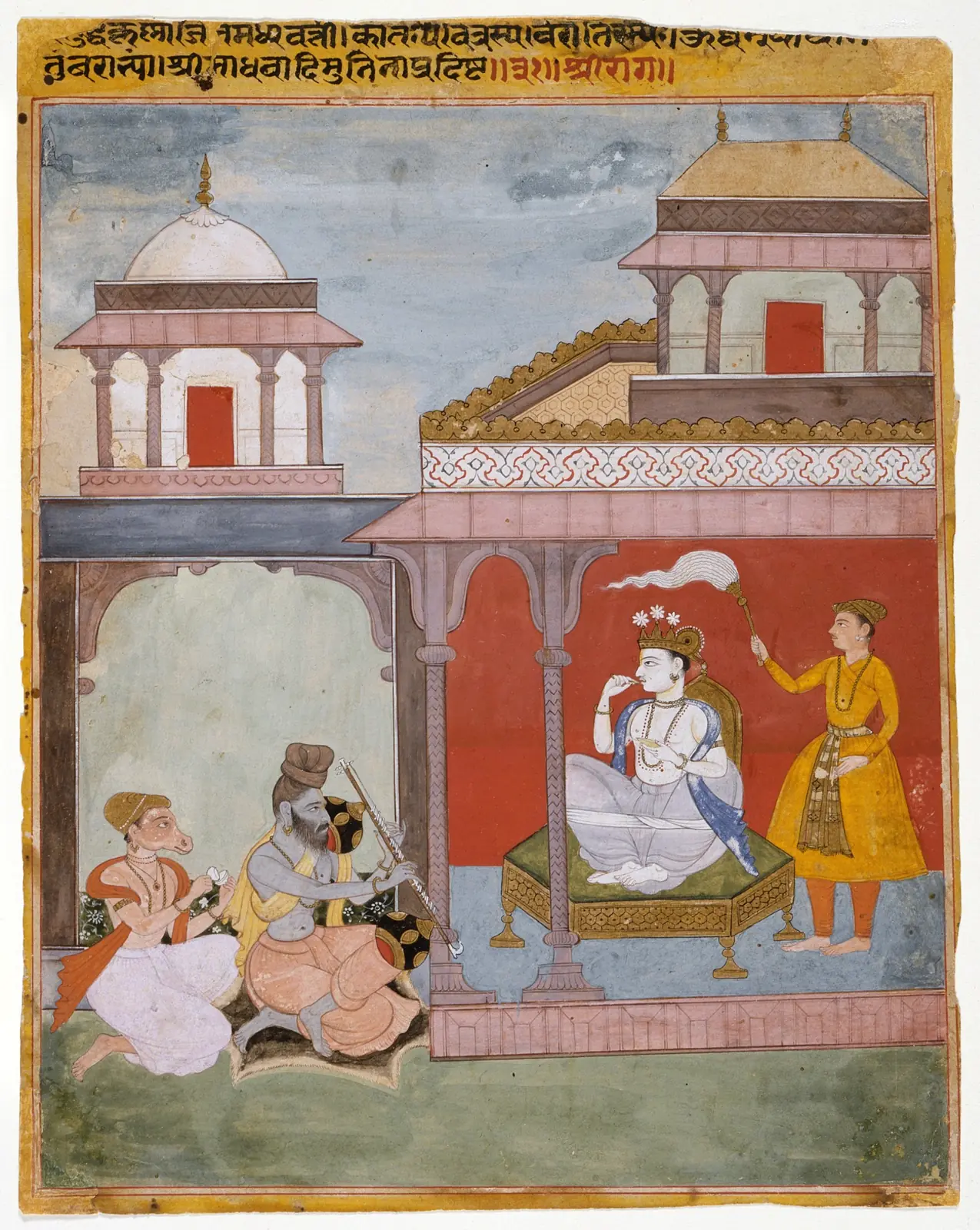
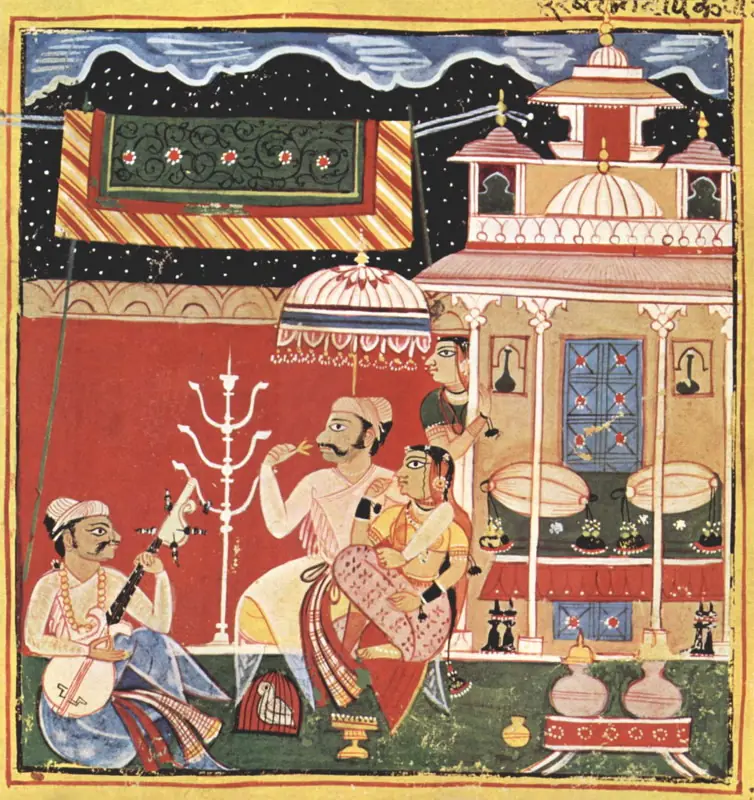
Shri Raga, Ragamala folioश्री · hindustaniShri

Sunset · Bhakti, gravity

One of the six principal ragas, grave and majestic, sung at dusk. Komal re and dha with tivra ma; the leap from re to pa is its signature. In Ragamala paintings Shri Raga is a king seated in splendour while musicians play.

पूरिया धनाश्री · hindustaniPuriya Dhanashri

Sunset · Bhakti, longing

A twilight raga of Purvi thaat, sung as the lamps are lit. Komal re and dha with tivra ma, and a strong pancham. It belongs to the sandhi prakash ragas, those of the joining of day and night.

मारवा · hindustaniMarwa

Sunset · Restlessness, karuna

A raga of the moment of sunset, with no pancham to rest on. Marwa lingers on komal re and shuddha dha, and its sa is often withheld, which gives a sense of waiting. It heads its own thaat.

भूपाली · hindustaniBhupali

Evening · Shanta, bhakti

Five notes, sa re ga pa dha, sung in the evening; the Carnatic Mohanam has the same scale. Bhupali uses only five notes and leaves out ma and ni. It is calm and bright, and is among the first ragas taught in Hindustani music.

Dipak Raga, by Sahibdinदीपक · hindustaniDeepak

Evening · Grishma, summer · Veera

The raga of fire, one of the six principal ragas, now no longer sung in its old form. The katha says that when Tansen sang Deepak in Akbar’s court the lamps lit themselves and his body burned until Megh Malhar brought rain. The original Deepak is not known today.

हंसध्वनि · bothHamsadhwani

Evening; opens Carnatic concerts · Joy, auspiciousness

The swan’s cry: a five-note raga from the Carnatic world, now sung in both systems. Ramaswami Dikshitar is credited with creating it. His son Muthuswami Dikshitar’s Vatapi Ganapatim in Hamsadhwani often opens Carnatic concerts. Hindustani musicians took it up in the twentieth century.

कल्याणी · carnaticKalyani

Evening · Auspiciousness, bhakti

The 65th melakarta, Mechakalyani: auspicious, sung for the evening and for festive occasions. Kalyani uses prati madhyama, the sharp ma, and matches Hindustani Yaman. It is often the subject of the main piece of a concert.

काम्भोजी · carnaticKambhoji

Evening · Bhakti, veera

A broad, stately raga born from Harikambhoji, a favourite for the main piece of a concert. Kambhoji uses kakali nishada only in passing phrases, which gives it its character. Tyagaraja’s O Rangasayi is in this raga.

मोहनम् · carnaticMohanam

Evening · Joy, shringara

Five notes, sa ri ga pa dha: the Carnatic twin of Bhupali. Mohanam is sweet and open. It is among the first ragas children learn songs in.

श्री · carnaticSri (Carnatic)

Evening; auspicious · Bhakti, auspiciousness

The fifth ghana raga, in which Tyagaraja sang Endaro Mahanubhavulu, a salute to all great souls. Born from Kharaharapriya, Sri is considered very auspicious. Concerts and festivals may end with a piece in it.

बेगडा · carnaticBegada

Evening · Joy, bhakti

A lively raga born from Shankarabharanam, with zig-zag phrases. Begada is often sung in the middle of a concert to lift the mood. Its phrases twist rather than climb straight.

Night14 ragas

यमन · hindustaniYaman

First part of night · Shringara, bhakti

Often the first raga a student learns: all shuddha notes but a sharp ma. Yaman, or Kalyan, is sung in the first prahar of the night, after the evening lamp. Its scale matches the Carnatic Kalyani. Yaman Kalyan adds a touch of shuddha ma.

Kedar Ragini, by Ruknuddin, c. 1690–95केदार · hindustaniKedar

Night · Bhakti, shringara

A raga of the night that shares a name with Kedarnath, abode of Bhagwan Shiva. Kedar leaps from sa to ma and uses both madhyams. It belongs to Kalyan thaat. Ragamala pages show Kedar as an ascetic seated at night.

दुर्गा · hindustaniDurga

Night · Joy, veera

A five-note raga named for the Devi, bright and straightforward. Durga uses sa re ma pa dha and leaves out ga and ni. It is traditionally sung at night.

देस · hindustaniDesh

Night · Rains · Shringara, joy

A night raga of Khamaj thaat, much loved in the rainy season. Desh rises with shuddha ni and falls with komal ni. Its songs often speak of clouds and rain, so it is sung often in the monsoon.

खमाज · hindustaniKhamaj

Late night · Shringara

The raga of thumri and light classical song, playful and tender. Khamaj heads its own thaat, with komal ni in descent. Many thumris and dadras on Radha and Krishna are set in it.

बिहाग · hindustaniBihag

Late night · Shringara

A raga of the second prahar of night, full of graceful curves. Bihag dwells on ga and ni and touches tivra ma lightly in passing. It is traditionally sung between about nine and midnight.

बागेश्री · hindustaniBageshri

Late night · Viraha, longing

A midnight raga of a woman waiting for her beloved. In Kafi thaat, with komal ga and ni. Pa is used sparingly, which gives Bageshri its tender, waiting quality.

Kanada Ragini, Jaipur Ragamalaदरबारी कान्हड़ा · hindustaniDarbari Kanada

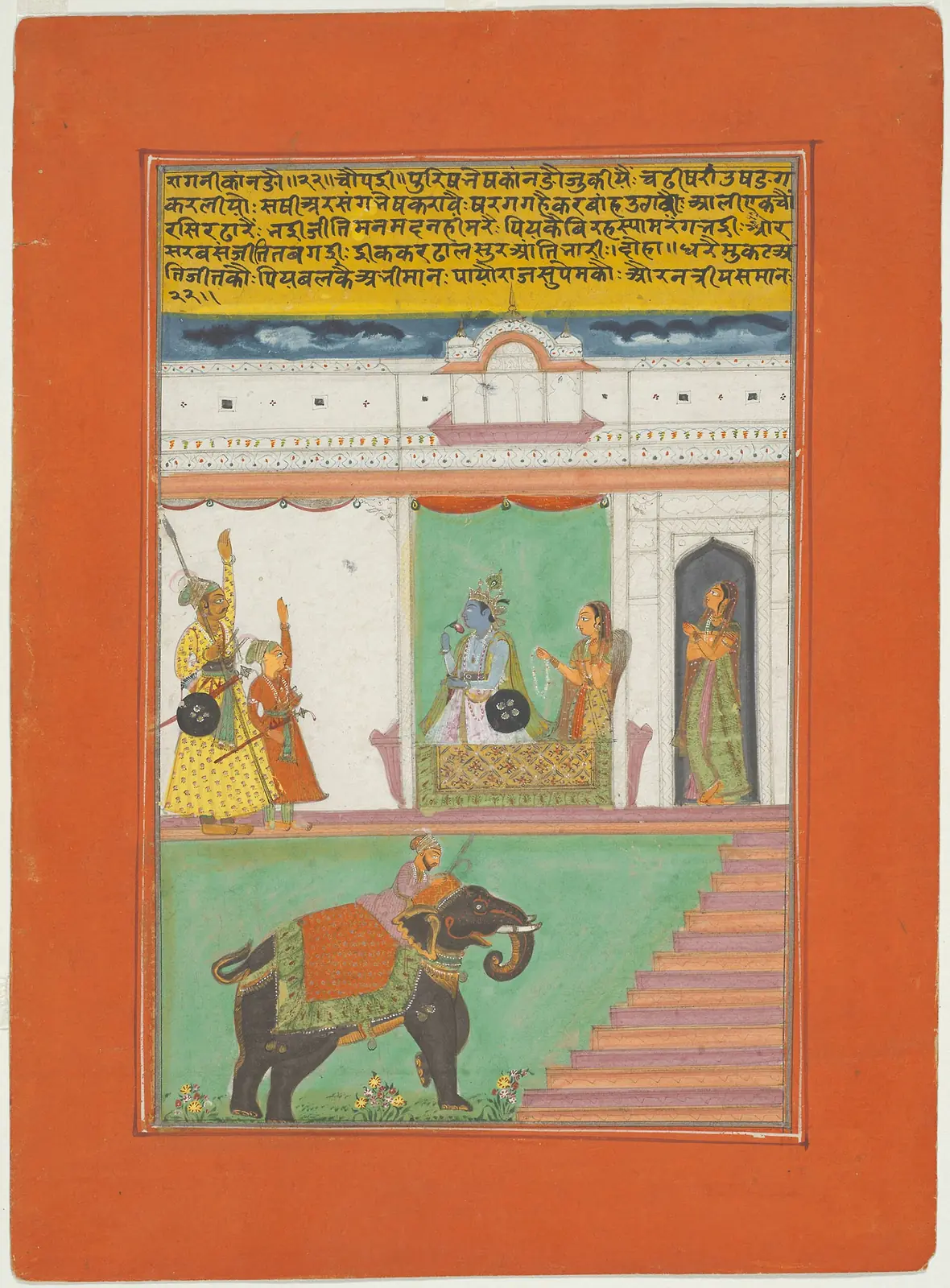
Midnight · Gravity, karuna

The grave midnight raga that tradition credits to Tansen, sung slow and deep. Komal ga is sung with a wide, slow oscillation, and the raga moves mostly in the lower octave. The Kanada family is old; Ragamala painters showed Kanada Ragini too.

Malkos (Malkauns) Raga, Ragamala folioमालकौंस · hindustaniMalkauns

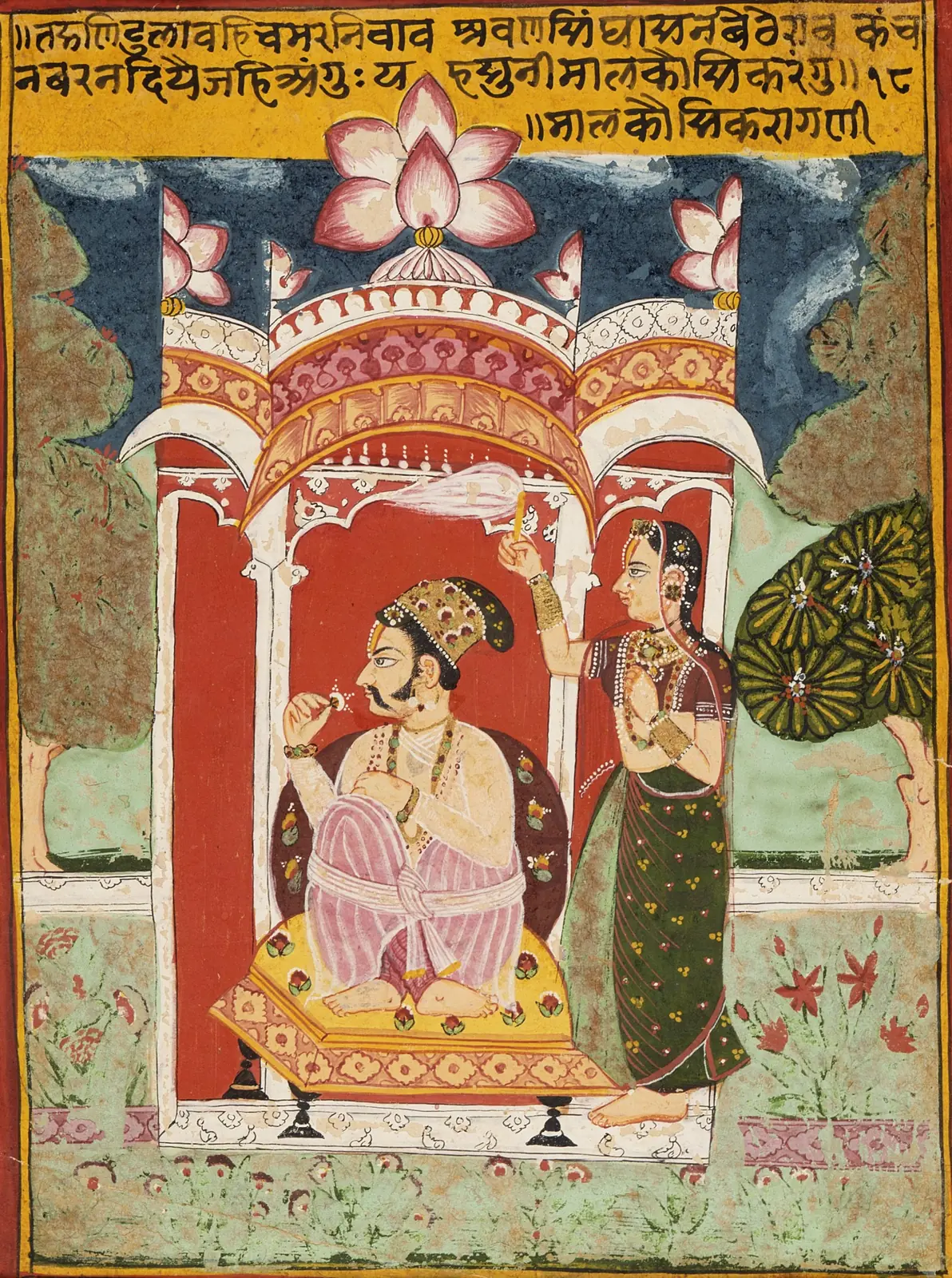
Late night · Shanta, veera

A five-note raga of deep night, sung slowly; the Carnatic Hindolam has the same notes. Sa, komal ga, ma, komal dha, komal ni. Malkauns is one of the six principal ragas of the Ragamala, painted as a prince among women. It is sung after midnight.

सोहनी · hindustaniSohini

Last part of night · Longing

A short, piercing raga of the hours before dawn. Sohini drops pa and climbs quickly to the upper sa. It belongs to Marwa thaat and is sung near the end of the night.

Raga Kafi, a Ragamala paintingकाफ़ी · hindustaniKafi

Night · Phagun, Holi · Shringara, joy

The raga of Holi songs, with komal ga and komal ni. Kafi heads its own thaat and matches the Carnatic Kharaharapriya. Hori and phagun songs of Krishna playing colour in Braj are sung in it.

Vasant Ragini, Rajput, 1770बसंत · hindustaniBasant

Any time in spring; otherwise night · Vasant, spring · Shringara, joy

The spring raga, sung at Vasant Panchami and through the season of mustard flowers. Basant uses komal re and dha with both madhyams. In Ragamala paintings Vasant is Krishna dancing with the gopis among blossoming trees.

नीलाम्बरी · carnaticNilambari

Night · Shanta, tenderness

The lullaby raga of South India, sung at night and when the deity is put to rest. Nilambari is born from Shankarabharanam. In temples the nadaswaram plays it at the deity’s night ritual, and mothers sing lullabies in it.

हिन्दोलम् · carnaticHindolam

Night · Shanta, bhakti

The Carnatic twin of Malkauns, five notes with no ri or pa. Hindolam is born from Natabhairavi. It shares its name with the Hindustani Hindol, but the notes are those of Malkauns.

Any hour17 ragas

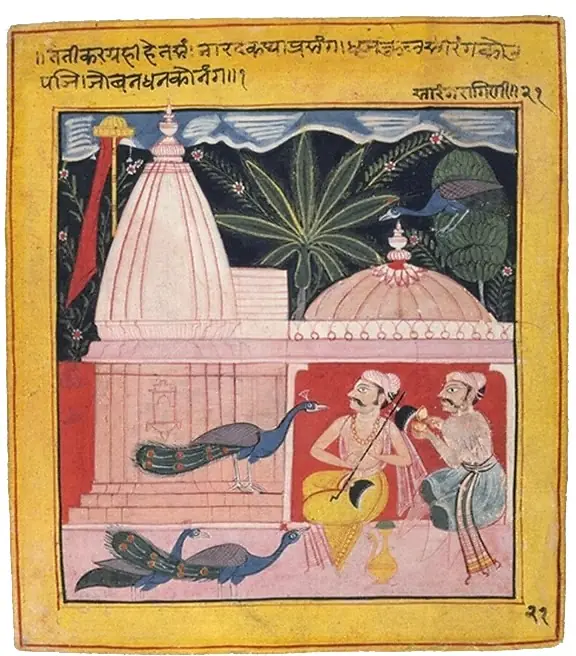
Sarang Ragini, Ragamala, c. 1605वृन्दावनी सारंग · hindustaniBrindavani Sarang

Midday · Shringara, joy

The raga of the noon heat, named for Krishna’s Vrindavan. A five-note raga that leaves out ga and dha and uses both nishads. The Sarang family is traditionally sung in the hottest hours of the day.
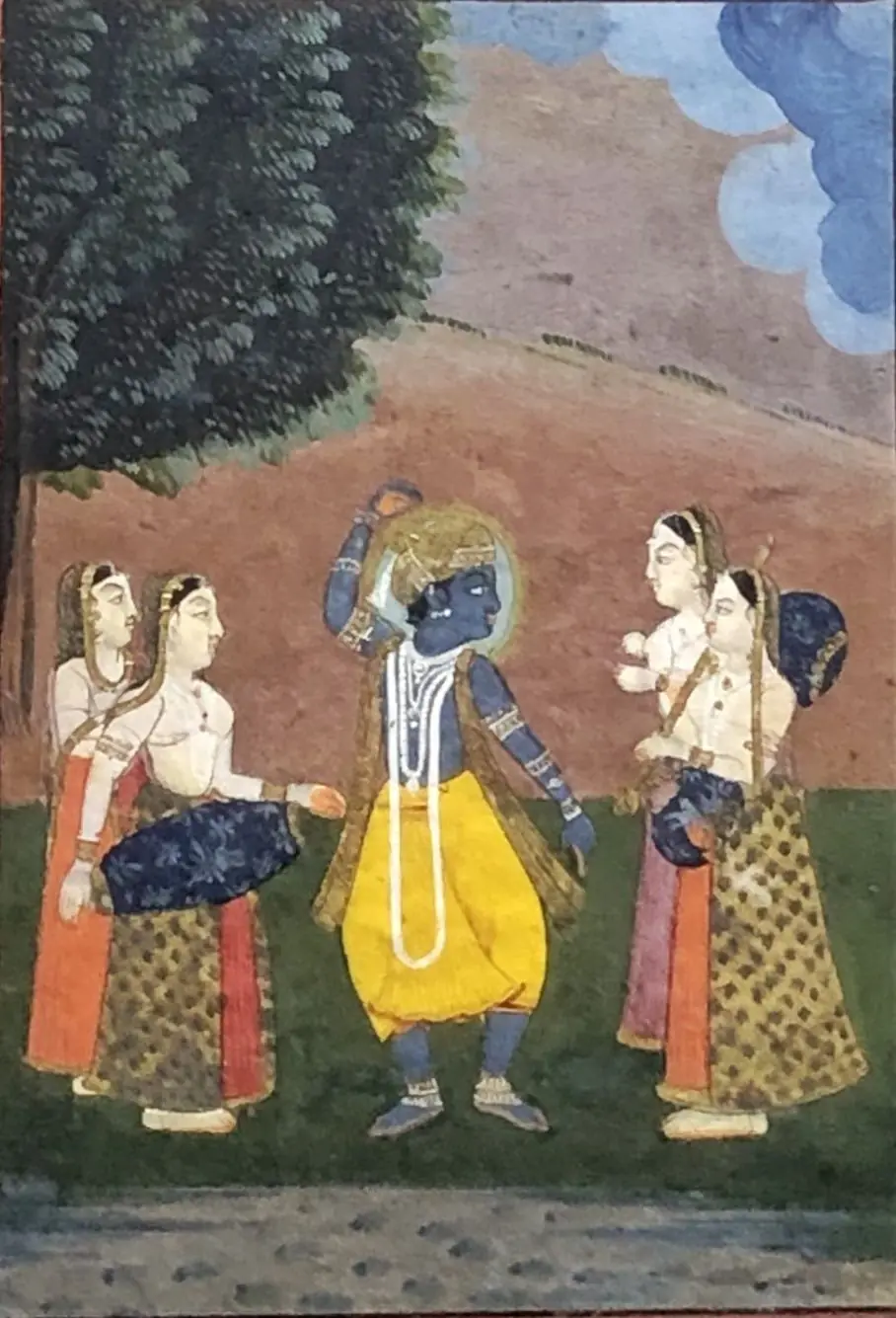
Megh Malhar, Jaipur Ragamala, 19th centuryमेघ · hindustaniMegh

Any time in the rains · Varsha, the monsoon · Shringara, gravity

The cloud raga, one of the six principal ragas, sung in the monsoon. Megh is a five-note raga of the Malhar family. By the famous katha of Akbar’s court, Megh Malhar was sung to bring rain after Tansen sang Deepak.

मियाँ की मल्हार · hindustaniMiyan ki Malhar

Any time in the rains · Varsha, the monsoon · Shringara, viraha

The best-known Malhar, credited by tradition to Miyan Tansen. Both nishads are heard, the komal ni falling slowly to dha. Like all the Malhars it may be sung at any hour while the monsoon lasts.

शंकराभरणम् · carnaticShankarabharanam

Any time · Joy, majesty

The 29th melakarta, Dheerasankarabharanam: the ornament of Shiva, with all shuddha notes. Its scale matches Bilawal and the Western major scale. Large kritis by all three of the Trinity are set in it, and many ragas are born from it.

खरहरप्रिया · carnaticKharaharapriya

Any time · Karuna, bhakti

The 22nd melakarta, with a scale that matches Hindustani Kafi. Tyagaraja gave it many of its best-known kritis. Sri, Madhyamavati and Abhogi are among the ragas born from it.

नटभैरवी · carnaticNatabhairavi

Any time · Karuna

The 20th melakarta, matching the Hindustani Asavari scale. Many ragas are born from it, among them Carnatic Bhairavi and Hindolam.

भैरवी · carnaticBhairavi (Carnatic)

Any time · Bhakti, karuna

A majestic janya raga, quite different from the Hindustani Bhairavi of the same name. It uses both dhaivatams, one going up and the other coming down. Shyama Shastri’s great swarajati and the Viriboni ata tala varnam are set in it.

नाट · carnaticNata

Any time; often opens · Veera

A strong, bright raga, the first of Tyagaraja’s five Pancharatna kritis. Jagadananda Karaka, the first Pancharatna kriti, is sung in Nata at the Tyagaraja Aradhana each year at Thiruvaiyaru. It is one of the five ghana ragas.

वराळि · carnaticVarali

Any time · Karuna, bhakti

A ghana raga of the 39th melakarta family, set for the fourth Pancharatna, Kanakana Ruchira. Varali uses the sharp prati madhyama with a very low gandhara. Of the five Pancharatnas, the one in Varali is the least often sung.

आनन्दभैरवी · carnaticAnandabhairavi

Any time · Bhakti, tenderness

A gentle, folk-touched raga loved for lullabies, padams and songs to the Devi. Shyama Shastri, devotee of Kamakshi at Thanjavur, gave Anandabhairavi some of its finest kritis. Its touches of the foreign note make it sweet and unhurried.

मध्यमावती · carnaticMadhyamavati

Close of a concert · Auspiciousness

The raga of the mangalam: Carnatic concerts end in Madhyamavati. Five notes, sa ri ma pa ni. A concert ends with a mangalam in it, or the last song closes on a few phrases of it.

अमृतवर्षिणी · carnaticAmritavarshini

Any time · Associated with rain · Joy

The shower of nectar: a five-note raga that Carnatic tradition links with rain. Tradition says Muthuswami Dikshitar sang Anandamritakarshini in it at Ettayapuram during a drought, and rain fell. The raga leaves out ri and dha.

बौळि · carnaticBowli

Before sunrise · Shanta, bhakti

A five-note raga of the early morning, heard in suprabhatam prayers. Born from Mayamalavagowla. Bowli is traditionally sung before sunrise to wake the deity and the household.

षण्मुखप्रिया · carnaticShanmukhapriya

Any time · Veera, bhakti

The 56th melakarta, dear to Shanmukha, Bhagwan Kartikeya. It joins prati madhyama with komal dha and ni, giving a strong, dramatic sound often chosen for the main piece.

चारुकेशी · carnaticCharukesi

Any time · Karuna, shringara

The 26th melakarta, of beautiful hair, now sung in Hindustani music as well. Charukesi’s lower half sounds major and its upper half minor, which gives it a tender, wistful pull.

रेवती · carnaticRevati

Any time · Karuna, bhakti

A five-note raga born from the 2nd melakarta, heard often in devotional songs. Revati uses sa, komal ri, ma, pa and komal ni. Its Hindustani cousin is Bairagi.

आभोगी · carnaticAbhogi

Any time · Shringara

A five-note raga of the Kharaharapriya family, light and graceful. Abhogi uses sa, ri, komal ga, ma and dha. Hindustani musicians sing a raga of the same notes as Abhogi Kanada.

Instruments

The Natya Shastra sorts every instrument into four families: strings, winds, drums and solid instruments.

Tata · strings

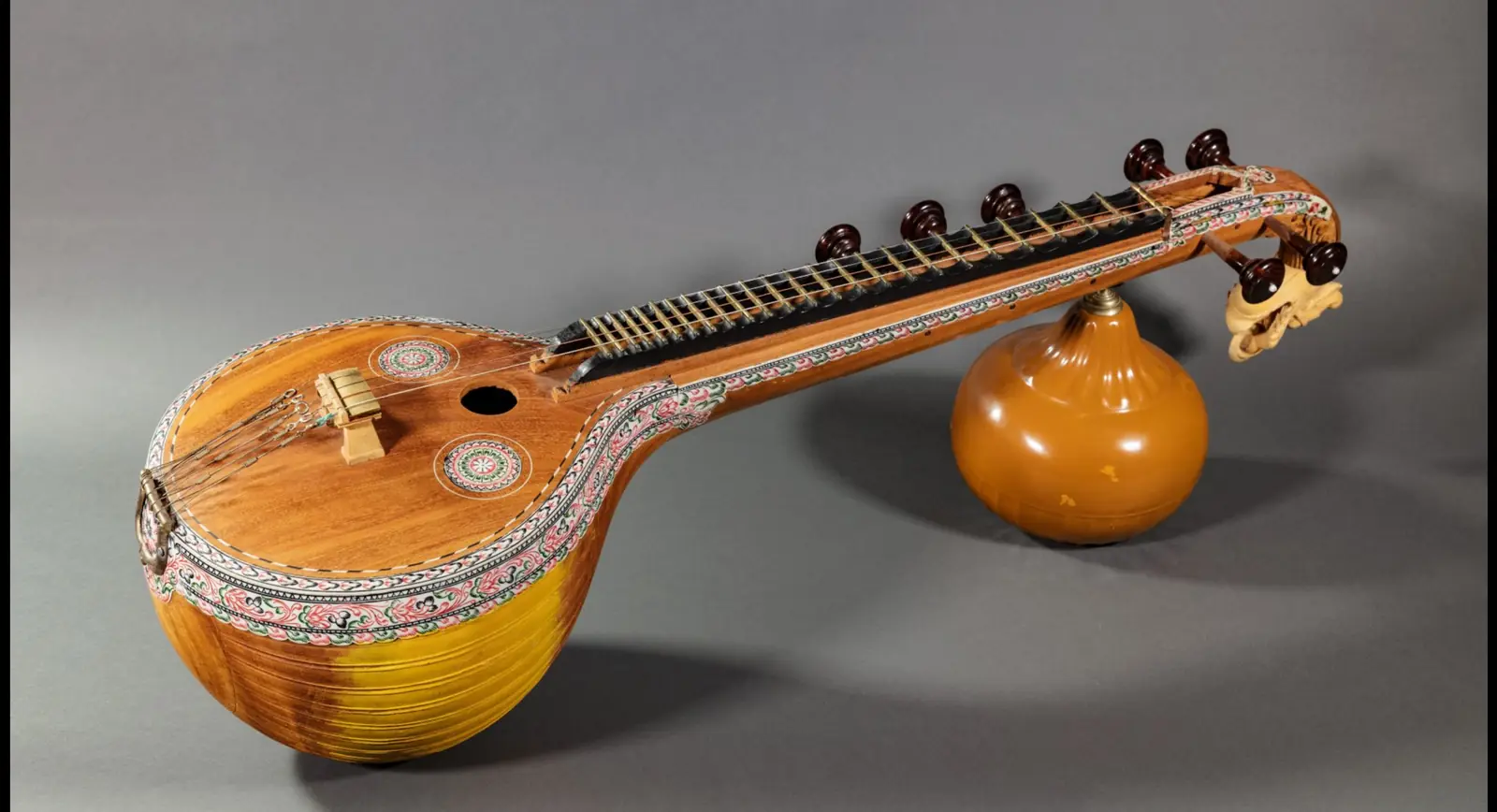
Saraswati veenaसरस्वती वीणाSaraswati Veena

The veena Mata Saraswati holds, the lead string instrument of Carnatic music. Carved from jackfruit wood, with a large resonator, a smaller gourd near the head, 24 frets set in wax, four playing strings and three drone strings. The player sits with it across the lap.

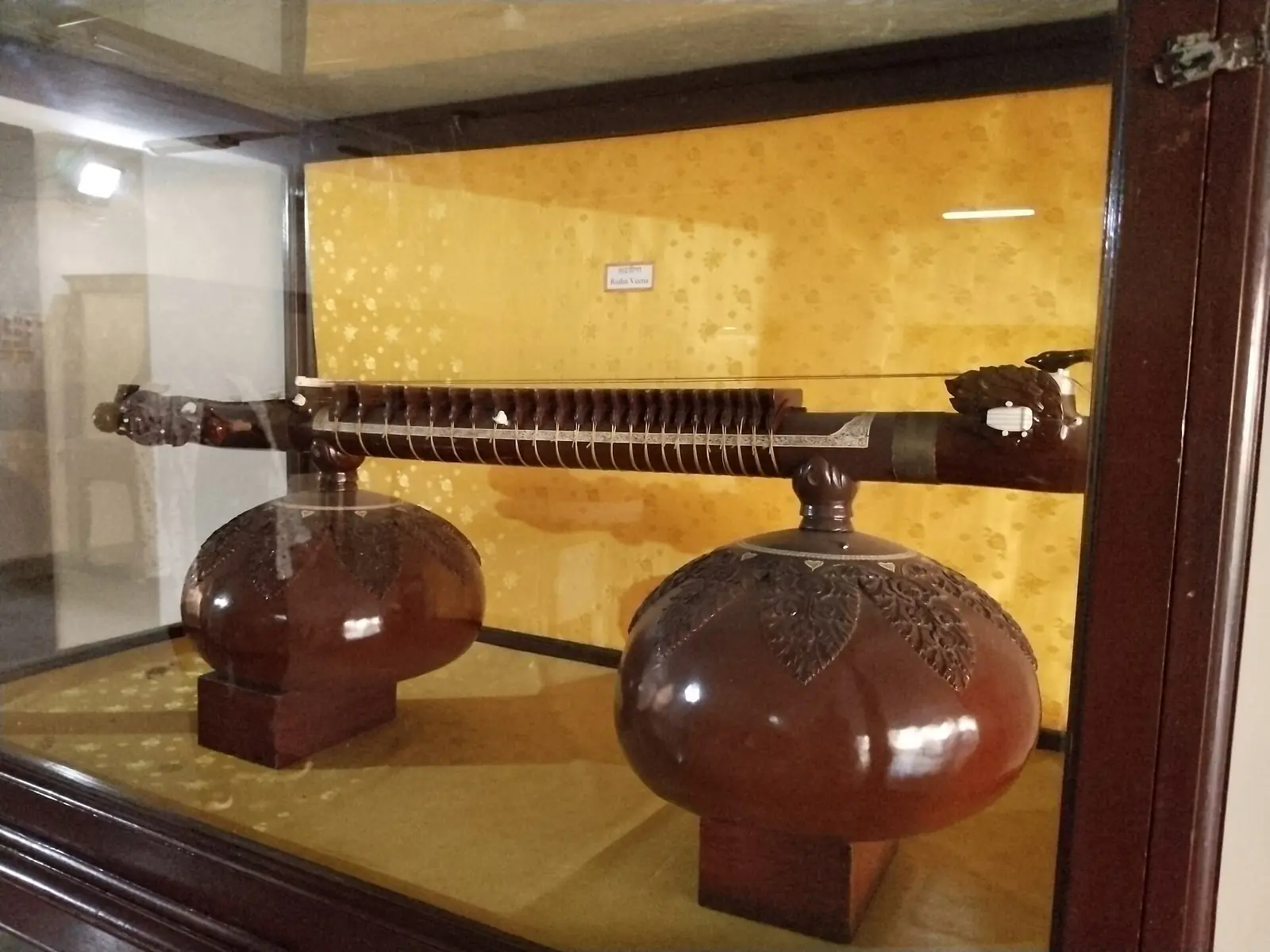
Rudra veenaरुद्र वीणाRudra Veena

The veena of Rudra, Bhagwan Shiva: a long tube on two great gourds, voice of the Dhrupad tradition. Its low, sustained sound suits the slow alap of Dhrupad. The neck often ends in a carved peacock or makara. It is played resting on the shoulder.

Sitar, Metropolitan Museum of ArtसितारSitar

The long-necked lute of Hindustani music, with curved movable frets and a ring of sympathetic strings. The player pulls the string across the fret to bend notes, the meend. Pandit Ravi Shankar and Ustad Vilayat Khan made it known around the world.

Sarod, Metropolitan Museum of ArtसरोदSarod

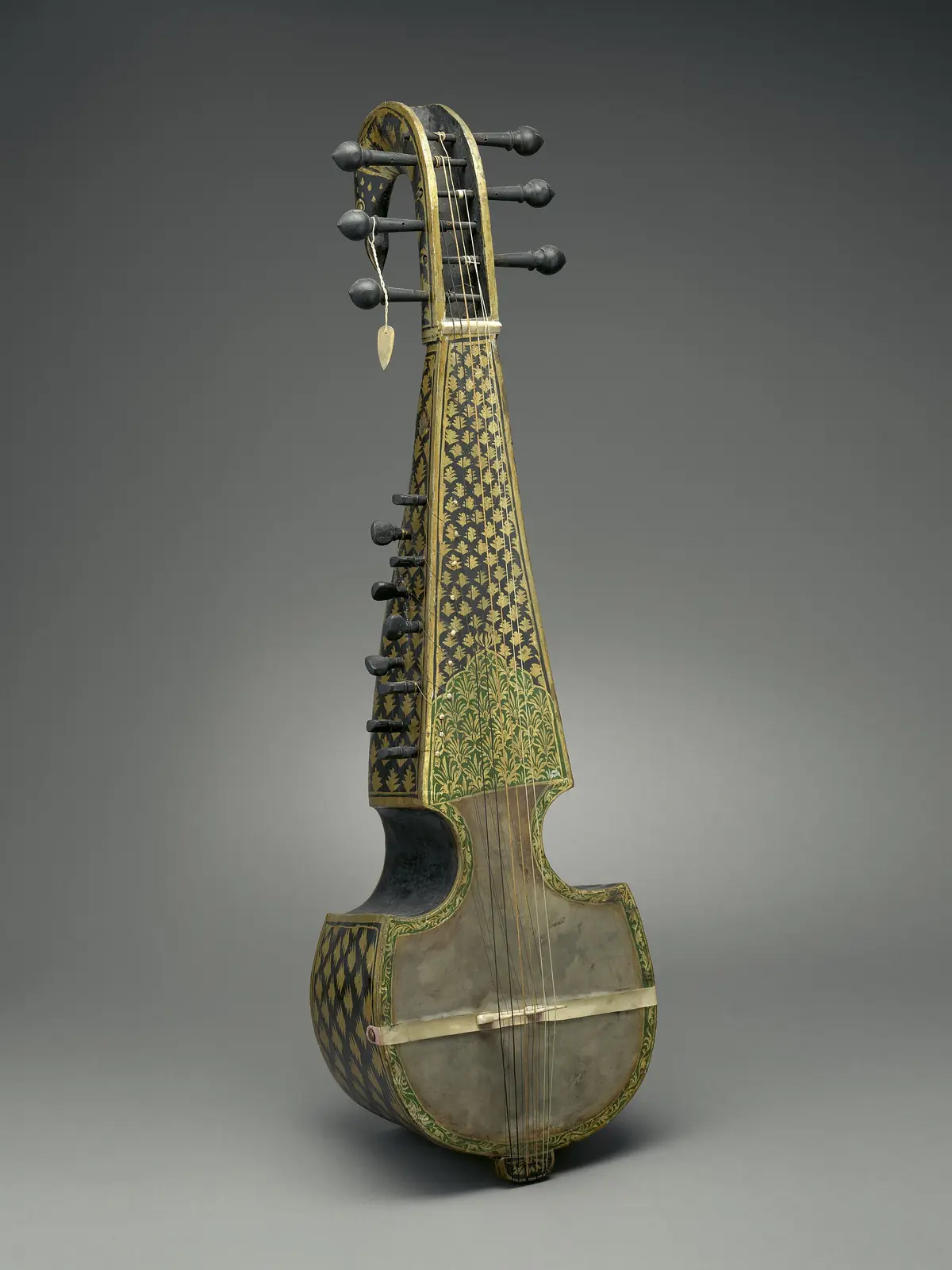
A fretless lute with a steel fingerboard and a skin belly, plucked with a coconut-shell plectrum. With no frets, the fingertip slides along the metal board for smooth glides. Ustad Allauddin Khan, Ustad Ali Akbar Khan and Ustad Amjad Ali Khan are its great names.

SarangiसारंगीSarangi

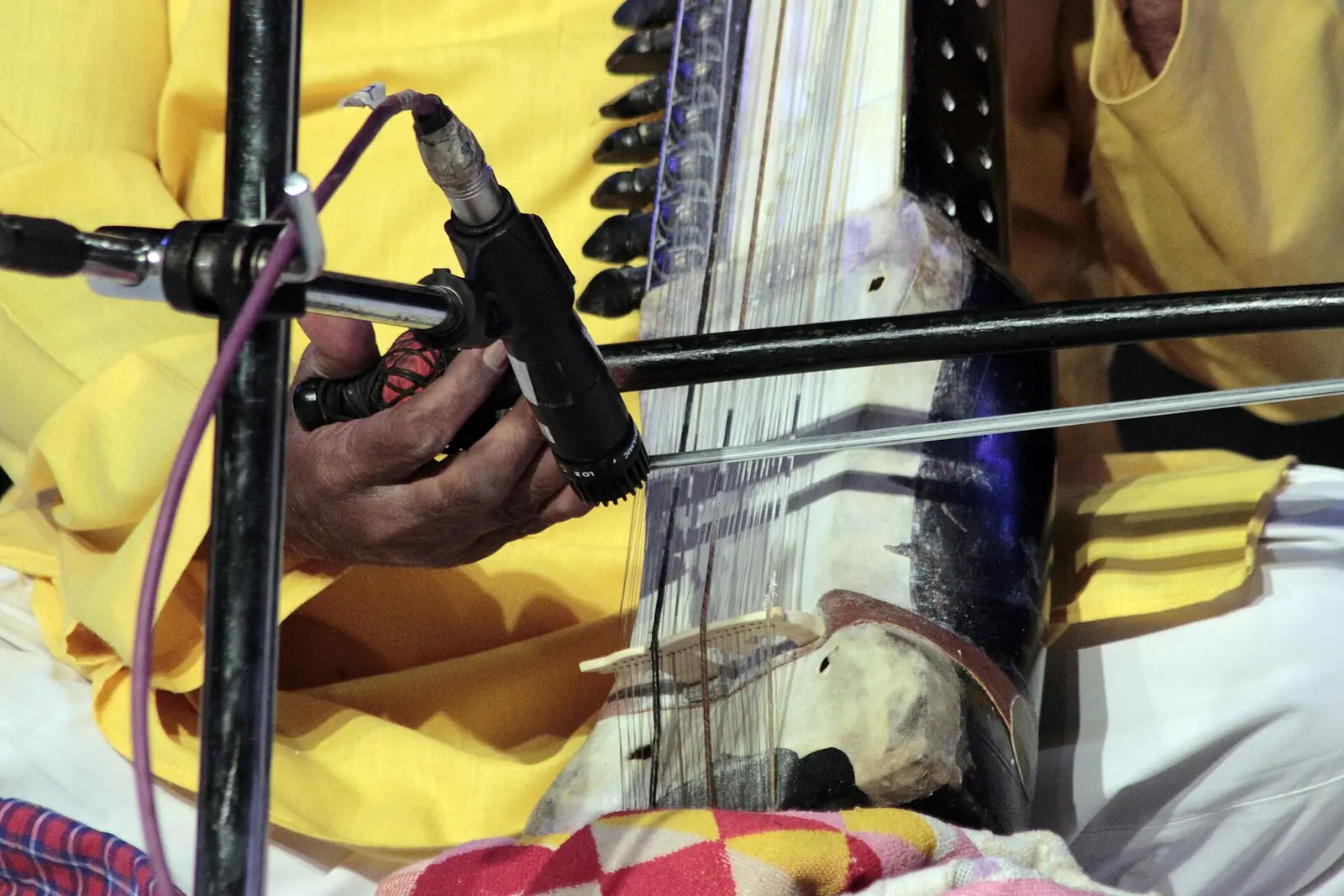
The bowed instrument closest to the human voice, played by pressing the strings with the cuticles. Three gut strings and over thirty sympathetic strings. It long accompanied singers and Kathak dancers. Pandit Ram Narayan made it a solo instrument.

A pair of tanpurasतानपूराTanpura

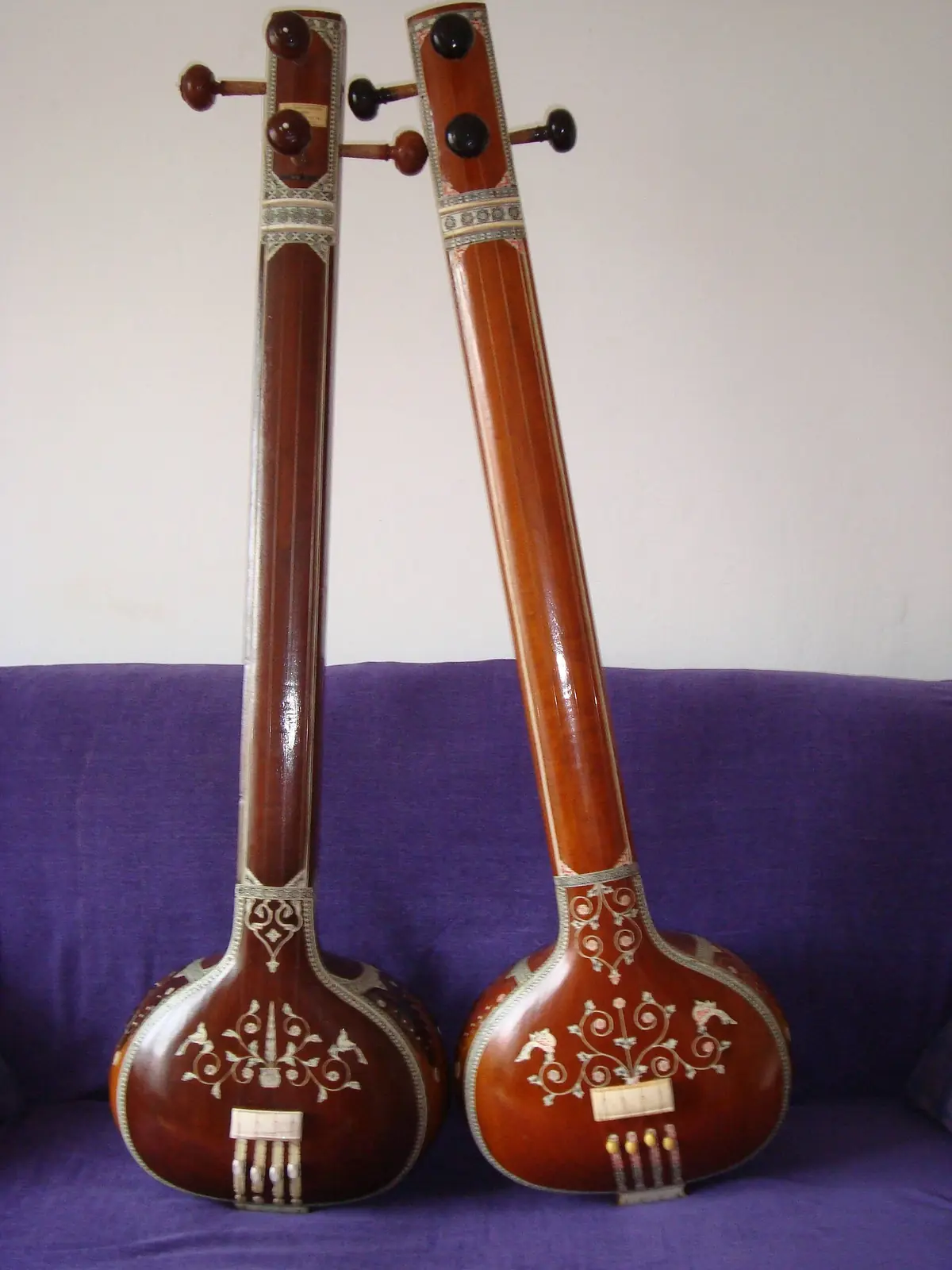
The drone behind every Indian classical singer, plucked over and over without melody. Usually four strings tuned to pa or ma and sa. A thread under the strings at the bridge, the jivari, gives the shimmering buzz in which the notes are heard.

SantoorसंतूरSantoor

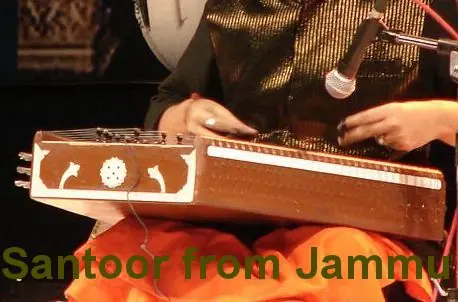
Kashmir’s hammered dulcimer, a trapezium of many strings struck with light curved mallets. Long played in Sufiana music of Kashmir. Pandit Shivkumar Sharma brought it to the Hindustani classical stage. It is often compared with the shatatantri veena, the hundred-stringed veena of old texts.

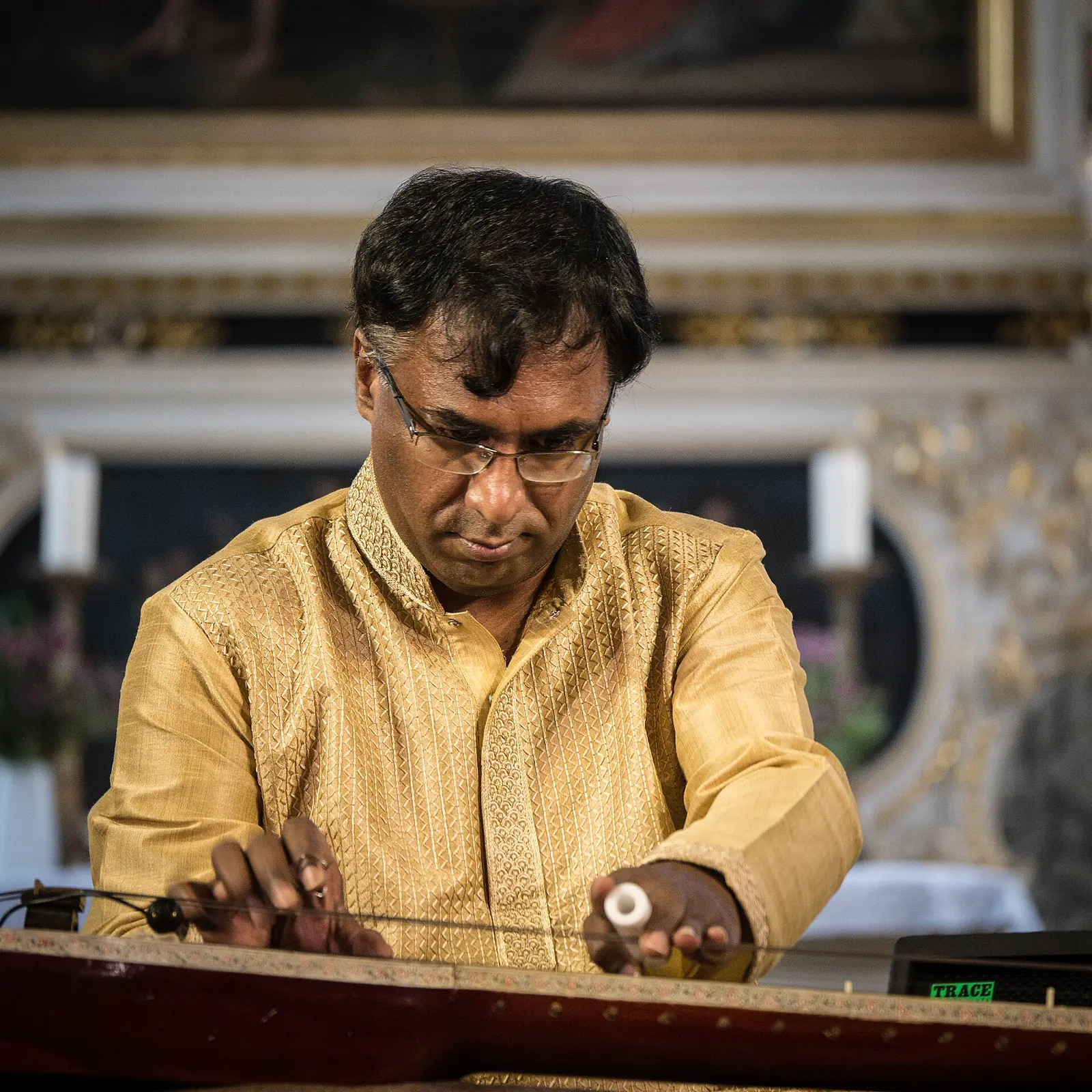
N. Ravikiran playing the chitravinaचित्रवीणाChitravina

A fretless Carnatic veena played with a slide, also called gottuvadyam. The player glides a smooth cylinder along the strings, so every gamaka can be played. N. Ravikiran is its best-known player today.

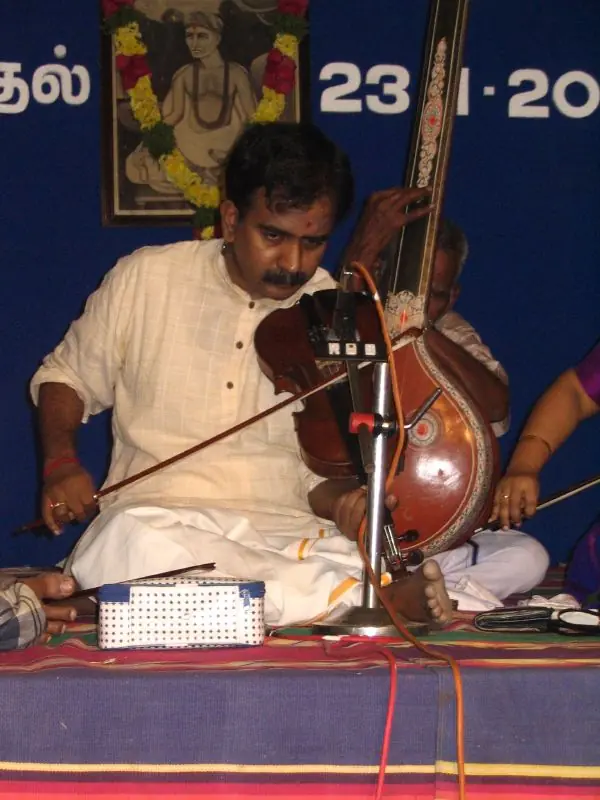
A Carnatic violinistवायलिनViolin (Carnatic)

A European instrument made Carnatic, played seated with the scroll resting on the foot. Baluswami Dikshitar, brother of Muthuswami Dikshitar, is credited with bringing it into Carnatic music. It is now the standard accompaniment to a singer. Lalgudi Jayaraman was among its masters.

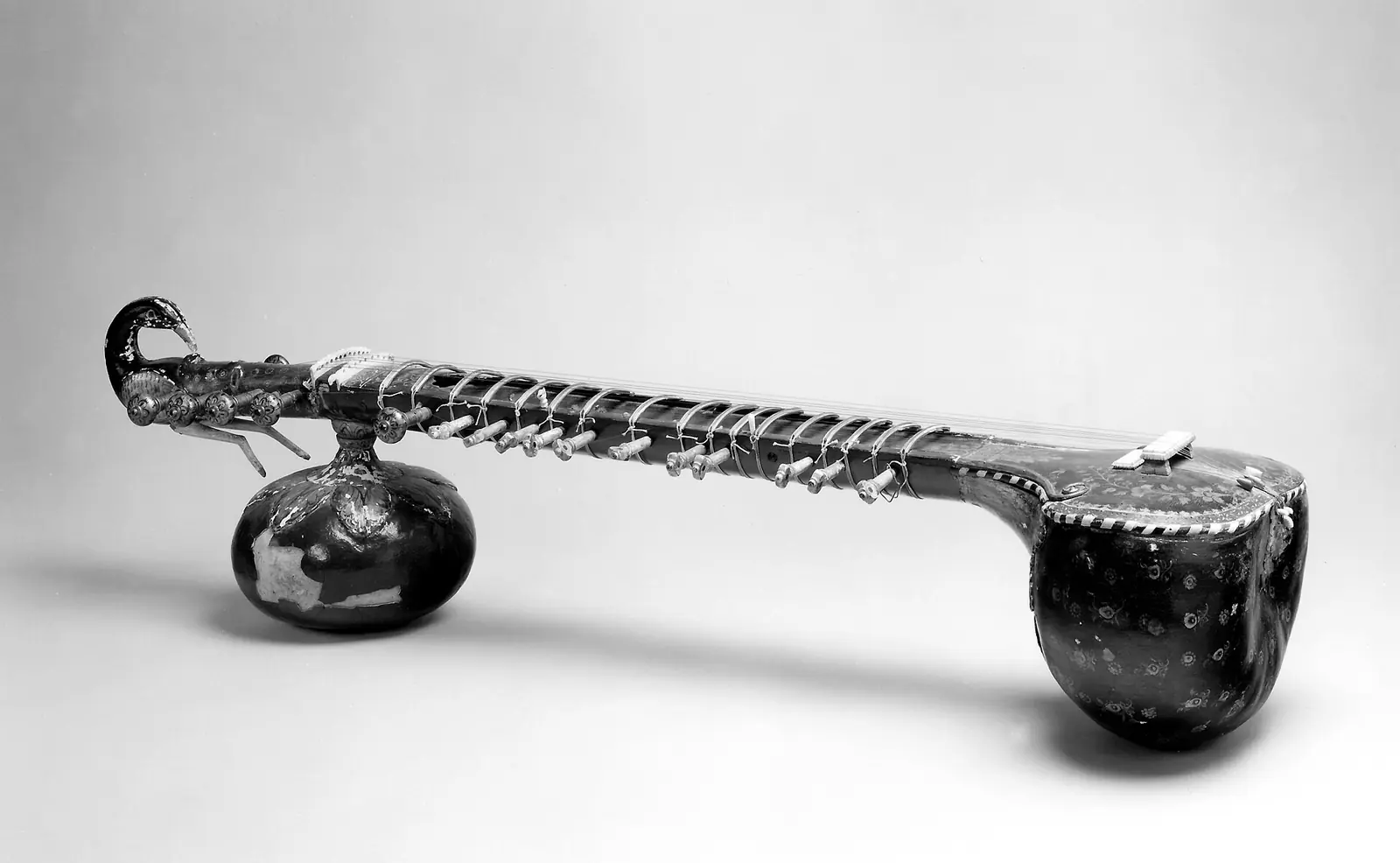
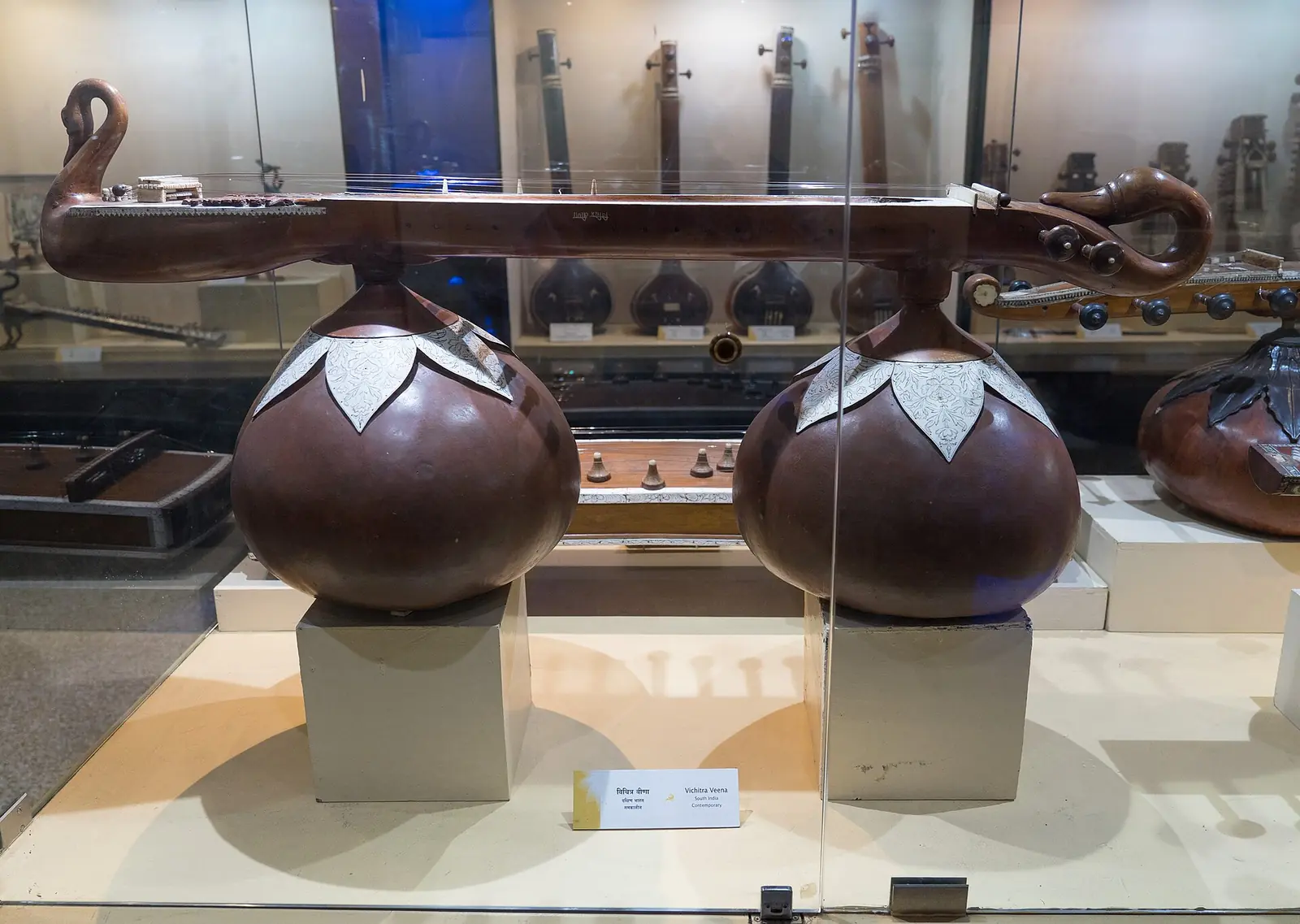
Vichitra veena, Raja Dinkar Kelkar Museum, Puneविचित्र वीणाVichitra Veena

A fretless stick zither on two gourds, played with a glass ball sliding on the strings. Its glides make it sing like a voice. It is rare today and is played lying flat before the musician.

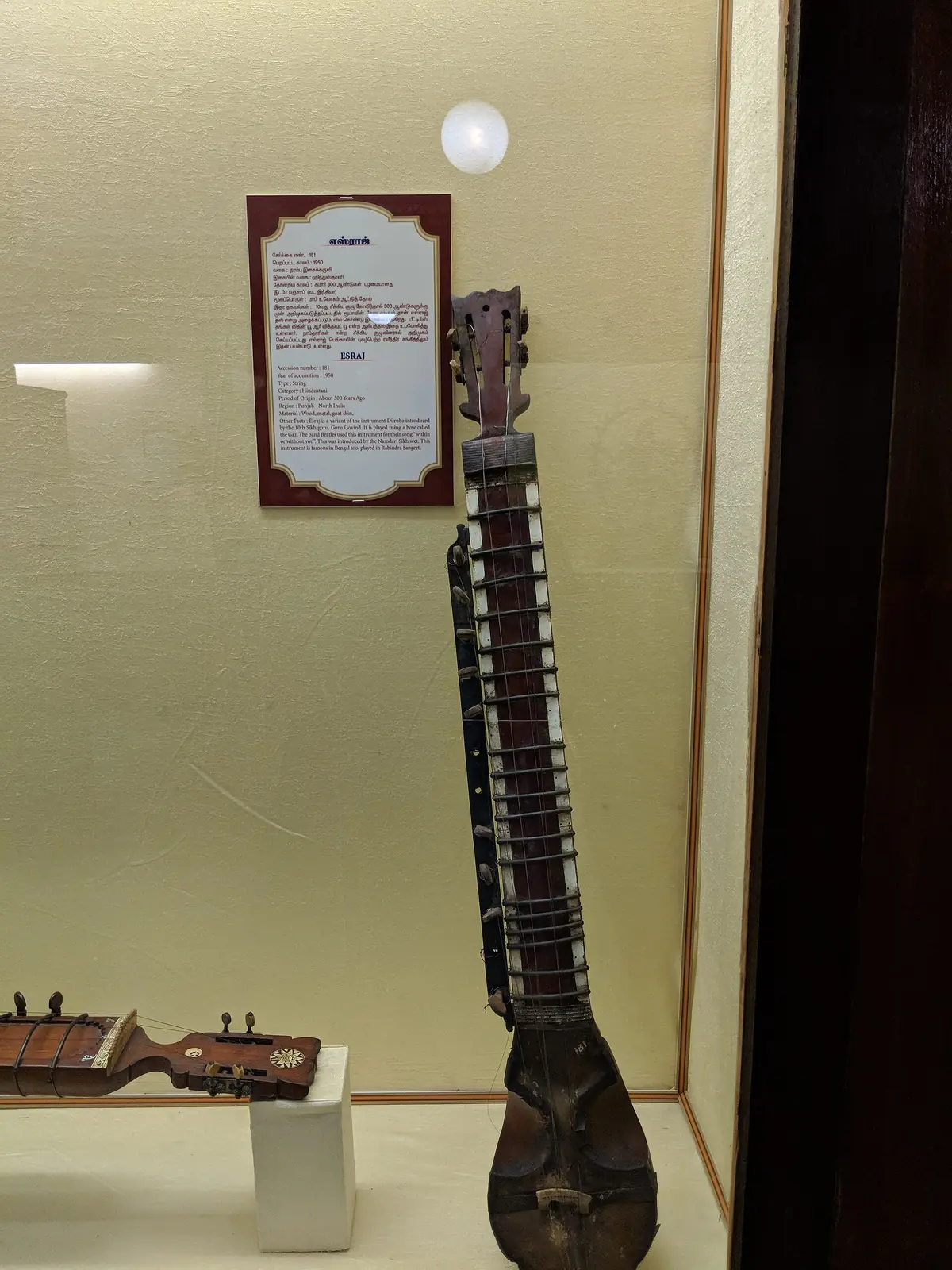
EsrajएसराजEsraj

A fretted bowed instrument of Bengal, beloved at Santiniketan for Rabindra Sangeet. It has a sitar-like neck with frets and a small skin-covered body, played with a bow. The dilruba of Punjab is a close relative.

DilrubaदिलरुबाDilruba

The bowed, fretted instrument of Punjab, used in devotional kirtan. Larger than the esraj, with a wide sound box and sympathetic strings. It accompanies singing in gurdwaras and in Hindustani music.

EktaraएकताराEktara

One string on a gourd and a split bamboo: the companion of wandering singers. Bauls of Bengal and bhajan singers across India keep time and drone with it. Squeezing the bamboo bends the pitch.

A folk singer with a dotaraदोताराDotara

A plucked folk lute of Bengal and Assam, carved from a single piece of wood. Despite the name, two strings, it often has four. It carries Baul, Bhawaiya and other folk songs.

Kamaicha, played by Manganiyar musiciansकमायचाKamaicha

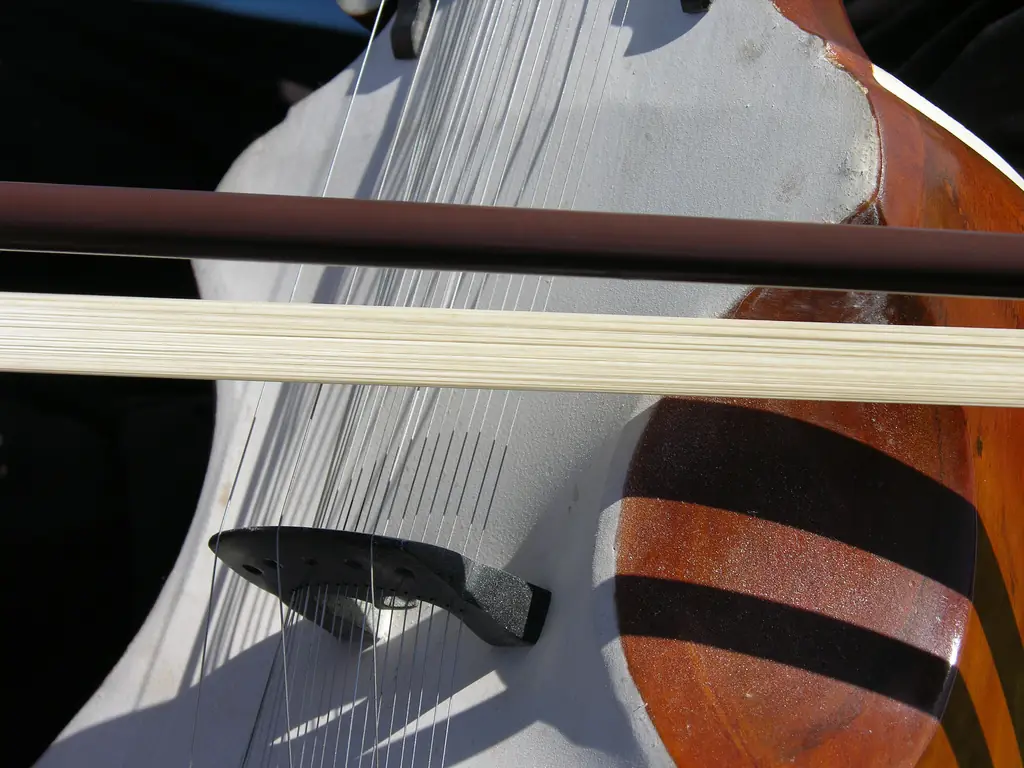
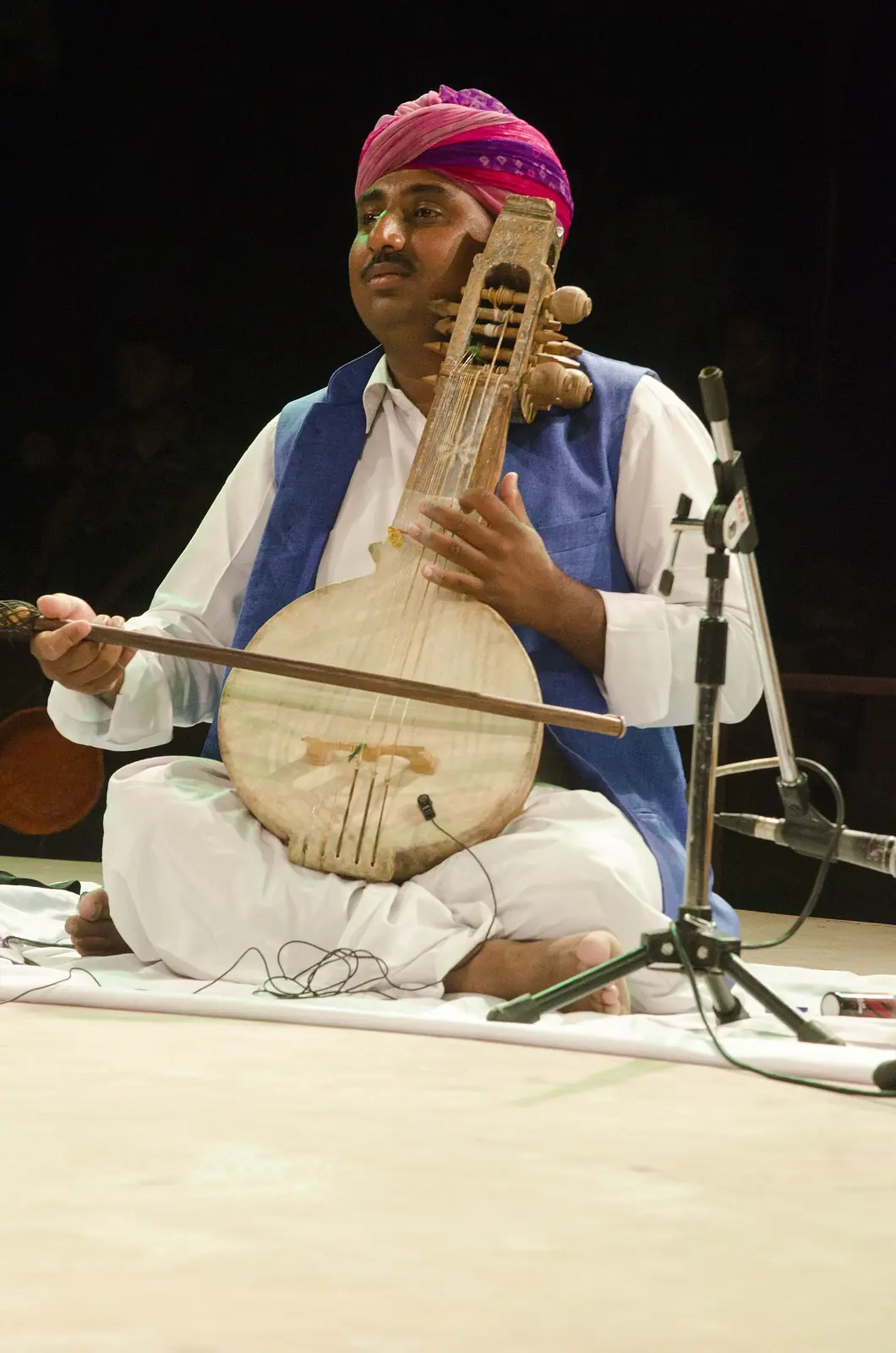
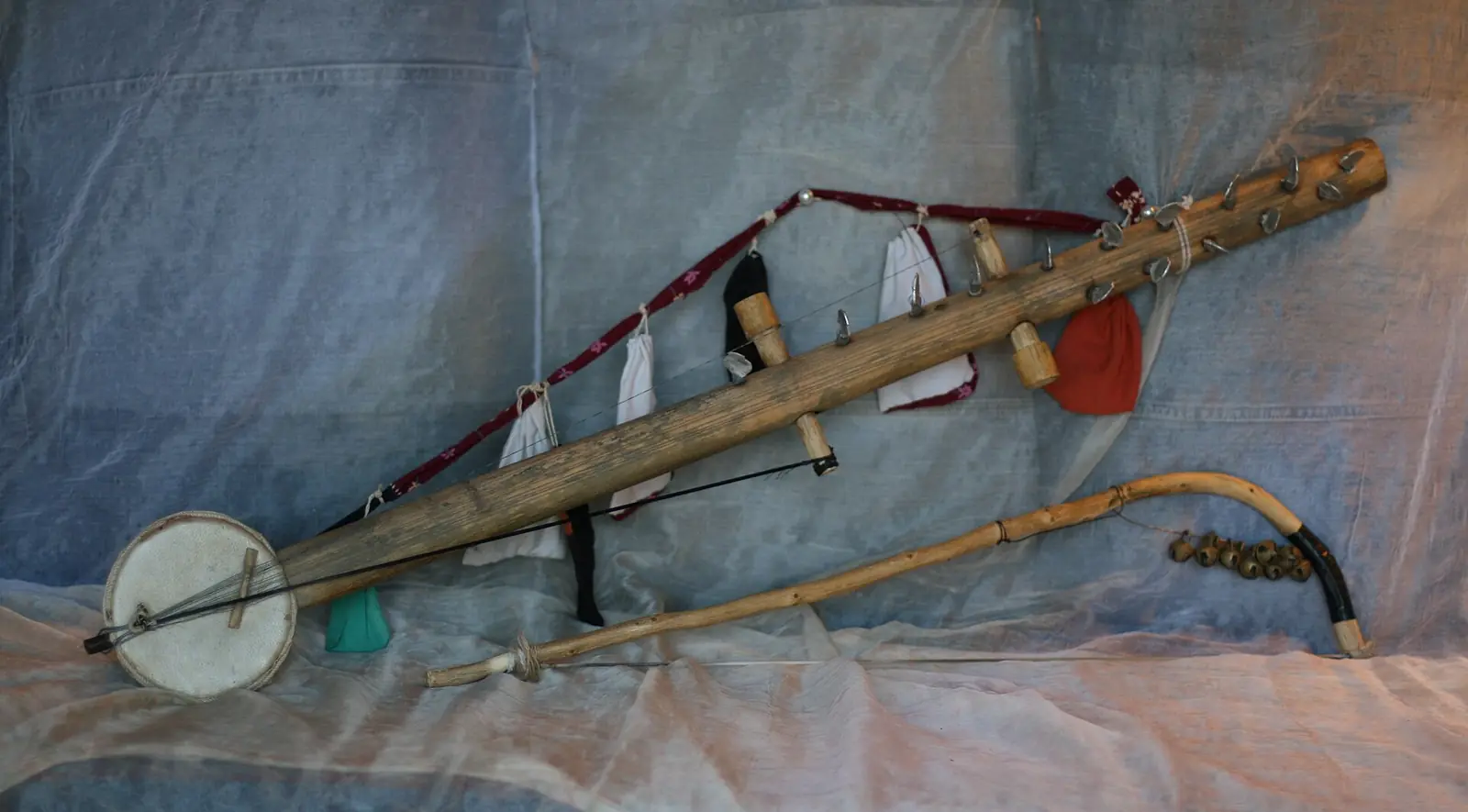
A bowed instrument of the Manganiyar singers of western Rajasthan, with a deep round body. Carved from mango wood with a skin face. Its low, resonant sound carries the Manganiyars’ songs across the desert.

Ravanahatha, Udaipurरावणहत्थाRavanahatha

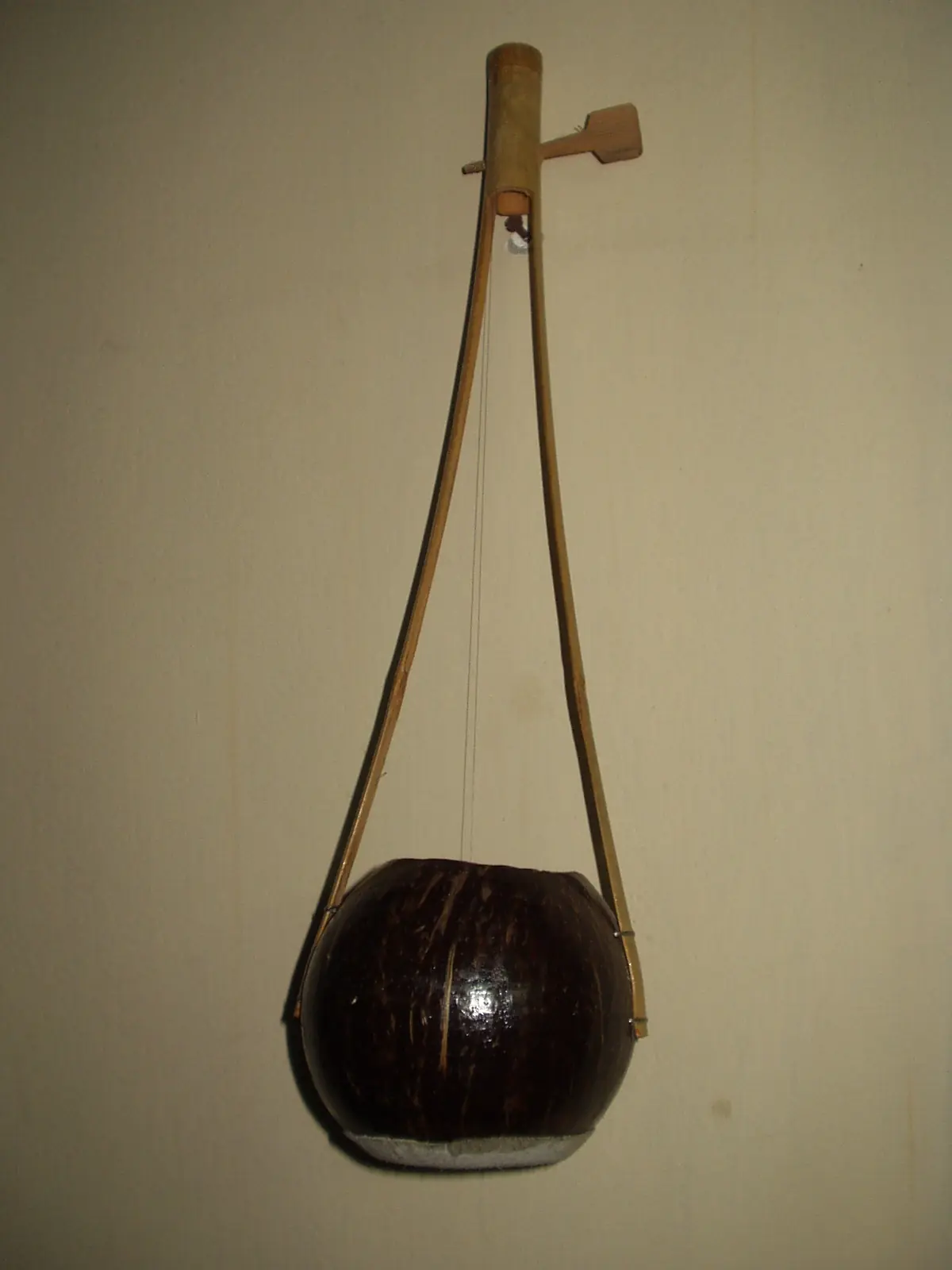
A simple bowed fiddle of bamboo and coconut shell, whose name links it to Ravana. Bhopa singers of Rajasthan play it while singing the epic of Pabuji before the painted phad scroll. Tradition says Ravana, a devotee of Shiva, played it.

Pena, ManipurपेनाPena

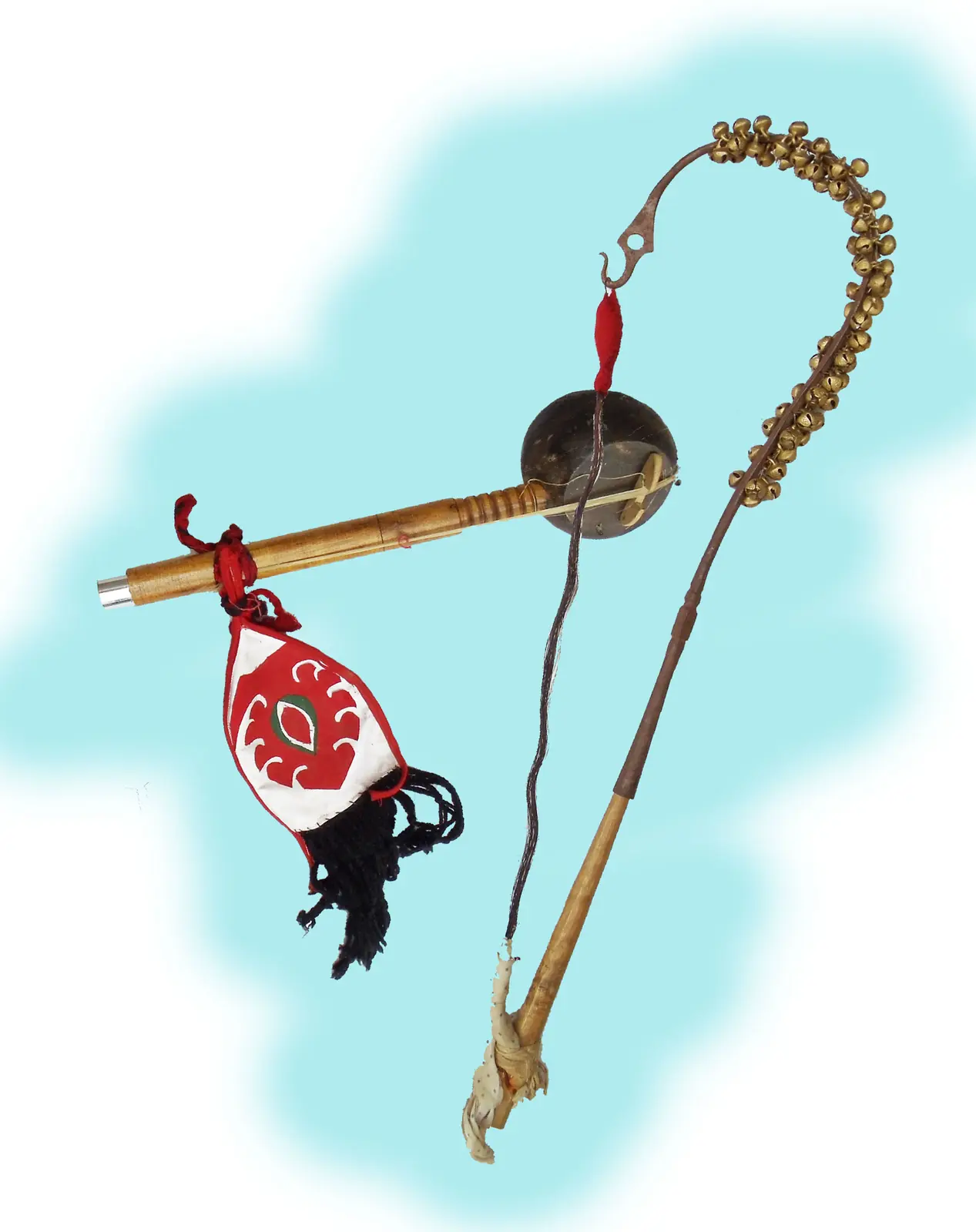
Manipur’s bowed instrument of coconut shell and bamboo, played at Lai Haraoba. A single string is bowed with a bow hung with small bells. It accompanies the old ritual songs of the Meitei.

Sushira · winds

BansuriबाँसुरीBansuri

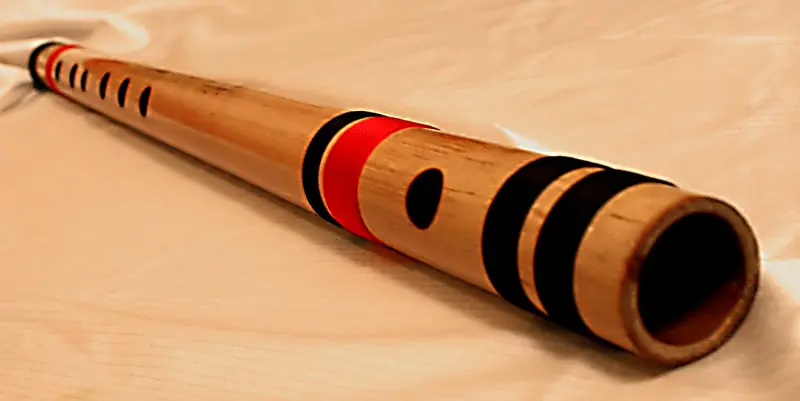
The bamboo flute of Shri Krishna, the murali or venu. Six or seven finger holes and no keys. Pannalal Ghosh made a longer bansuri for classical music; Pandit Hariprasad Chaurasia carried it to the world. In the south the venu is its Carnatic cousin.

ShehnaiशहनाईShehnai

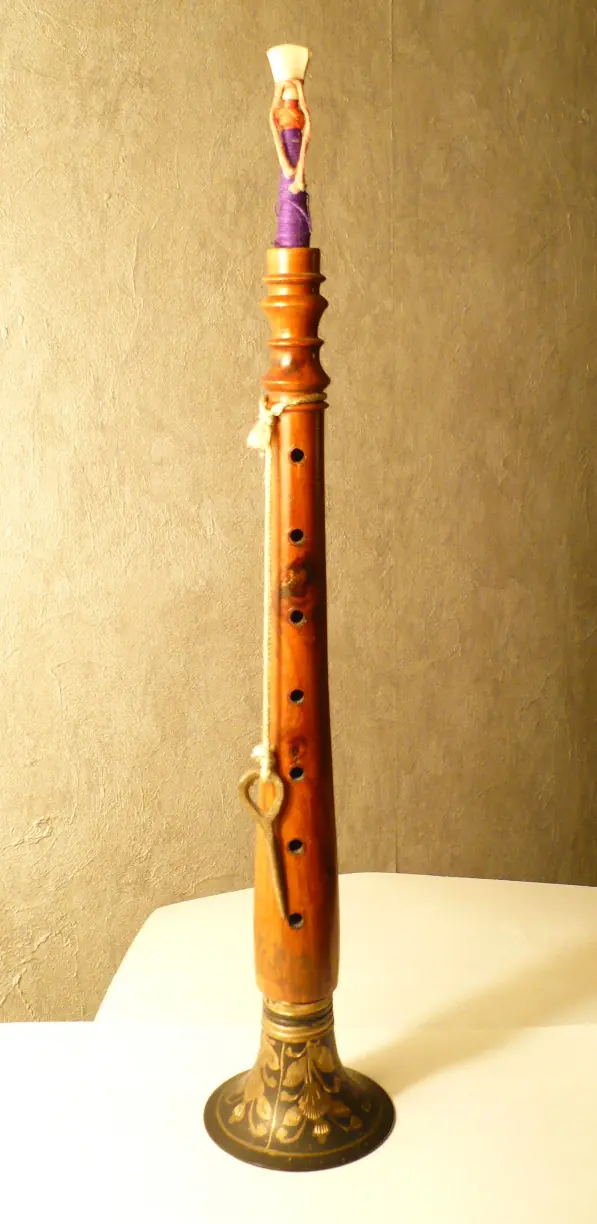
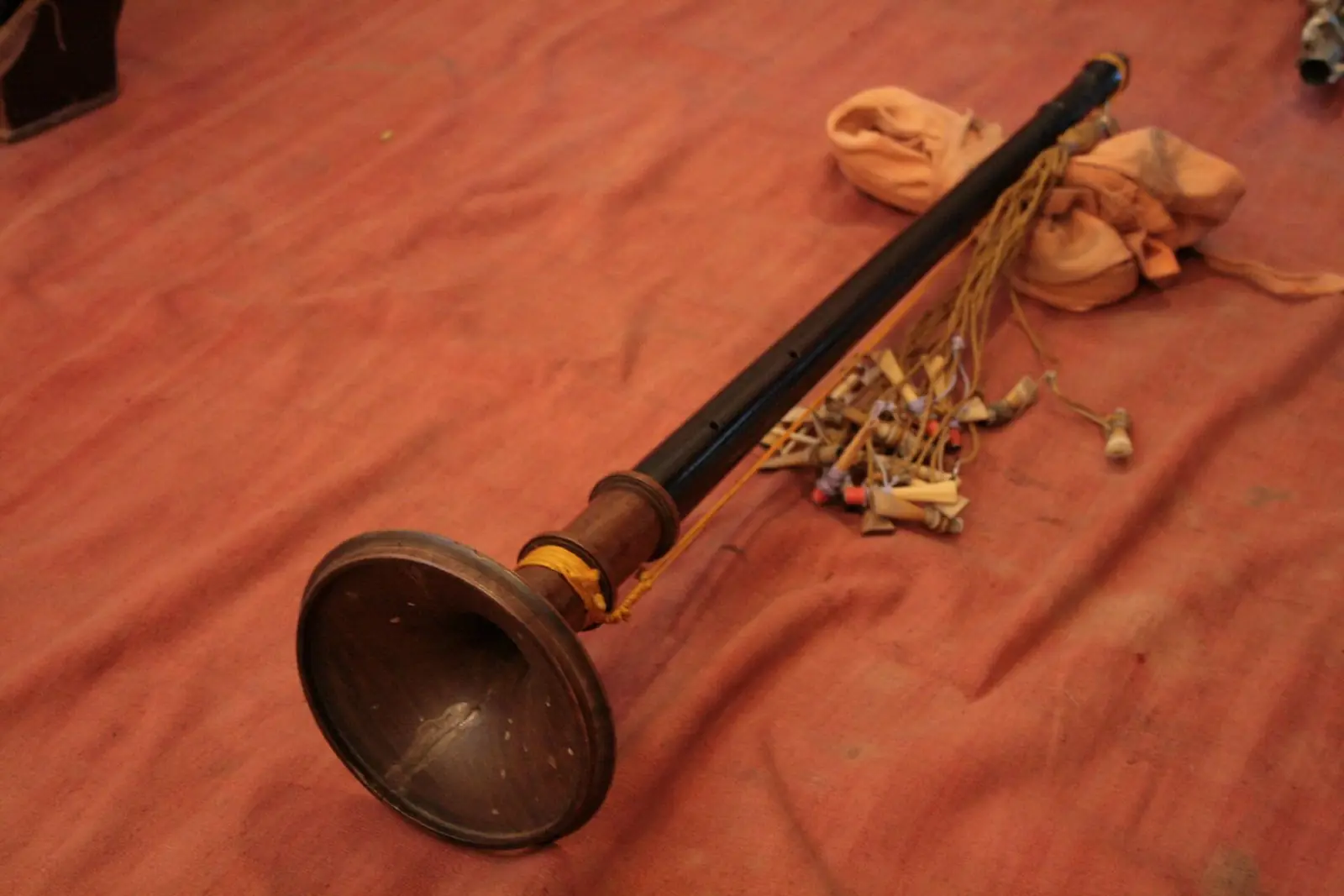
The double-reed pipe of weddings and temple gates, heard as a sign of good fortune. Ustad Bismillah Khan of Varanasi raised it to the concert stage and received the Bharat Ratna in 2001.

Nadaswaramनादस्वरम्Nadaswaram

The great double-reed pipe of South Indian temples, a mangala vadyam, auspicious instrument. Played with the thavil drum for temple rituals, processions and weddings. T. N. Rajarathinam Pillai was among its great masters.

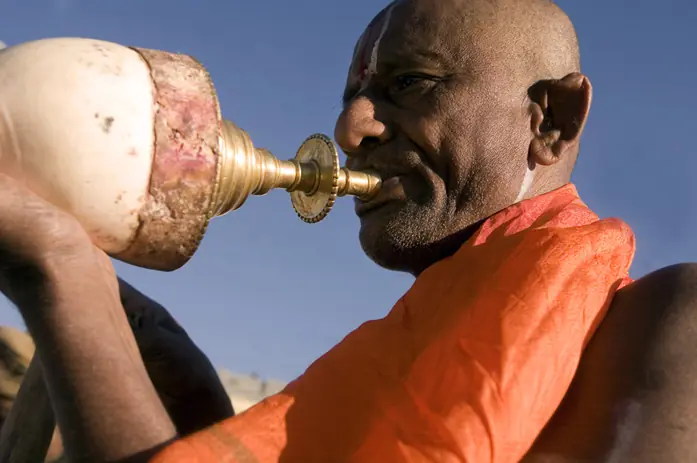
A priest blows the conch during puja, TirupatiशंखShankh

The conch blown at puja, held by Bhagwan Vishnu, and blown at Kurukshetra. The Bhagavad Gita (1.15) names the conches of the battle: Krishna blew Panchajanya, Arjuna blew Devadatta. In homes it is blown at the evening lamp and at aarti.

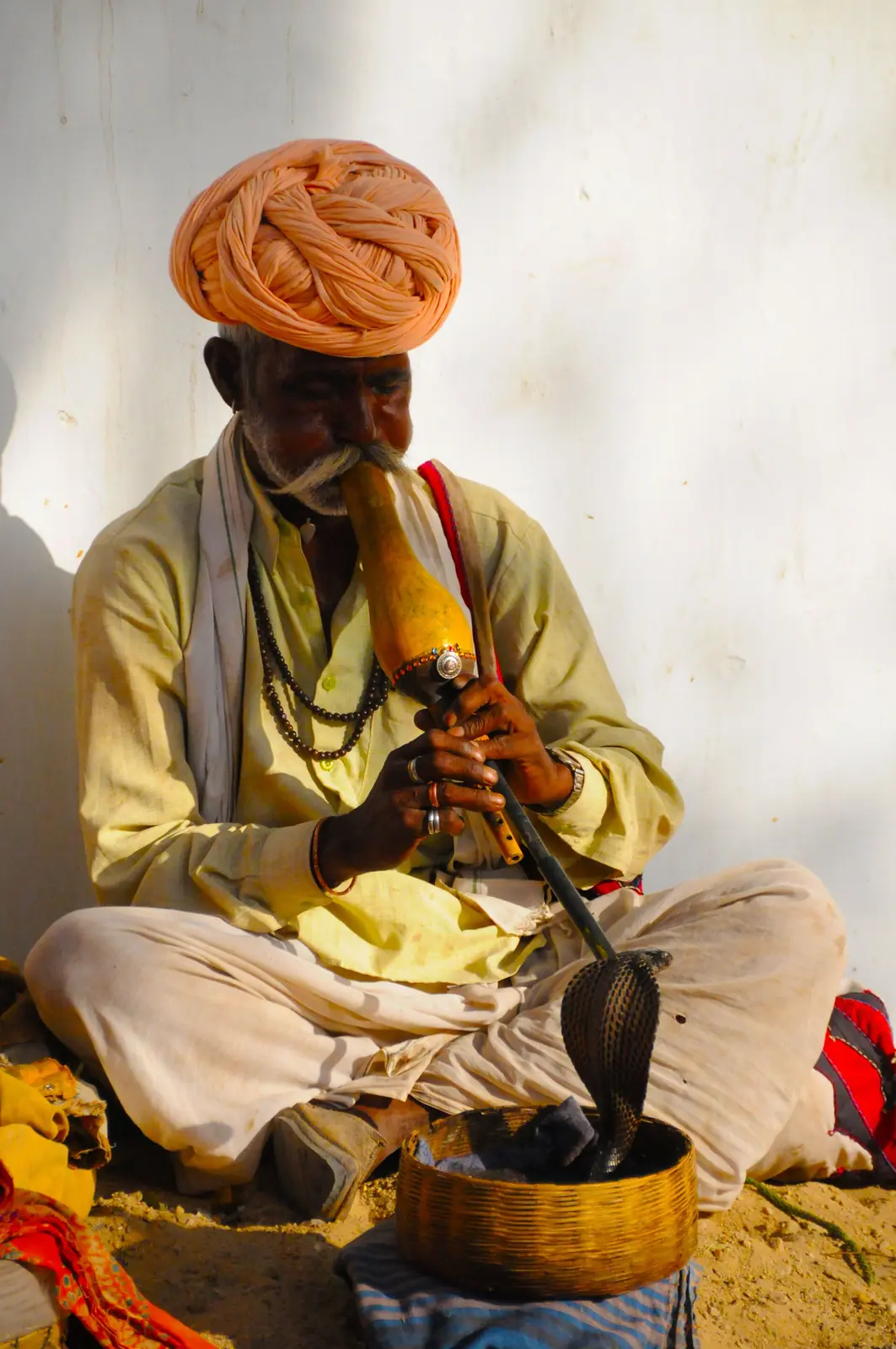
A snake charmer with his pungi, PushkarपुंगीPungi (Been)

The snake charmer’s pipe: a gourd wind chamber feeding two reed pipes, one a drone. Played with circular breathing so the sound never stops. It accompanies the Kalbelia dance of Rajasthan.

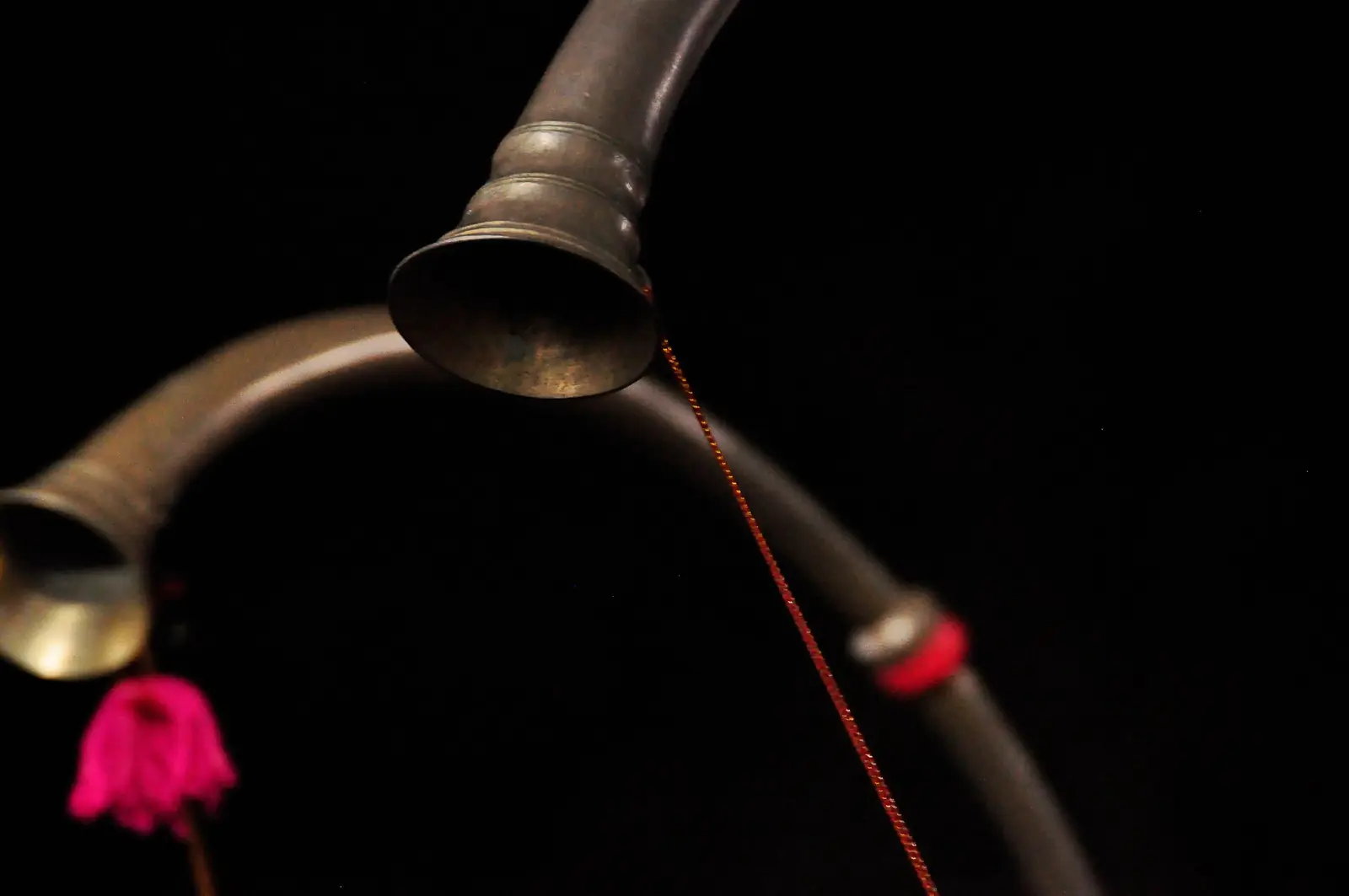
Kombuकोम्बुKombu

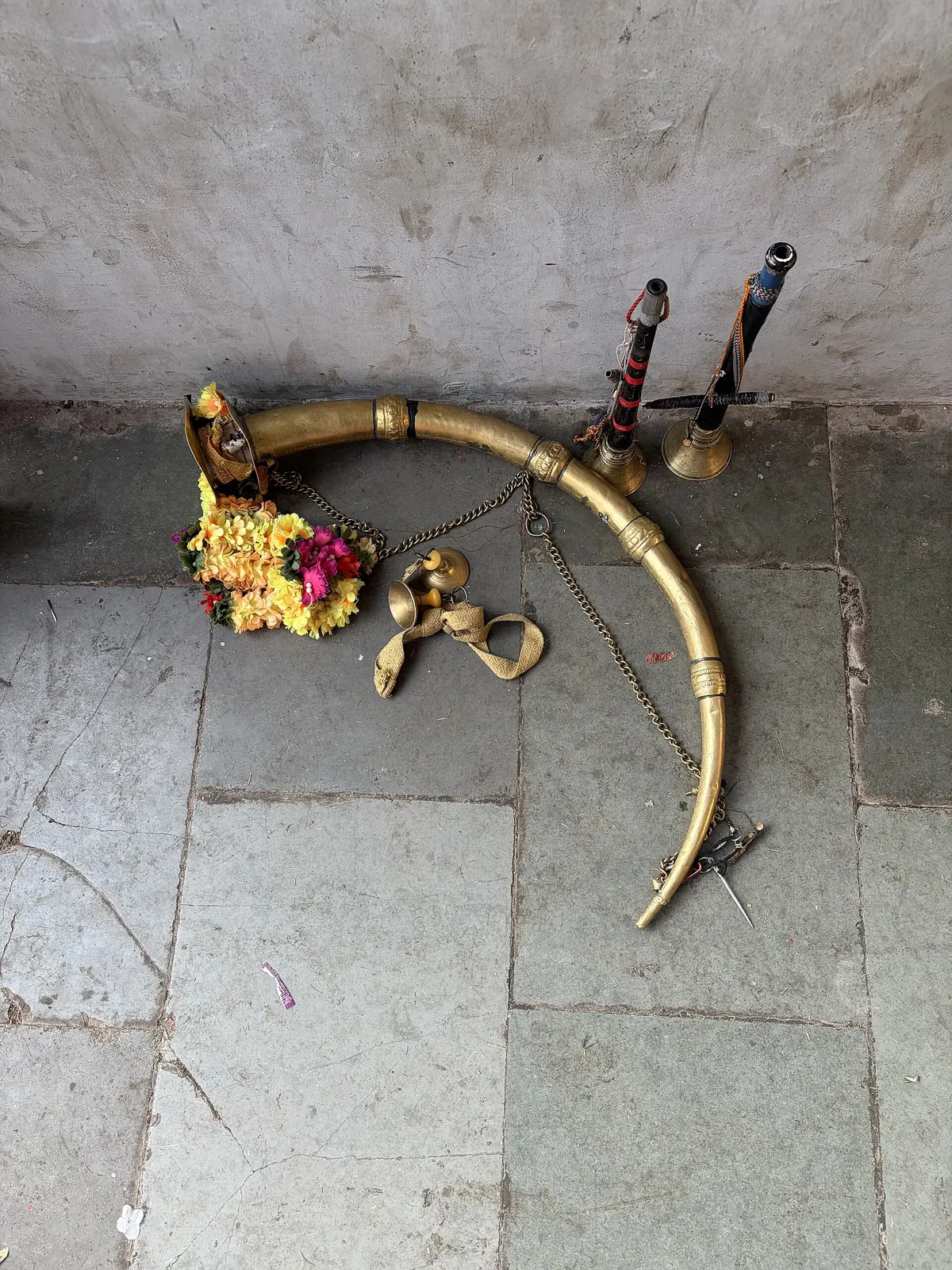
Kerala’s C-shaped brass horn, the one wind instrument in the panchavadyam orchestra. It plays few notes and is used to mark the rhythm’s cycles and climaxes in temple processions.

Tutari with sanai and tal, MaharashtraतुतारीTutari

A long curved trumpet of Maharashtra, blown to welcome and to announce. Its bright call opens processions, festivals and ceremonial welcomes.

Algoza, Arna Jharna Museumअलगोज़ाAlgoza

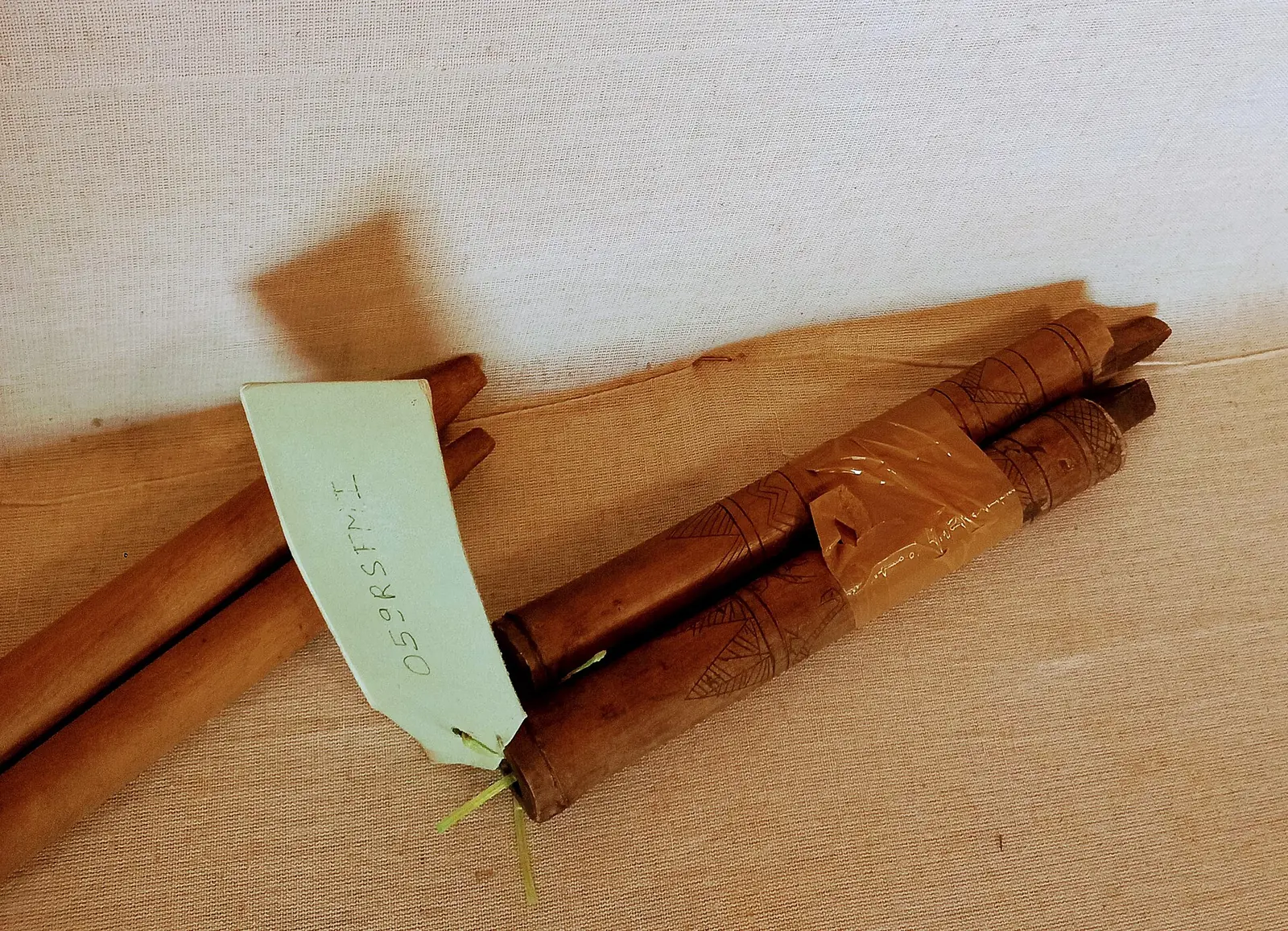
Two flutes played at once, one for the tune and one for the drone. Heard in the folk music of Rajasthan, Punjab and Kutch, played with continuous breath.

HarmoniumहारमोनियमHarmonium

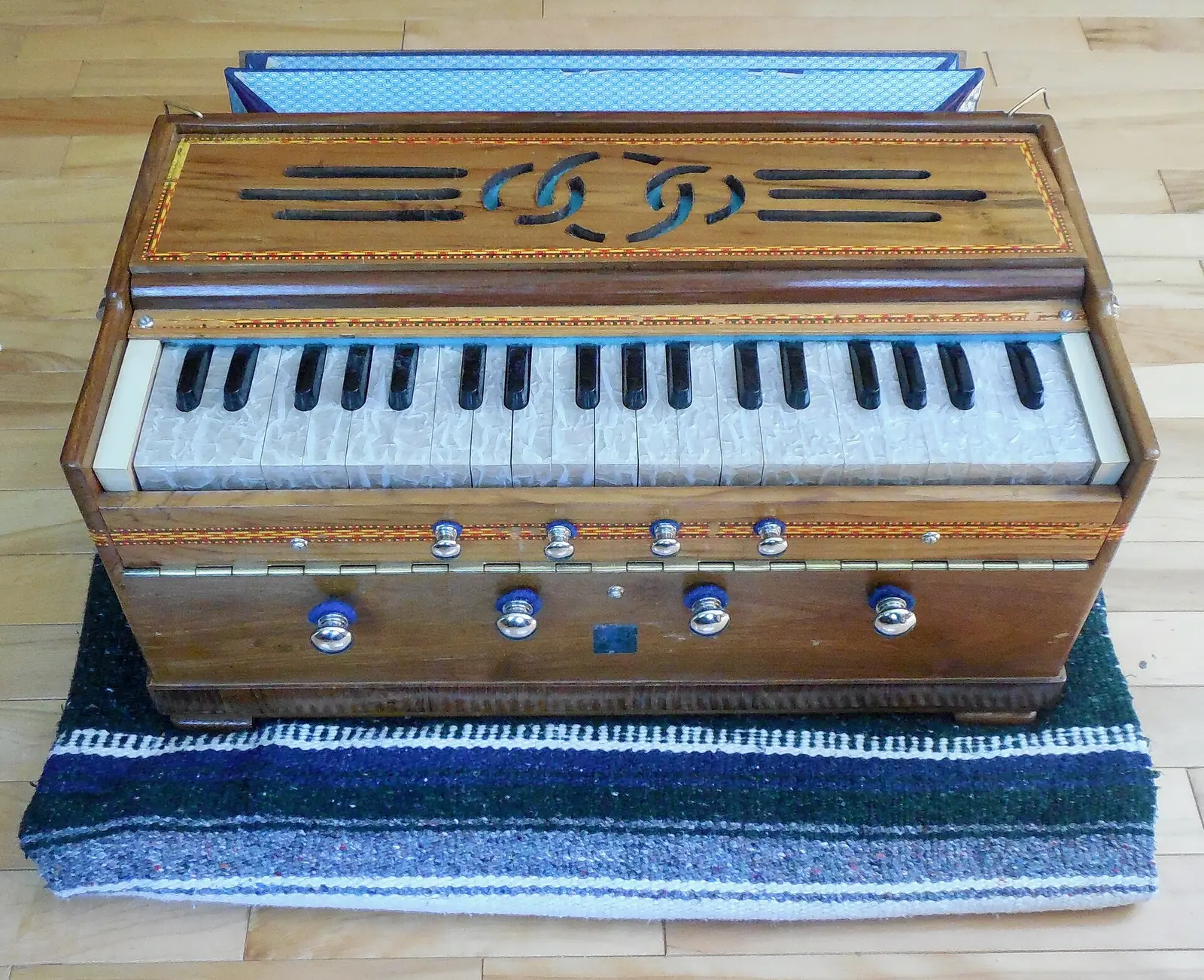
A hand-pumped reed organ that came with Europeans in the 19th century and settled into every bhajan. Air pushed by the bellows sounds metal reeds. Indian makers shrank it to sit on the floor. It now leads kirtan, bhajan, qawwali and much light classical singing.

Avanaddha · drums

Mridangam played at Bhoga Nandeeshwara templeमृदंगम्Mridangam

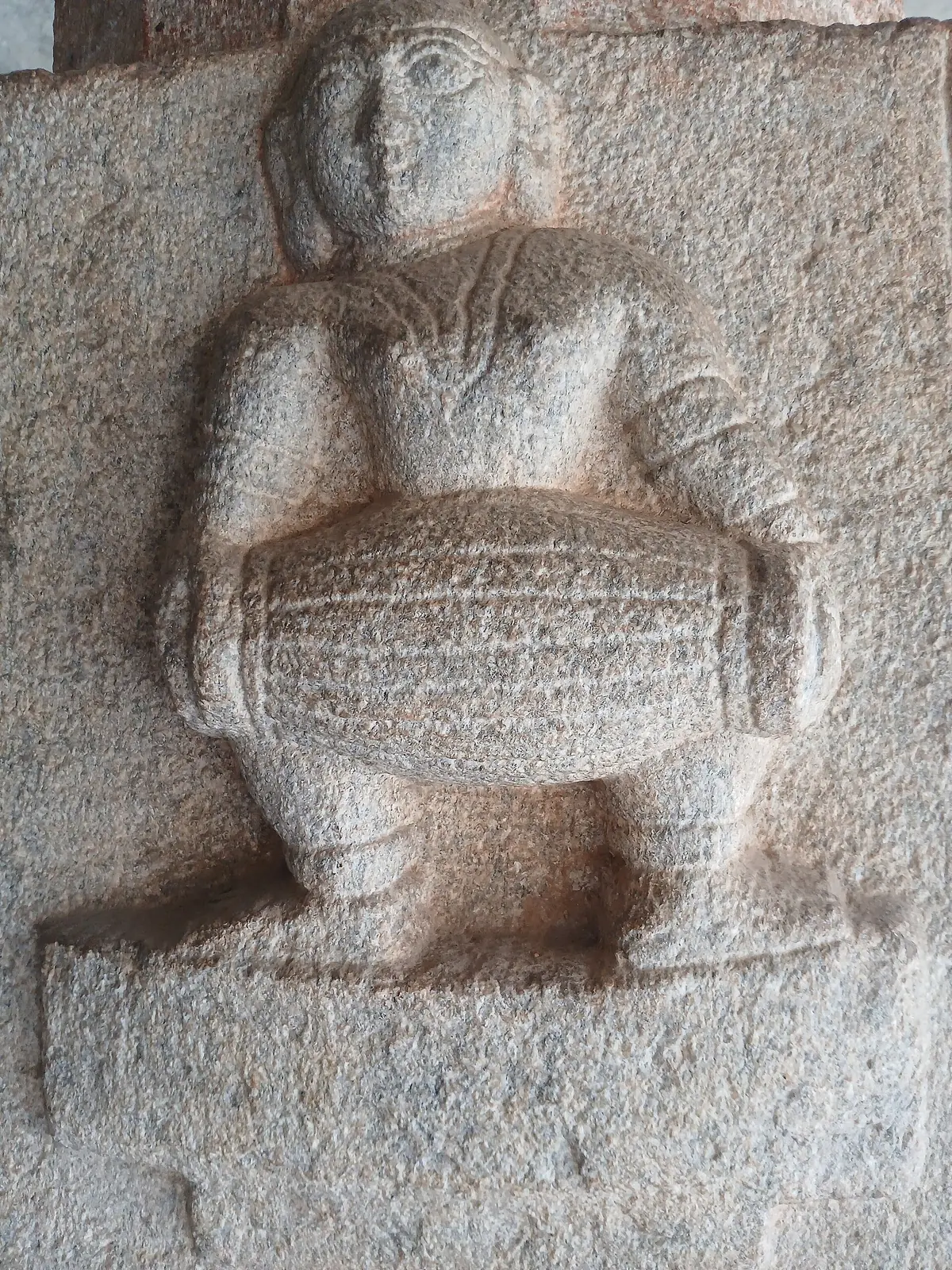
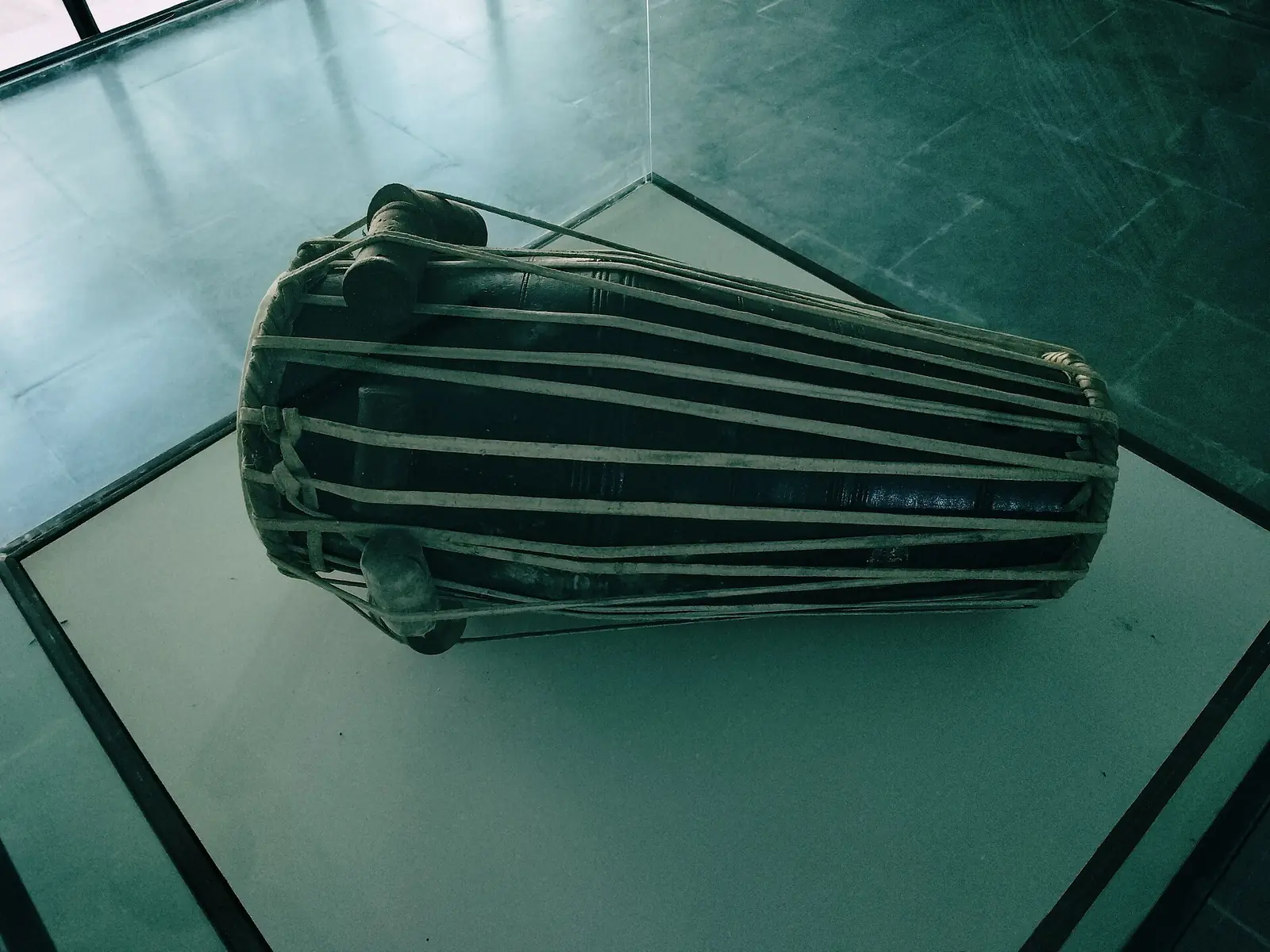
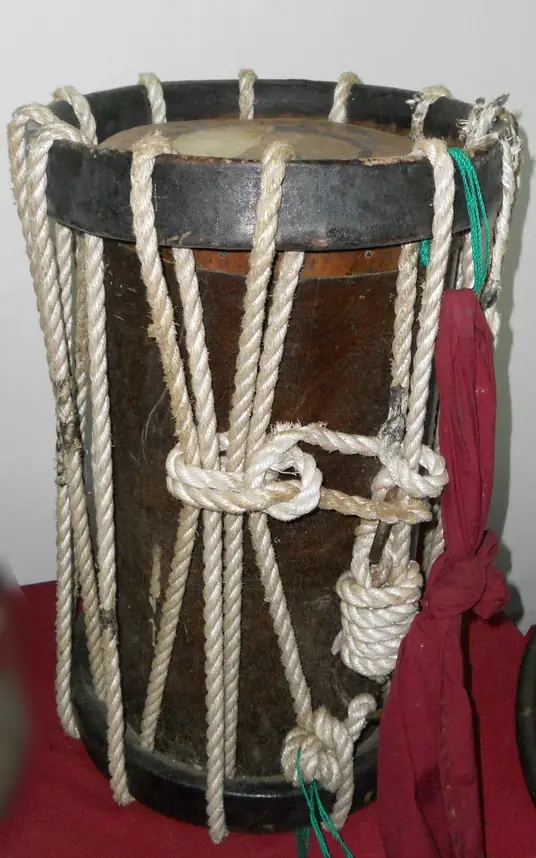
The double-headed drum of Carnatic music, its name from mrid, clay, of which the first ones were made. A barrel of jackfruit wood with two heads; the right head carries a black disc of paste for tone. Temple tradition shows Nandi playing the mridanga as Shiva dances.

PakhawajपखावजPakhawaj

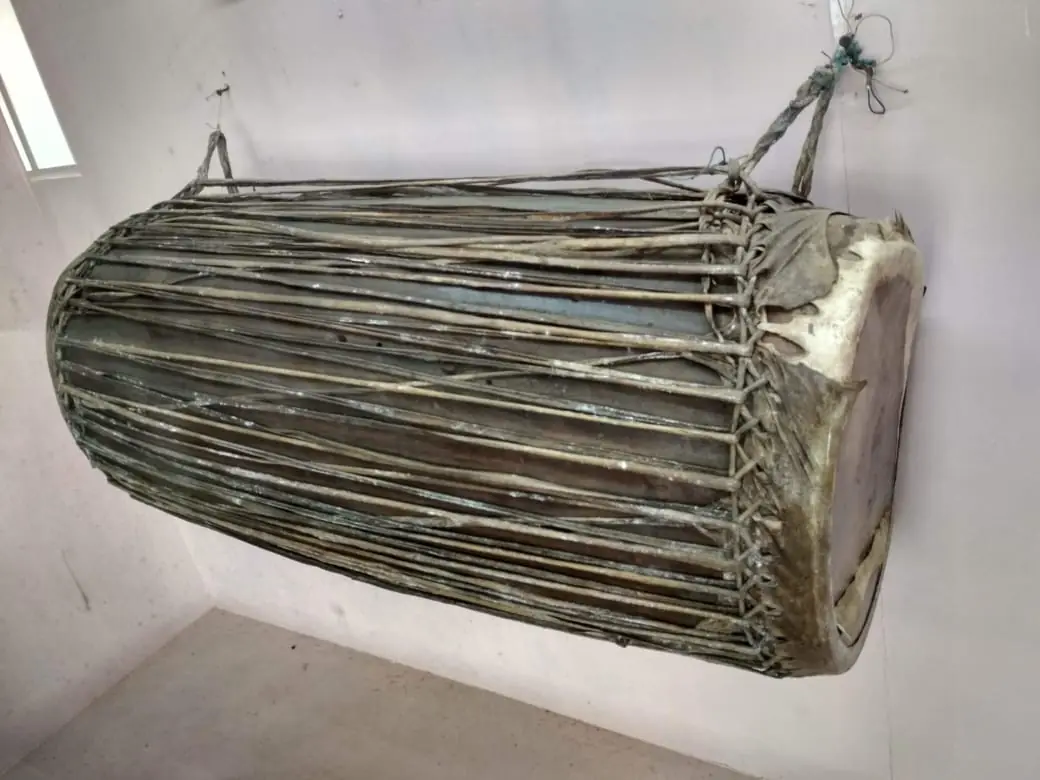
The barrel drum of Dhrupad and of temple music in the north, deep and resonant. The left head is loaded with wheat dough before playing for a low, open sound. It is the drum of haveli sangeet in Vaishnava temples and of Kathak’s heavy parans.

TablaतबलाTabla

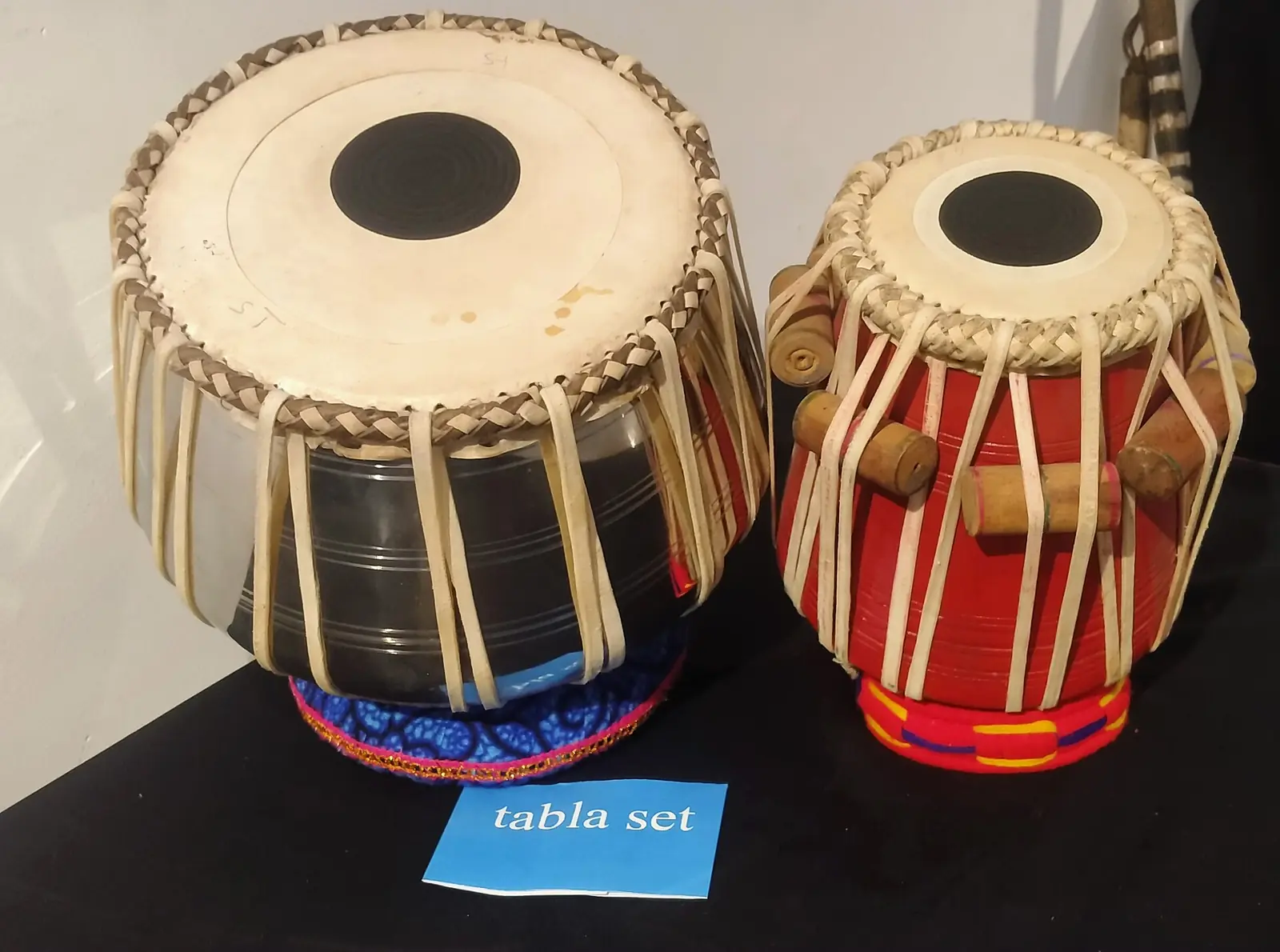
The pair of drums at the centre of Hindustani rhythm: the wooden dayan and the metal bayan. Each head carries the syahi, a black disc of iron paste that tunes it. The player speaks bols such as dha, dhin and na. Ustad Zakir Hussain was its best-known player.

DholakढोलकDholak

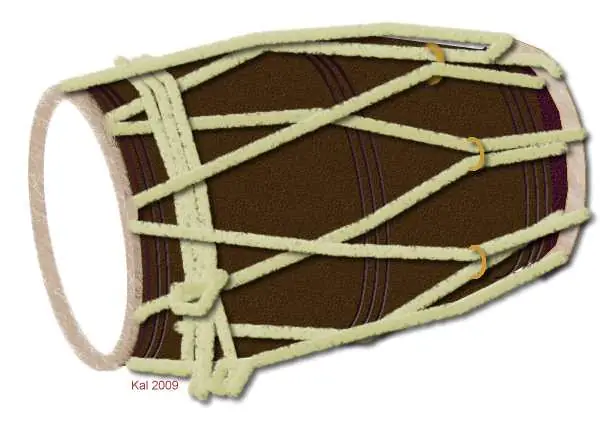
The everyday two-headed hand drum of bhajan, wedding songs and folk music. Played with the hands, sometimes on the lap. Women’s wedding songs in the north are sung around a dholak.

Dhol, GujaratढोलDhol

A big double-headed drum played with sticks at festivals, processions and garba nights. One side gives the bass, the other a sharp crack. Every region has its own: Gujarat’s for garba, Assam’s for Bihu, Punjab’s for bhangra.

DamaruडमरूDamaru

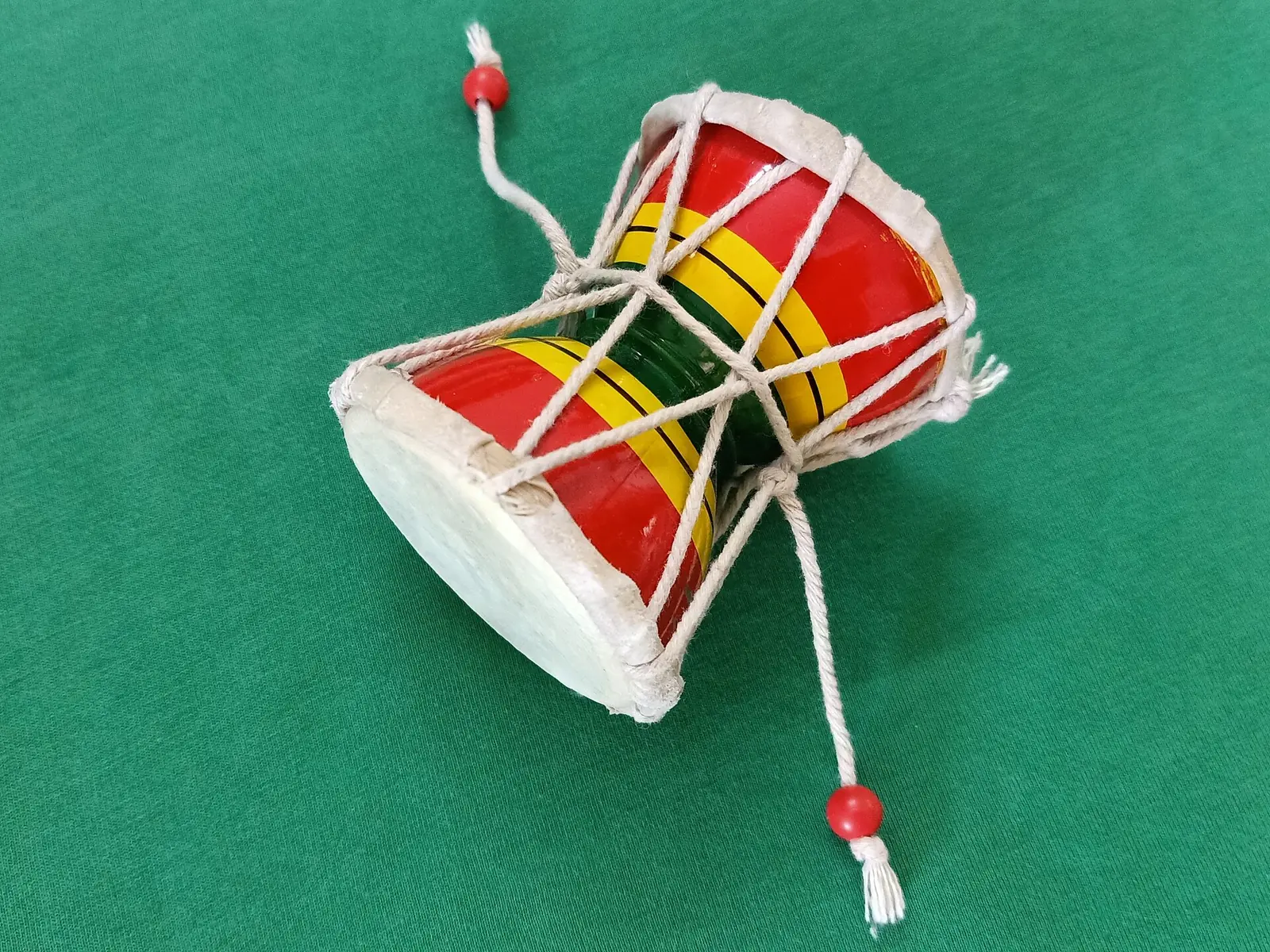
Bhagwan Shiva’s hourglass drum, sounded by two beads on strings as it is twisted. Tradition says the fourteen Maheshvara Sutras, the sound-list at the head of Panini’s grammar, came from fourteen beats of Shiva’s damaru at the end of his dance.

ChendaचेंडाChenda

Kerala’s cylindrical drum, played with curved sticks, loud enough to fill a temple festival. It leads the chenda melam of temple festivals and the thayambaka solo, and drives Kathakali and Theyyam.

ThavilतविलThavil

The barrel drum that always partners the nadaswaram in South Indian temples. One head is struck with a stick, the other with fingers capped in hard thimbles, for a bright, cracking sound.

Edakkaइडक्काEdakka

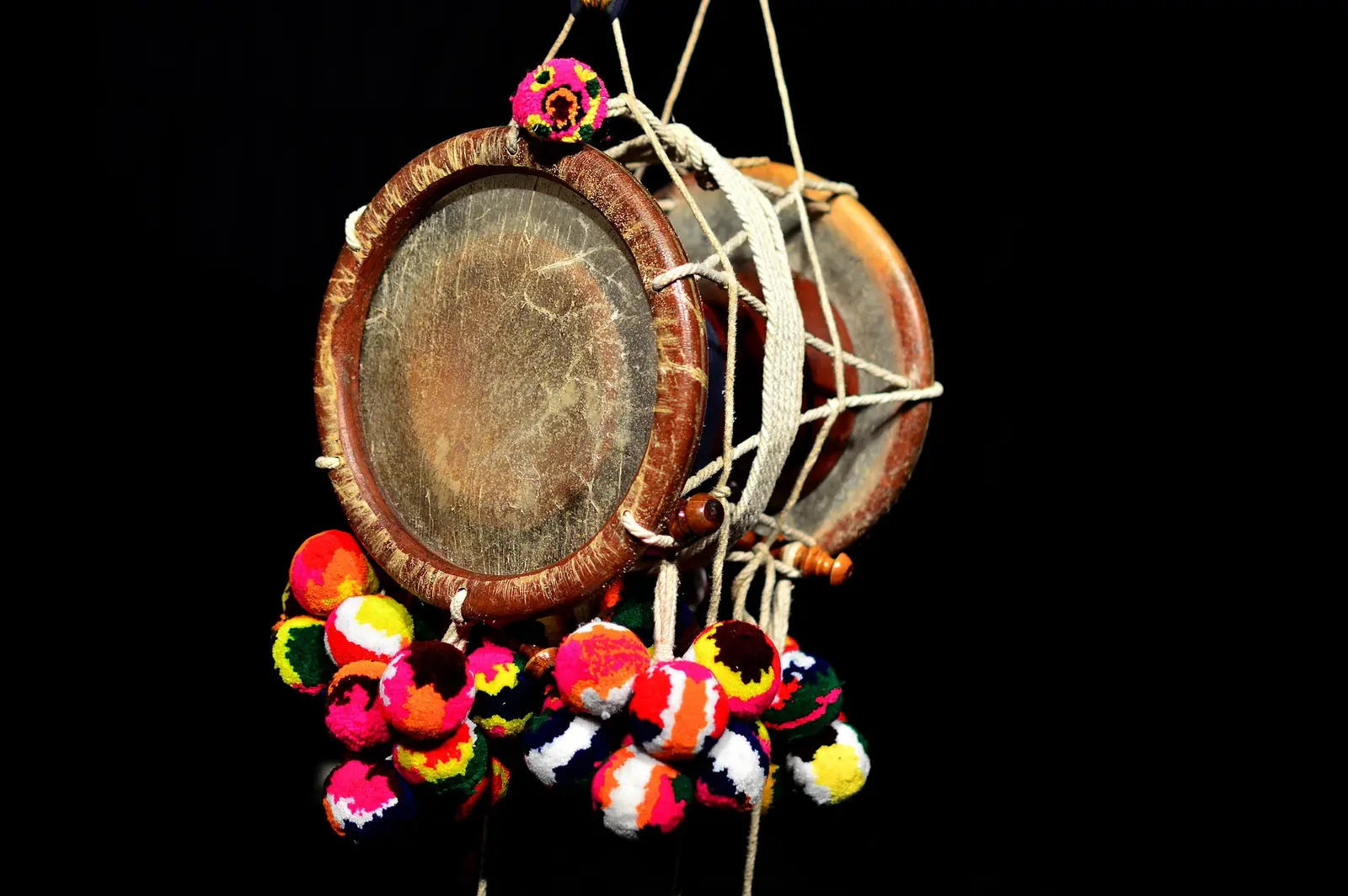
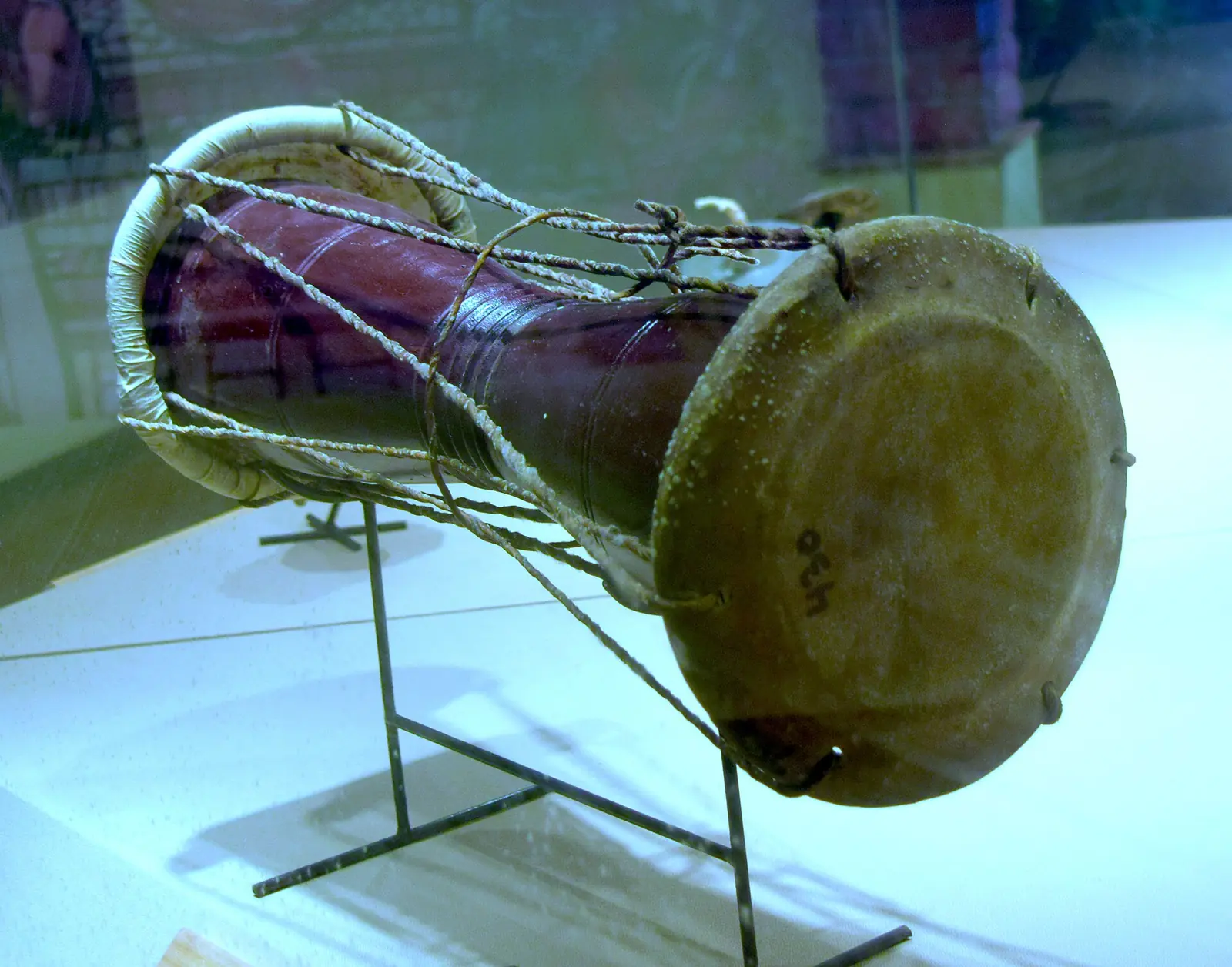
Kerala’s hourglass temple drum that can play melody, its pitch changed by squeezing the cords. Played with a stick, it accompanies sopana sangeetham, the songs sung at the temple steps. By custom it is treated as sacred and hung, not set on the floor.

KholखोलKhol

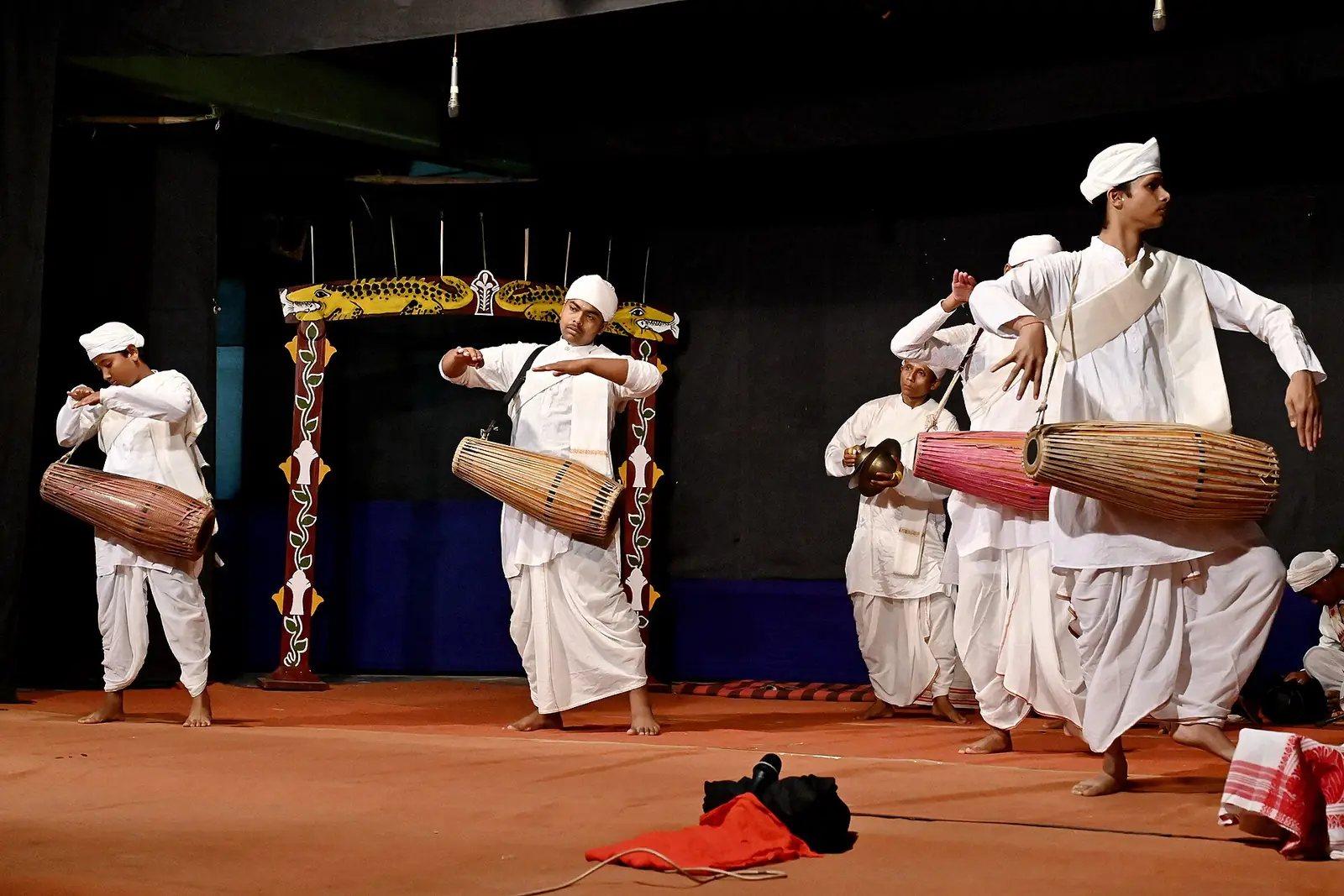
The clay-bodied drum of Bengal and Assam kirtan, the mridanga of Shri Chaitanya’s sankirtan. Its small right head and large left head give a bright, rolling beat. It is the drum of Gaudiya kirtan and of Sattriya.

Nagara, Rajasthanनगाड़ाNagara

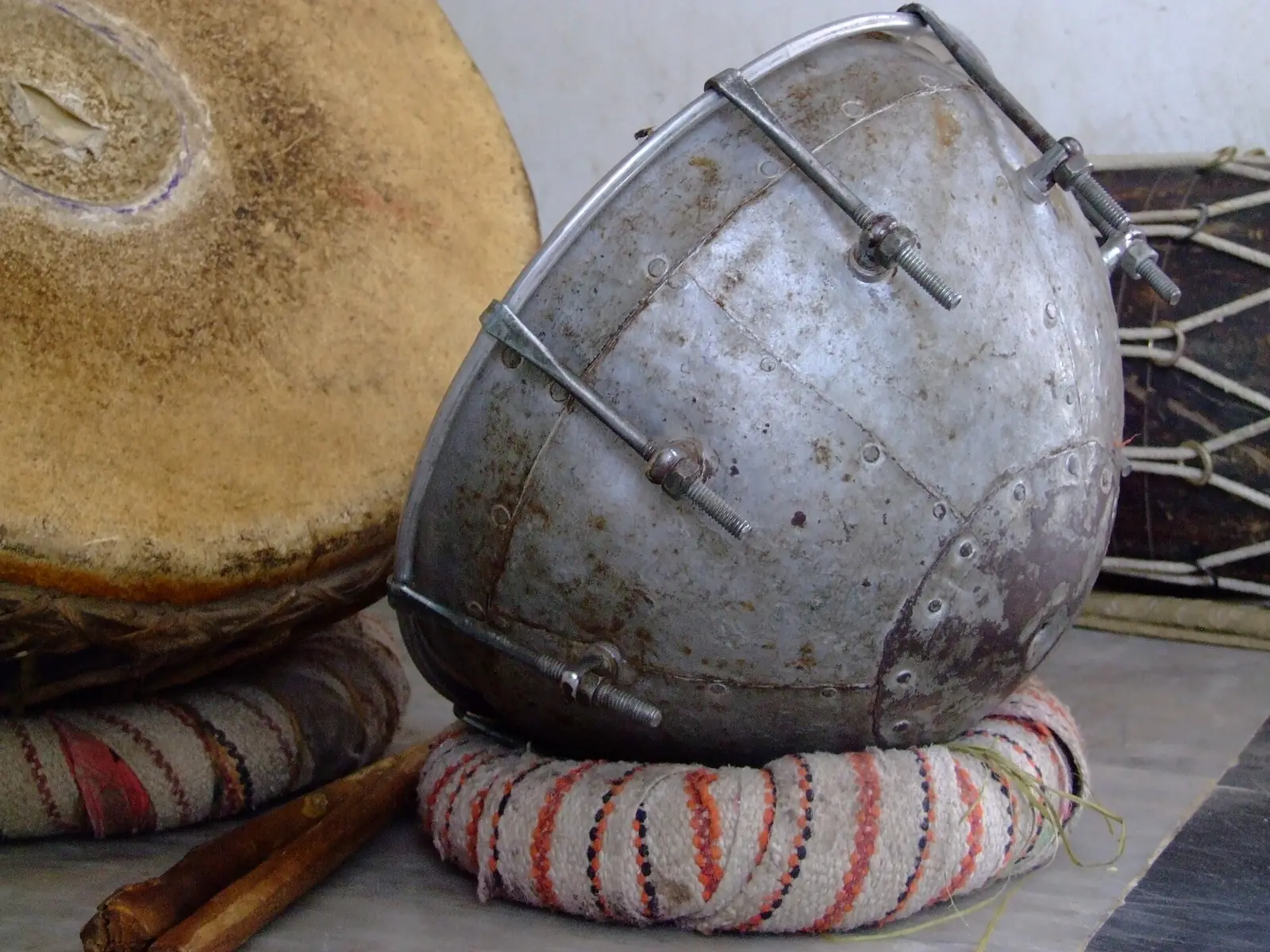
A pair of kettle drums beaten with sticks, sounded at temple gates and on festival days. Played in the naubat at temple and palace gates and in folk music of Rajasthan and Uttar Pradesh.

Dhakis at Durga PujaढाकDhak

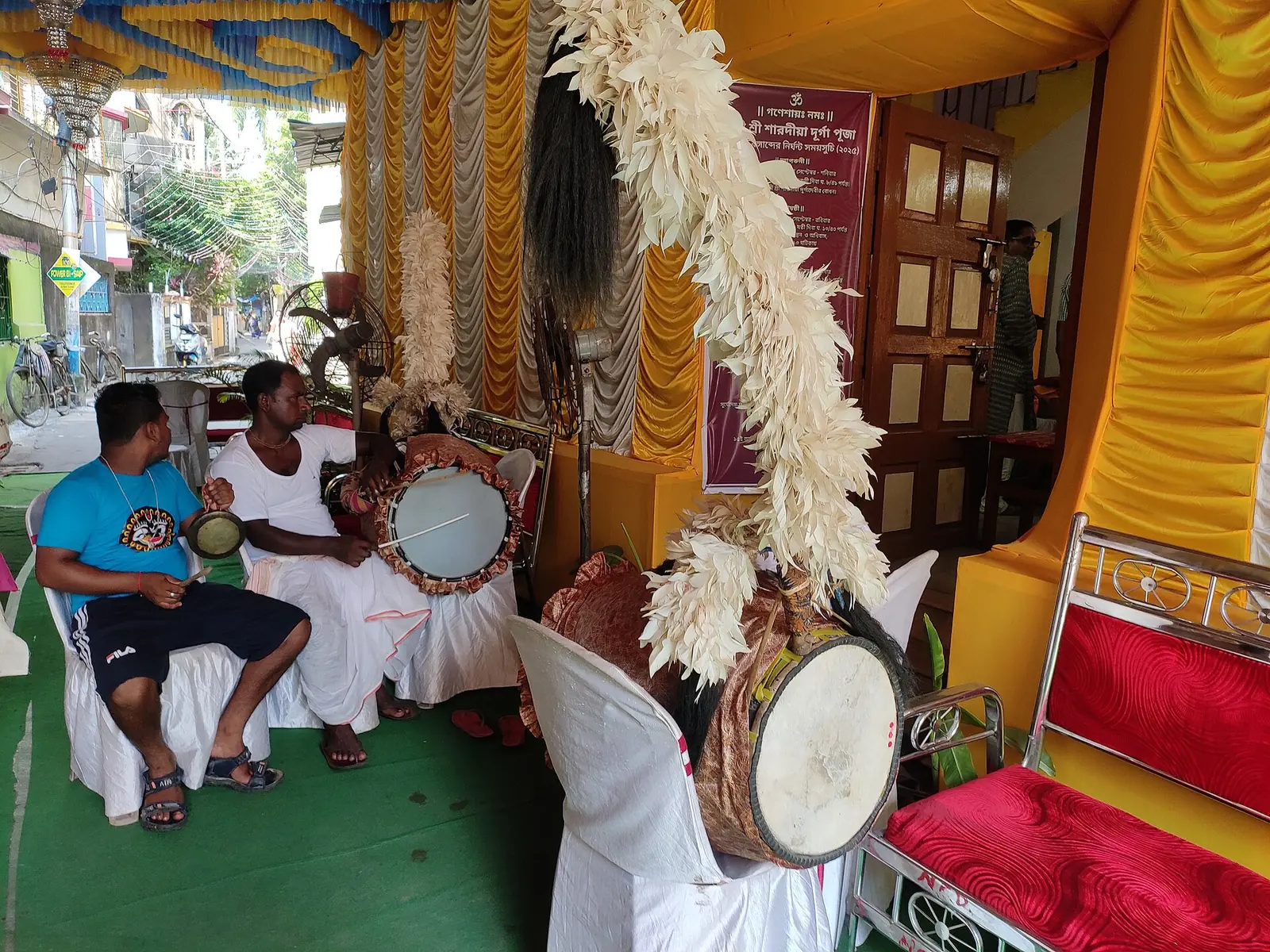
Bengal’s big drum of Durga Puja, hung from the shoulder and decorated with white plumes. The dhakis play through the five days of the Puja, at the aarti and the dhunuchi dance.

KanjiraकंजीराKanjira

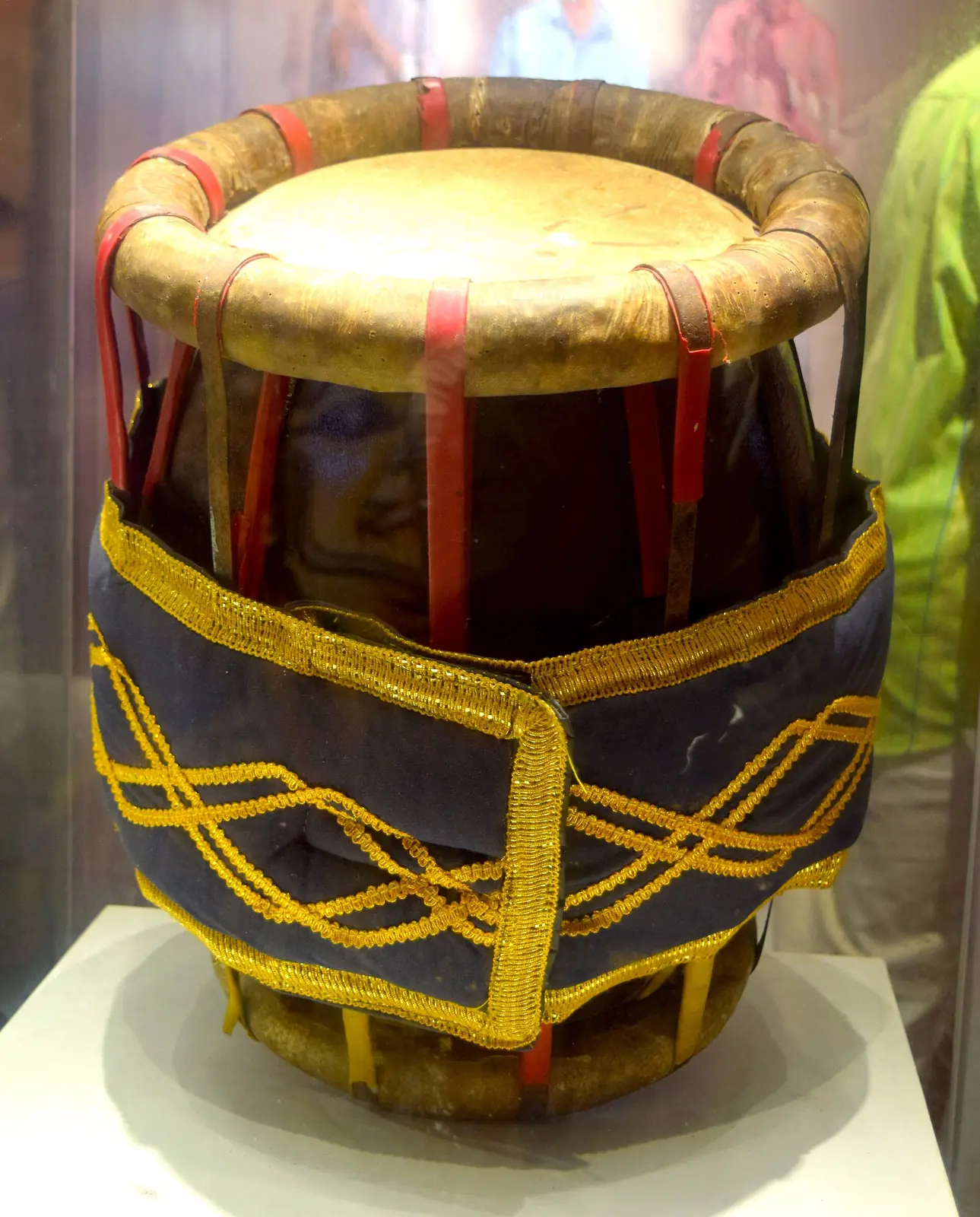
A small Carnatic frame drum with a single pair of jingles, tuned by moistening the skin. Played with one hand while the other holds and bends the pitch. It supports the mridangam in a concert.

Maddalamमद्दलम्Maddalam

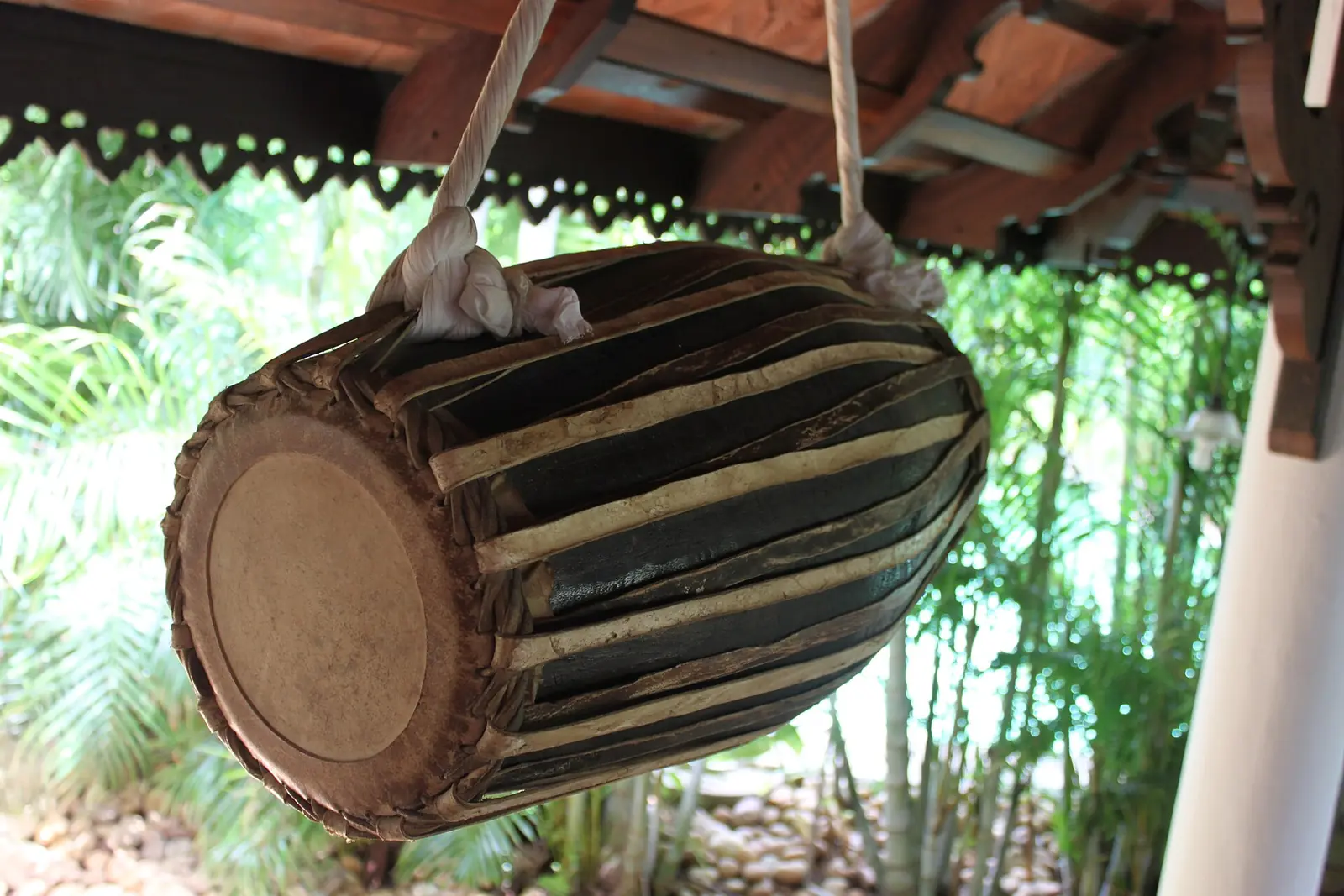
Kerala’s heavy barrel drum, played with the hands in panchavadyam and Kathakali. Tied at the waist and played on both heads. Kerala custom counts it as a deva vadyam, a divine instrument.

Mizhavu at AmbalappuzhaमिझावुMizhavu

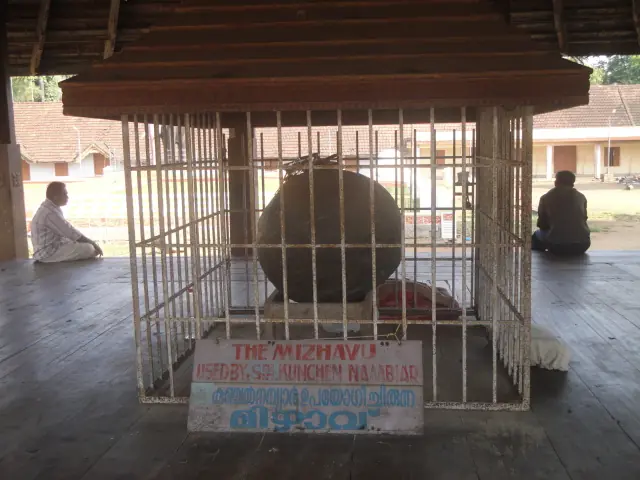
A great copper pot drum, set in a wooden frame, that accompanies Koodiyattam and Chakyar Koothu. Played with the palms by the Nambiars. It is treated as sacred and kept in the temple.

TimilaतिमिलाTimila

The hourglass drum that leads the panchavadyam orchestra of Kerala temples. Hung from the shoulder and played with the palms and fingers. The timila player at the centre sets the pace for the whole orchestra.

Pung cholom, ManipurपुंगPung

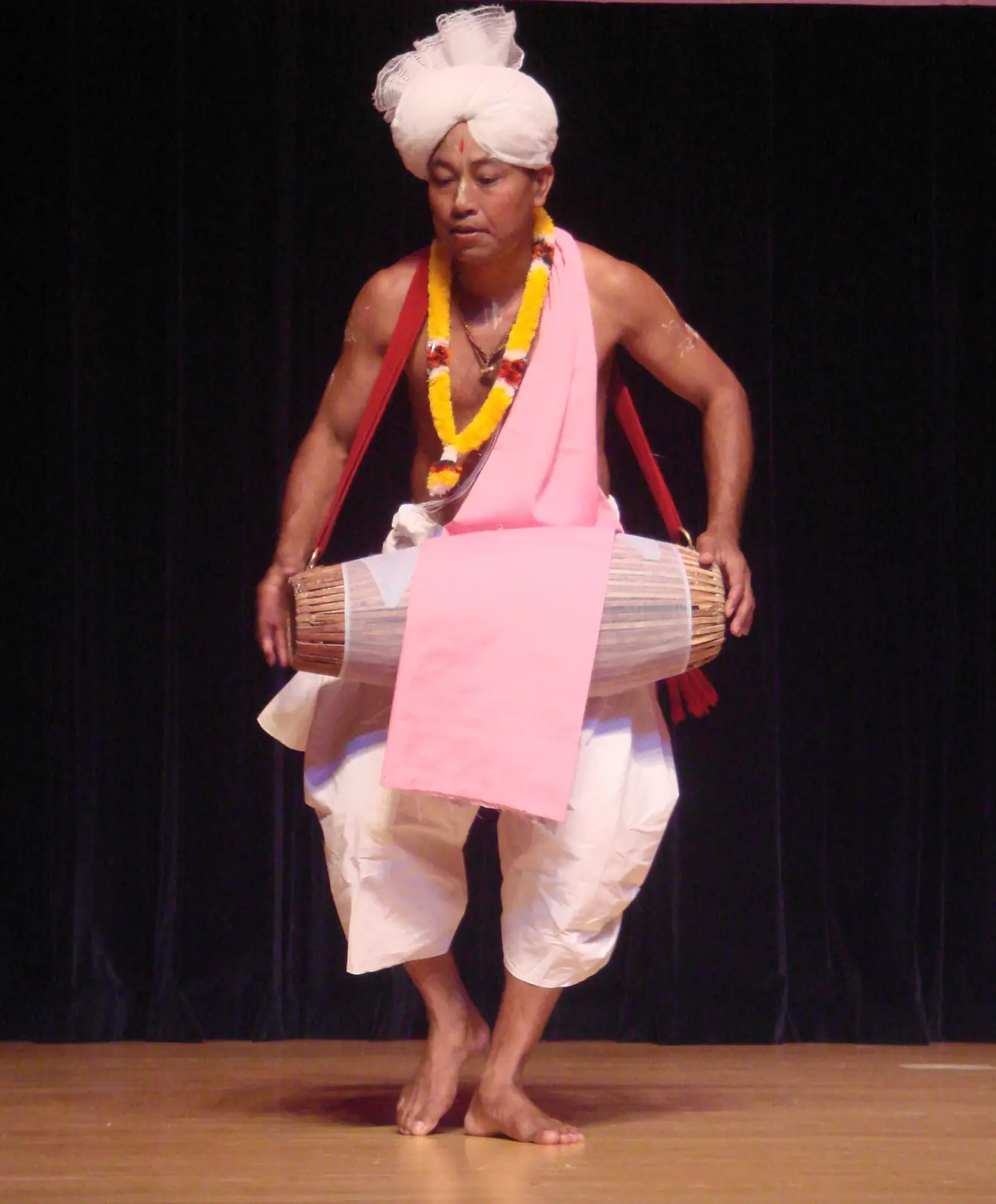
Manipur’s barrel drum, played by drummers who leap and spin in the pung cholom. It is the drum of Manipuri sankirtana and the Ras Lila. A whole dance, the pung cholom, is made around playing it.

Ghana · solid

Ghatamघटम्Ghatam

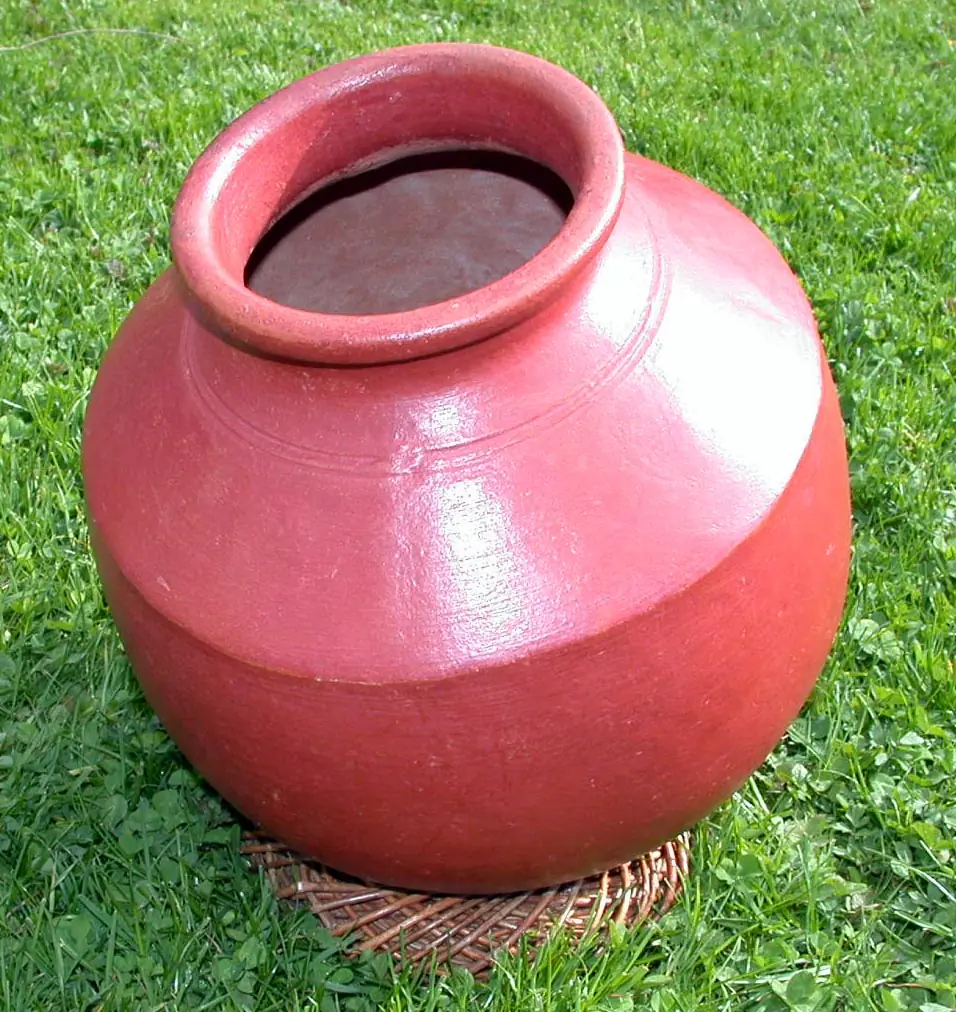
A clay pot played as a drum, struck with fingers, palms and nails in Carnatic concerts. The best ghatams come from Manamadurai in Tamil Nadu. The player can press the open mouth to the belly to deepen the tone. T. H. Vinayakram is its great name.

ManjiraमंजीराManjira

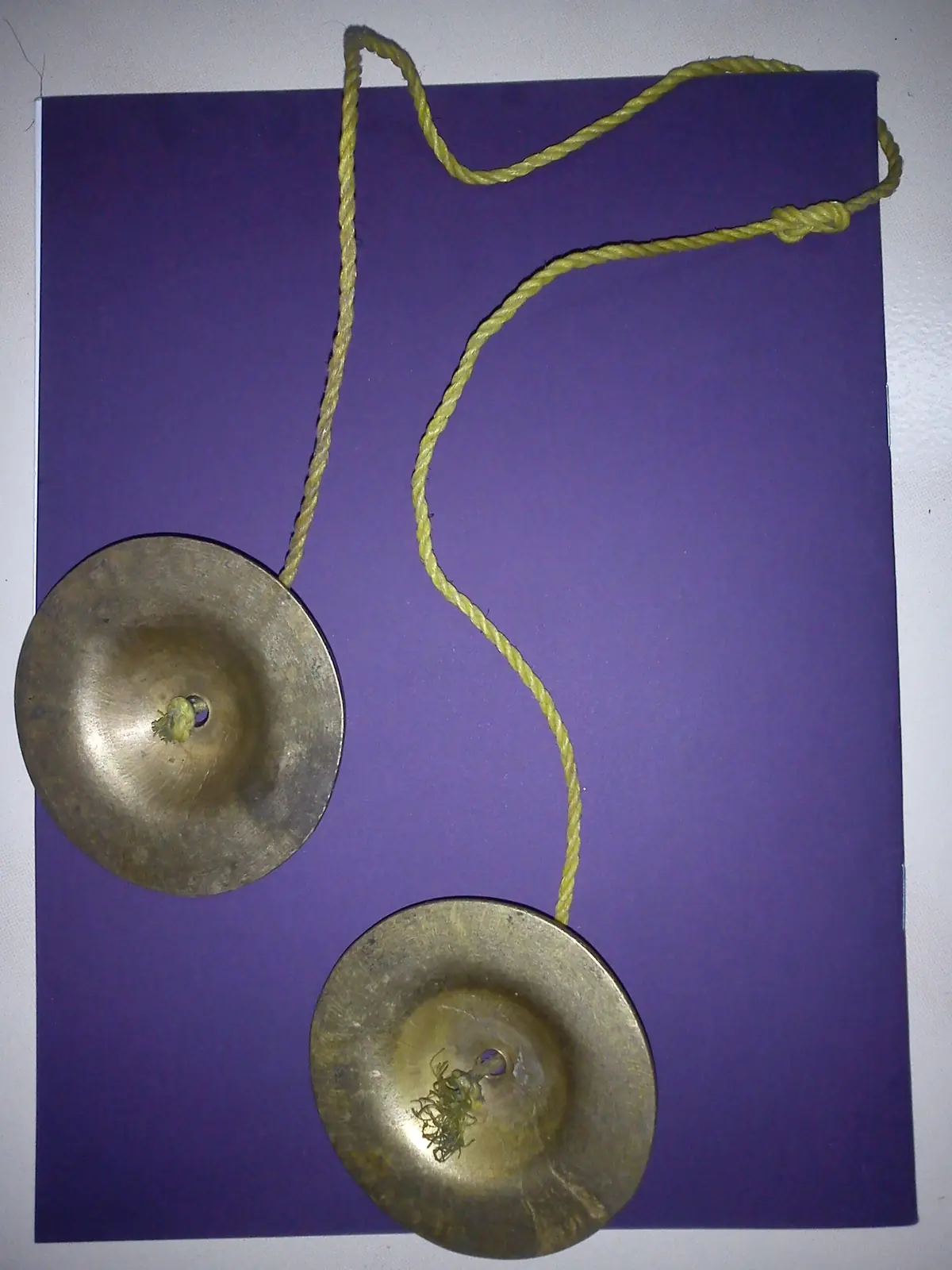
Small bronze cymbals tied with a cord, the beat of every bhajan and kirtan. Struck together, they mark the tala. In the south the larger version is called jalra or talam.

Playing the khartalकरतालKartal

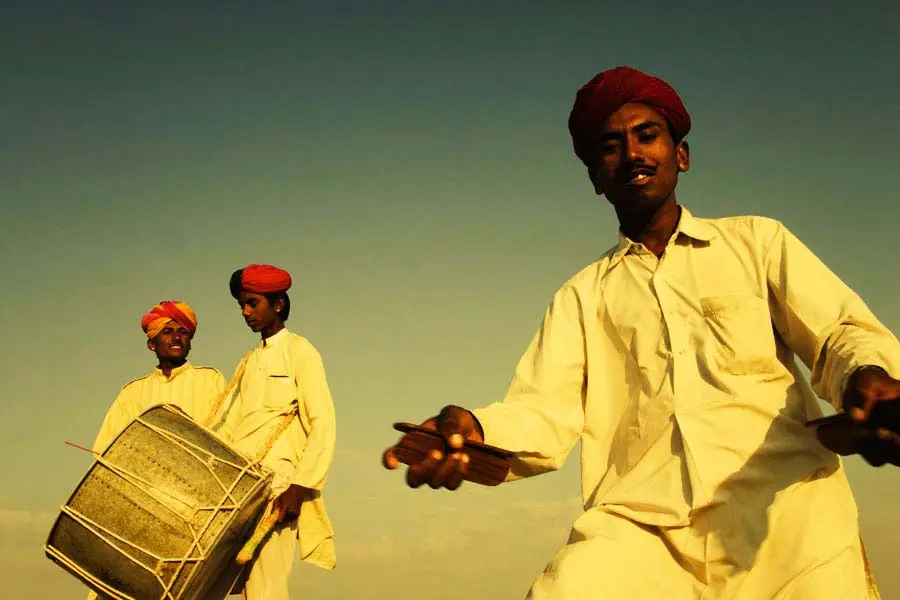
Wooden clappers of Rajasthan, held two in each hand and rattled at great speed. Manganiyar and Langa musicians make dazzling rhythms with them. In bhajan the name is also used for small cymbals.

A temple bell, Veerabhadra temple, LepakshiघंटाGhanta

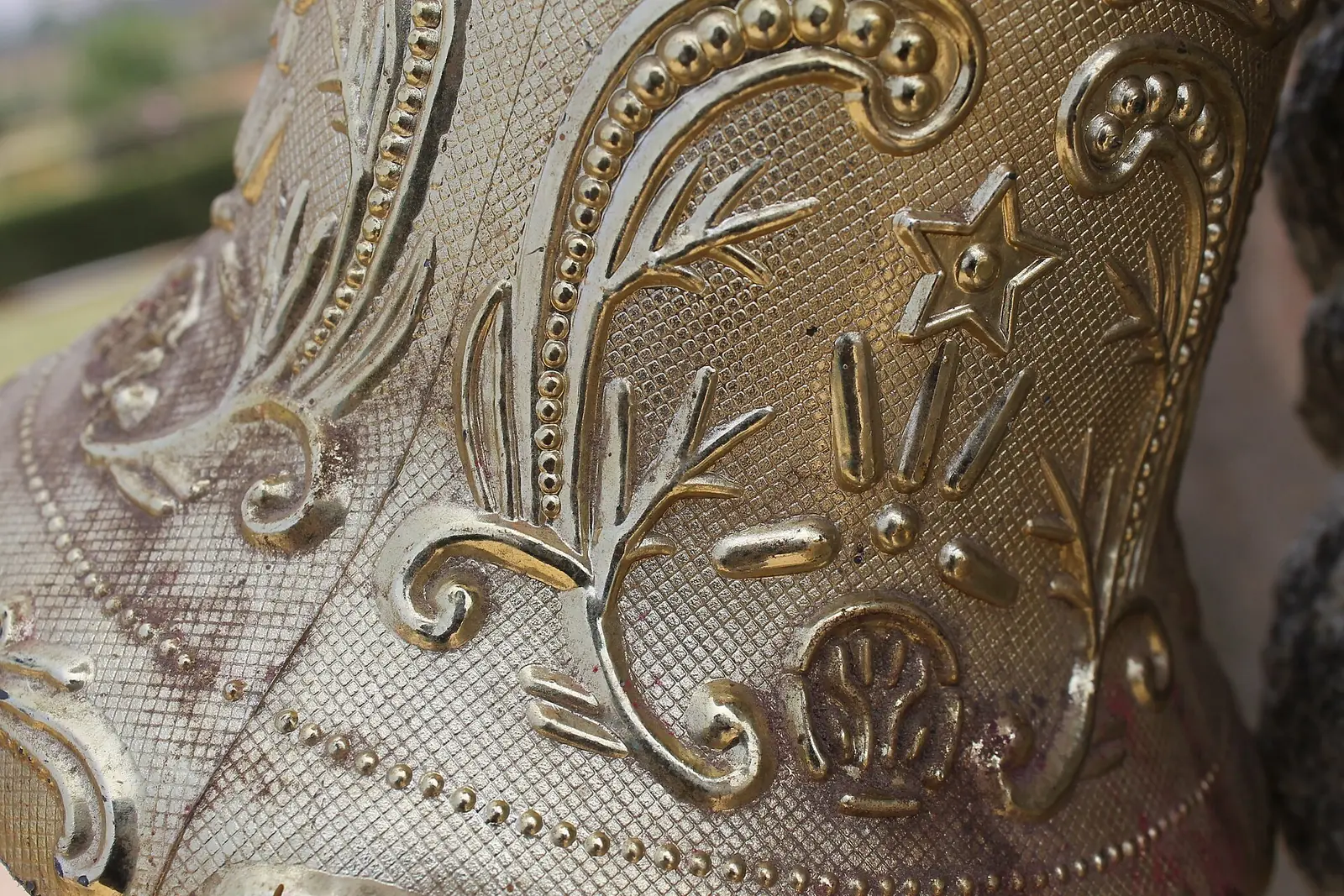
The temple bell, rung on entering, at aarti and as the offering is made. Large bells hang at the temple door for devotees to ring. The small hand bell, often crowned with Garuda or Nandi, is rung by the priest during puja.

JaltarangजलतरंगJaltarang

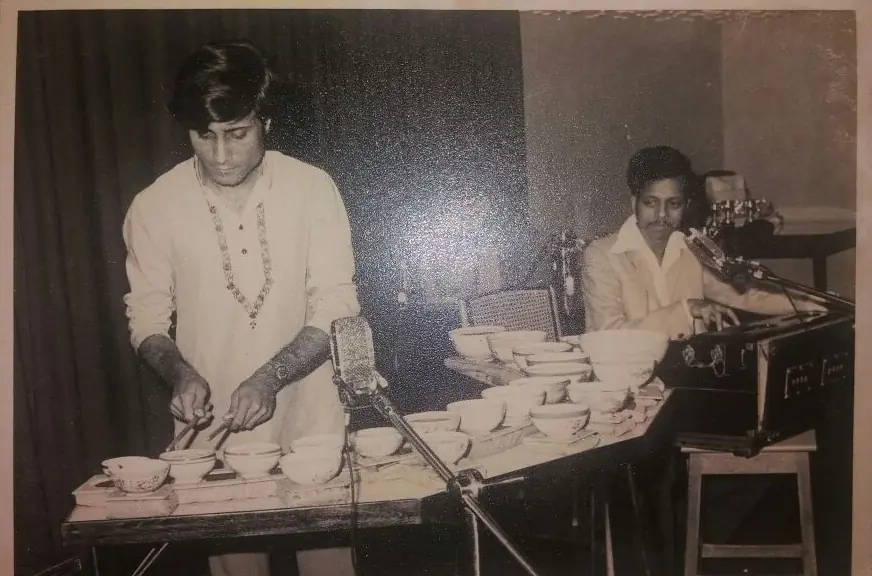
A half-circle of porcelain bowls filled with water to different levels, struck with light sticks. The water sets the pitch of each bowl. Ripples on the surface give its notes a soft wavering.

MorsingमोरसिंगMorsing

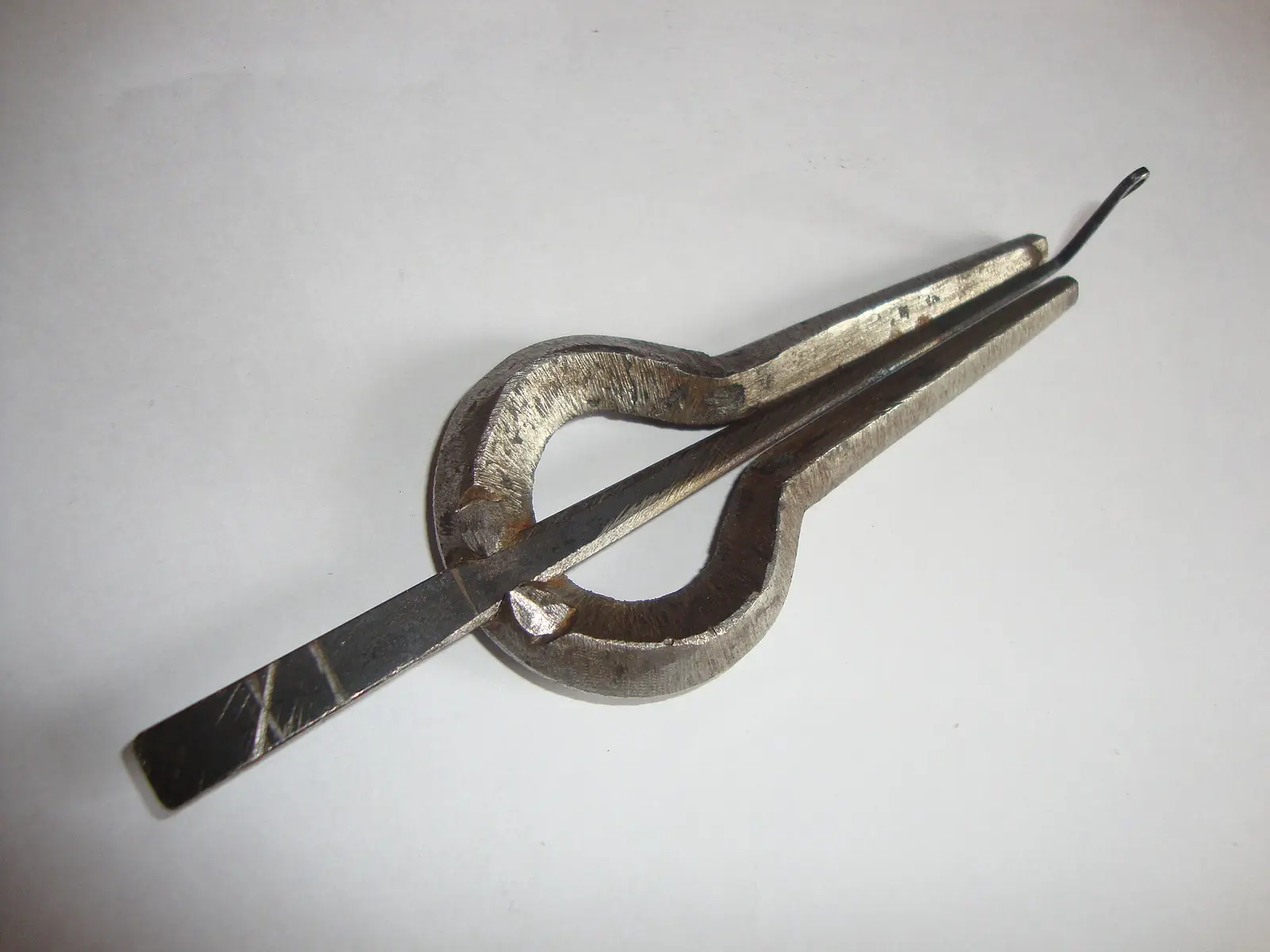
A steel jaw harp held between the teeth, twanging rhythm in Carnatic concerts. The player shapes the sound with the mouth and breath, often echoing the mridangam’s patterns.

ChimtaचिमटाChimta

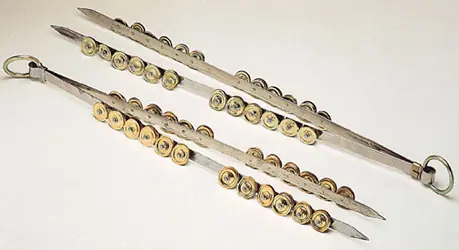
Long iron tongs hung with jingles, played in bhajan and folk song of the north. The player strikes the arms together and shakes the jingles. Sadhus carry chimtas too.

Ilathalamइलत्तालम्Ilathalam

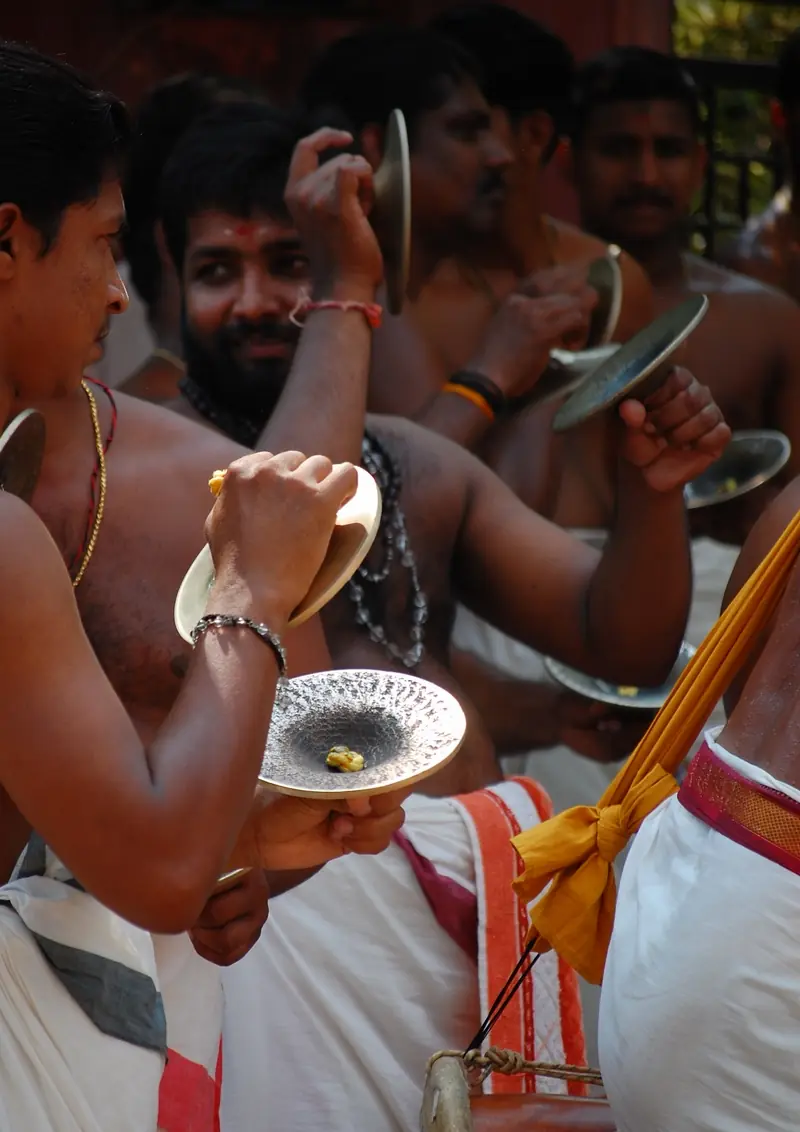
Kerala’s heavy bronze cymbals, which keep the beat in panchavadyam and chenda melam. Rows of ilathalam players stand behind the drummers, their clash marking each cycle of the rhythm.