A Hindu wedding is vivaha, a samskara performed before Agni, and for several days the whole house becomes its stage.
१५ rites१२ regional brides
Turmeric yellow comes first, then the green of mehendi leaves, then the red of the wedding day. The Vedic core is short: the hand is taken, the fire is circled, seven steps are walked. Around it each region has built its own costume, songs and games.
The rites in order
१तिलक और रोका · The engagementTilak and roka
The two families seal the match, and the bride's brother or father marks the groom's forehead with tilak. Roka in Punjab, tilak across much of North India, vagdana in the Grihya texts, the giving of the word. Gifts of clothes, fruit and sweets are exchanged on decorated plates.
A red tilak, rice grains on the forehead, plates of fruit and sweets.
२हल्दी · TurmericHaldi
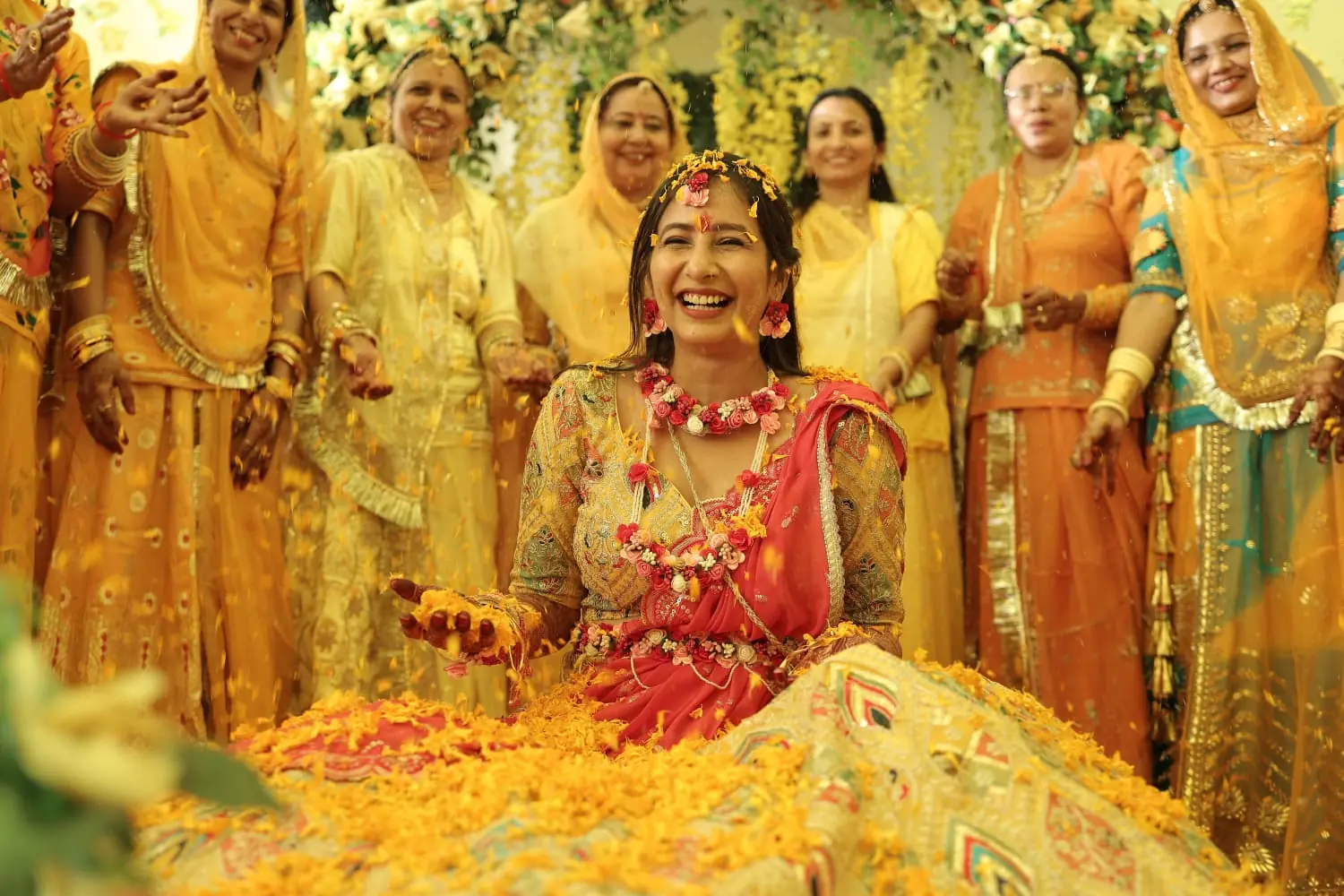
Turmeric paste is rubbed on the bride and groom in their own homes, by the women of the family. Called pithi in Rajasthan and Gujarat, gaye holud in Bengal. The paste is ground with oil or curd. After it, the couple are not to leave the house until the wedding.
Yellow clothes, yellow faces, marigolds and a low wooden stool.
३मेहंदी · HennaMehendi
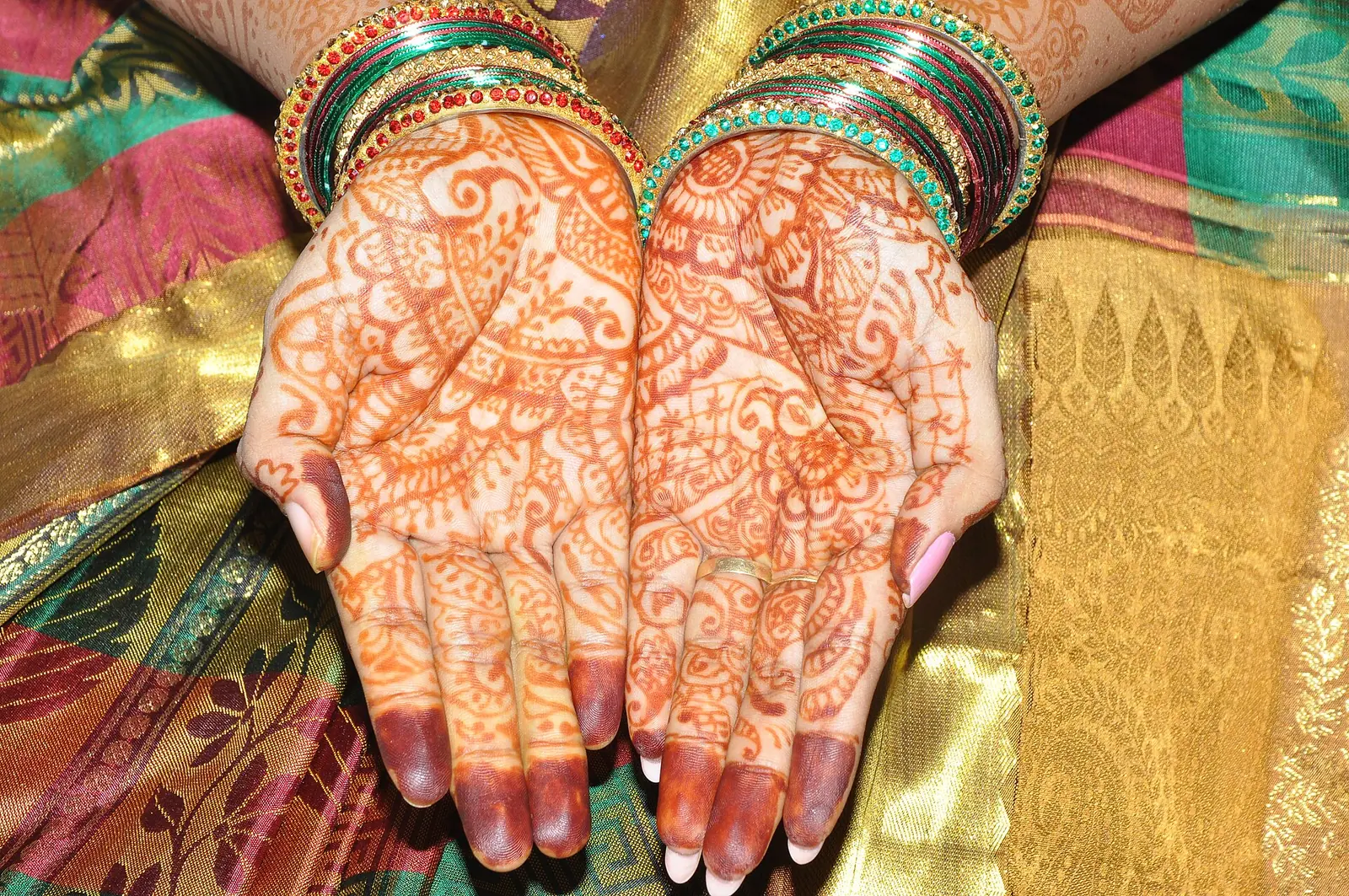
Henna is drawn on the bride's hands and feet, often with the groom's name hidden in the pattern. A North and West Indian custom. The darker the stain comes out, the saying goes, the more she will be loved. Women sing through the afternoon while the paste dries.
Hands held flat, palms covered to the elbow in fine brown lines.
४संगीत · SongsSangeet
An evening of singing and dancing by both families, a custom and not a rite. Once a gathering of women singing wedding songs to a dholak, it has grown in recent decades into staged dances by both sides.
Dholak, ghungroo, cousins rehearsing in the courtyard.
५बारात · Groom's processionBaraat
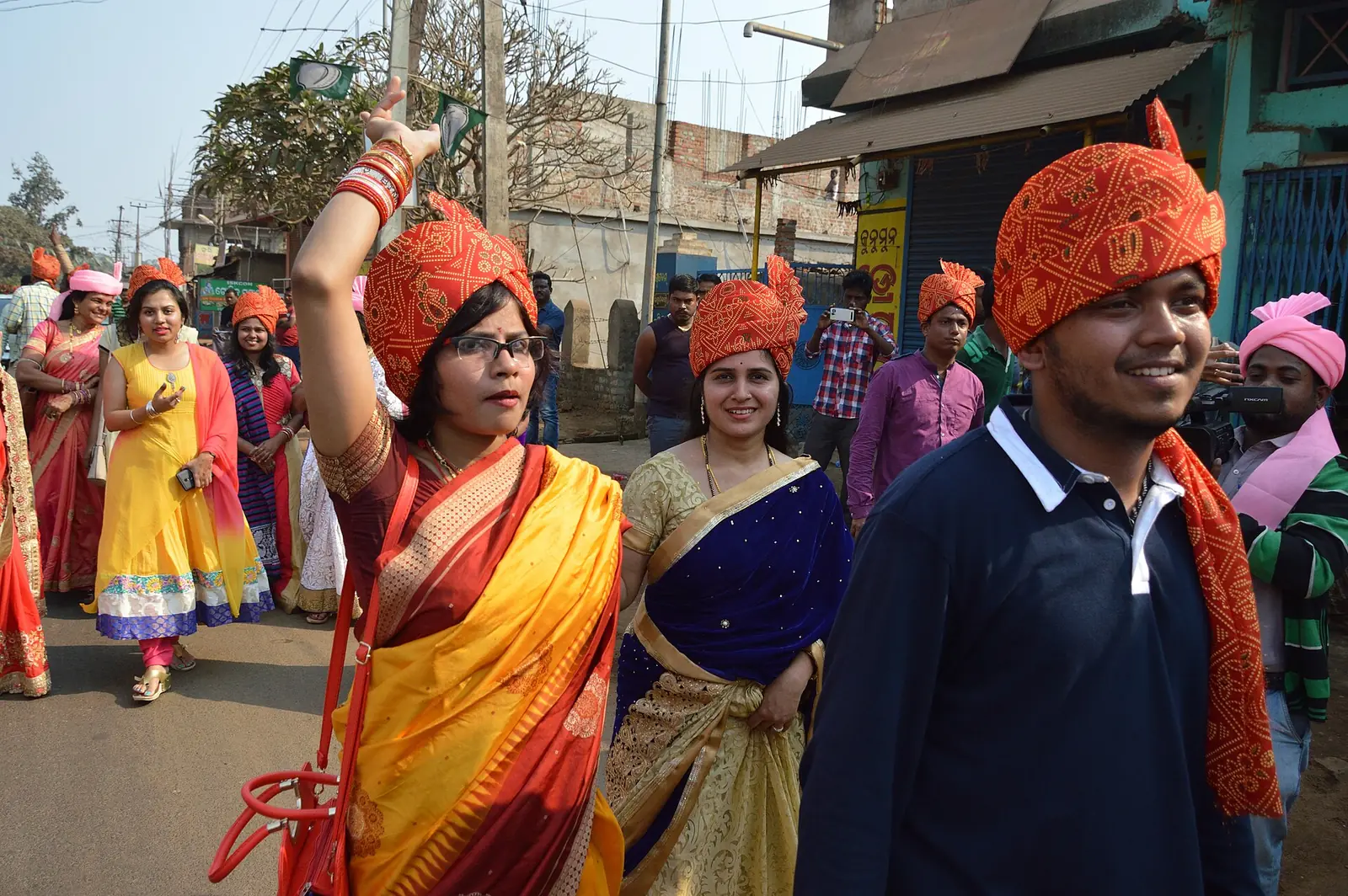
The groom's party walks or rides to the bride's house with a band, dancing in the street. The groom rides a mare in much of the north, his face behind a sehra of flowers or pearls. In Odisha the party is the barajatri. The bride's family meets them at the gate with aarti.
A white mare, a sehra, a brass band and dancing uncles.
६जयमाला · Exchange of garlandsJaimala
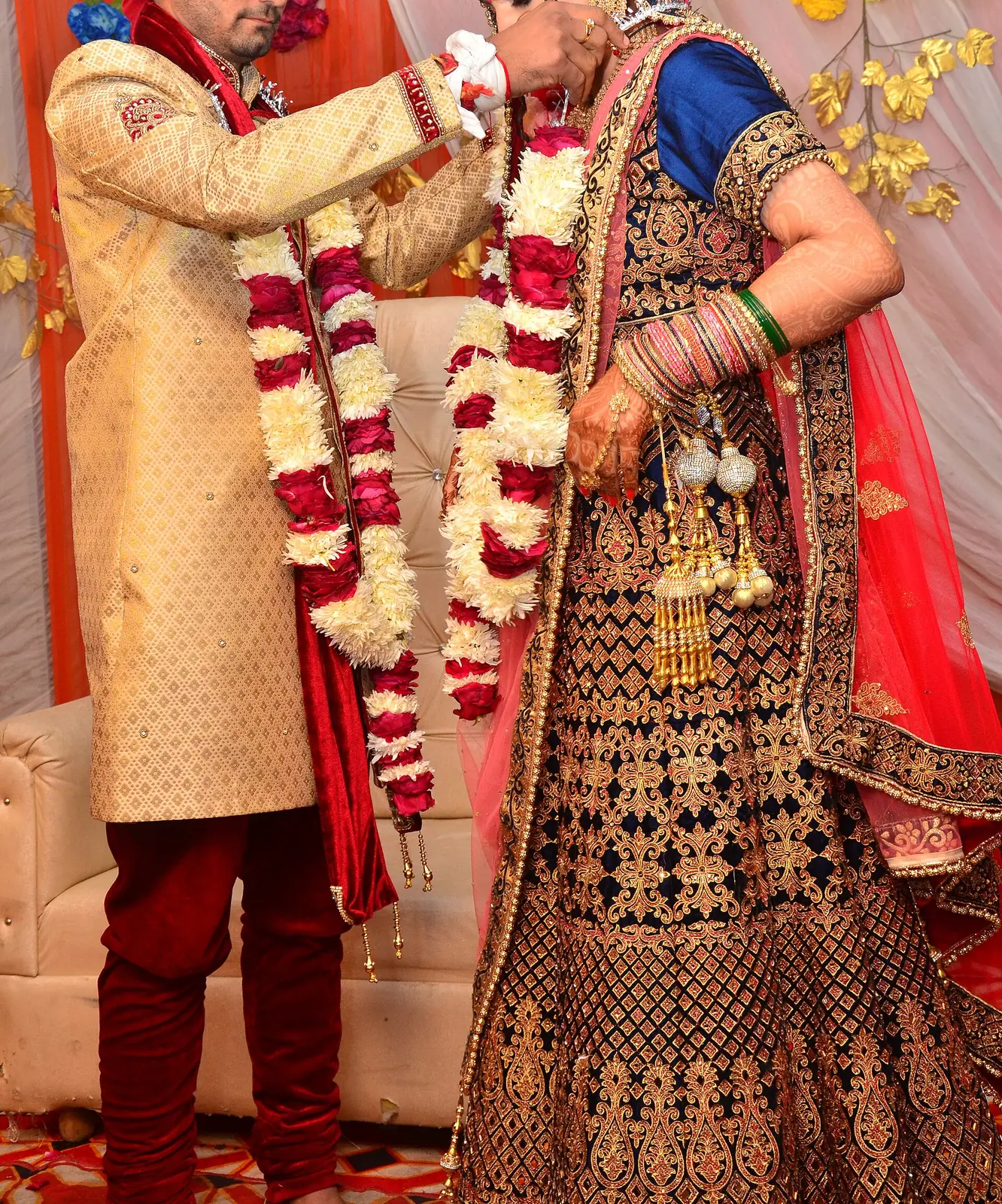
Bride and groom place garlands on each other, the first public moment they stand face to face. Also called varmala. Friends on each side sometimes lift the groom or bride high to make the other reach, a game every family enjoys.
Two thick garlands of rose and marigold, raised hands, laughter.
७कन्यादान · Giving the daughterKanyadaan
The father places his daughter's hand in the groom's, and water is poured over the joined hands. The groom promises not to fail her in dharma, artha and kama. If the father has died, a guardian of the bride's choosing gives her. Many count it the greatest gift a father can make.
Three hands stacked, water from a kalash, a coconut and flowers.
८ग्रंथि बंधन · Tying the knotGranthi bandhan
The end of the bride's chunni is knotted to the groom's scarf, and they stay tied through the rounds of the fire. Called gathbandhan in the north. The knot is tied by the priest or the groom's sister, sometimes with a coin, rice or a betel nut inside it.
A pink or yellow scarf knotted to a red veil.
९पाणिग्रहण · Taking the handPanigrahana
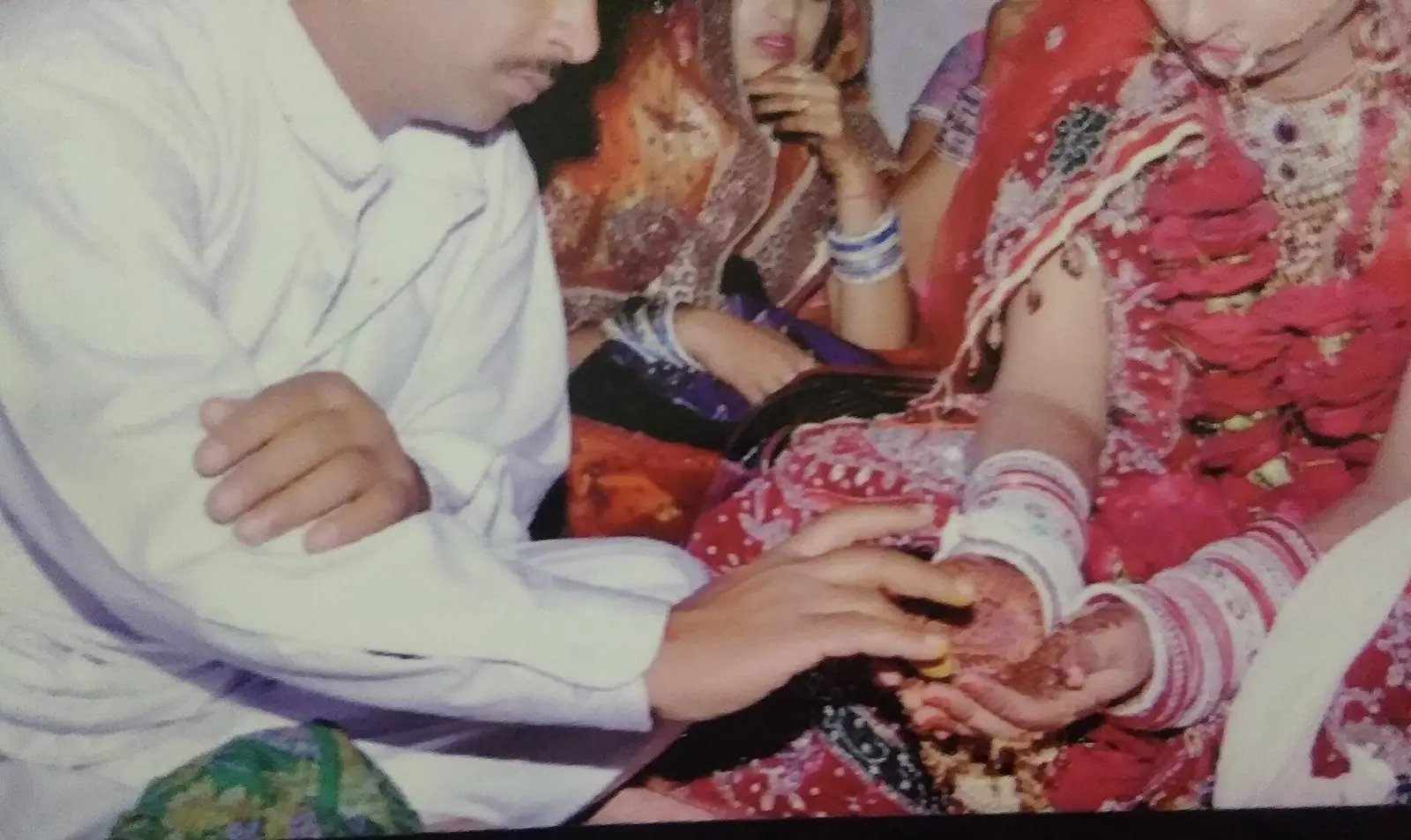
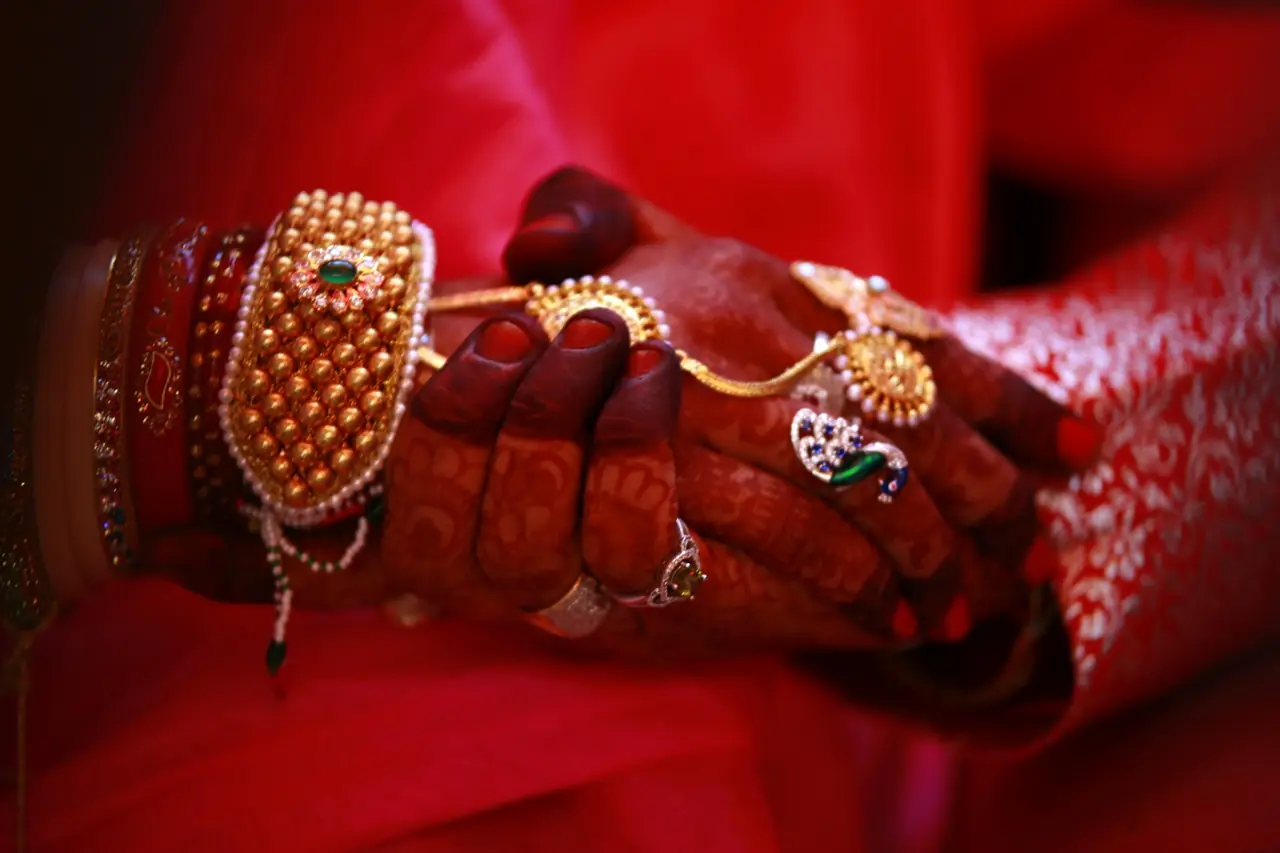
The groom takes the bride's right hand in his, the rite that gives the whole wedding its Sanskrit name. Hathleva in Rajasthan, hast-milap in Gujarat and Punjab, hata ganthi in Odisha, where a garland of mango leaves is bound round the joined hands.
Joined hands bound in mango leaves or a red thread.
१०अग्नि और लाजा होम · The fire and puffed riceAgni and laja homa
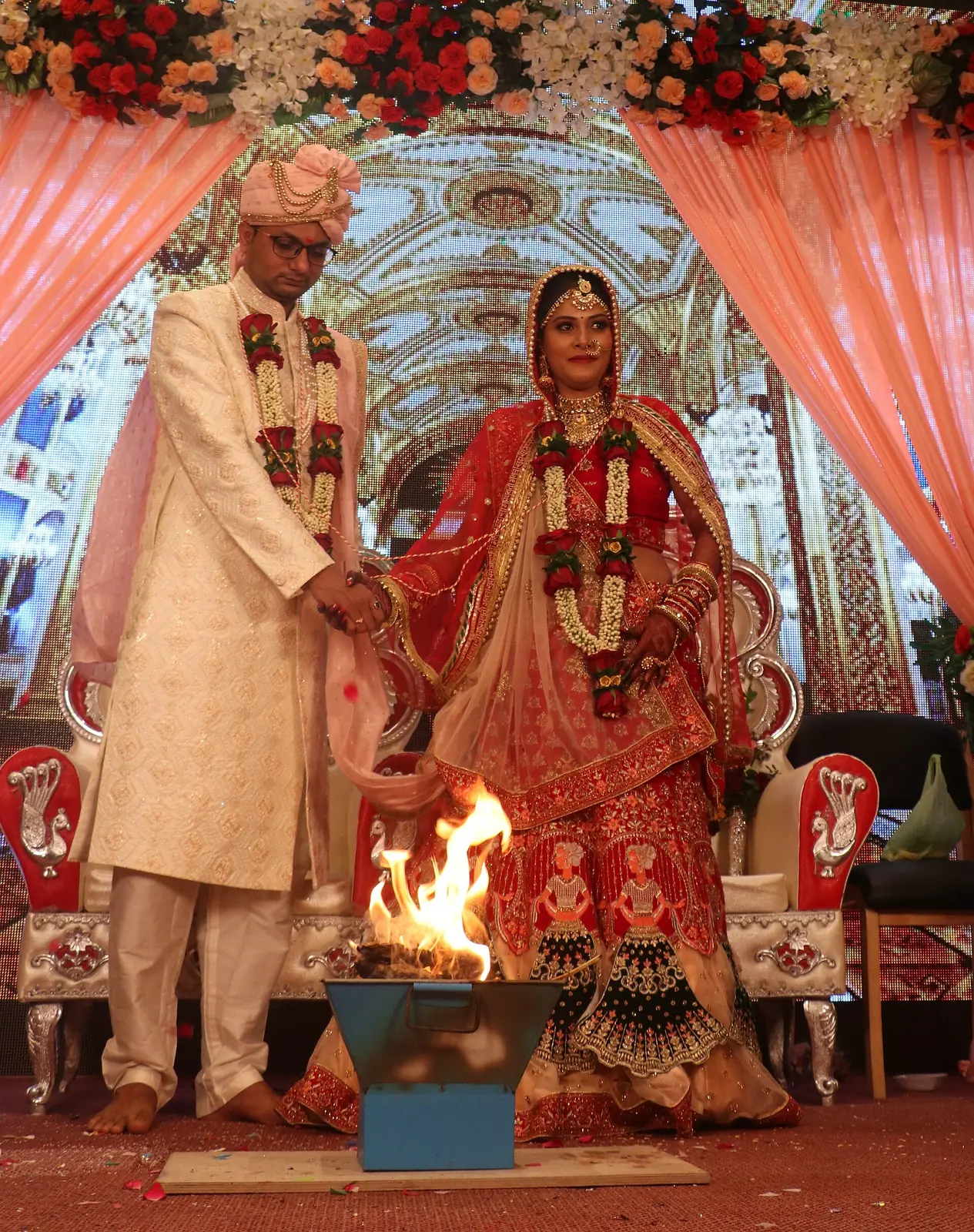
The fire is the witness; the bride's brother pours puffed rice into her hands and the couple offer it to Agni. The fire is lit in a kund at the centre of the mandap. In Odisha the bride's brother adds a playful punch to the groom's back, the sala bidha.
Puffed rice in cupped hands, ghee hissing on the flames.
११सप्तपदी · Seven stepsSaptapadi
Seven steps taken together to the north of the fire, and with the seventh they are friends for life. In the Paraskara Grihya Sutra the groom leads the bride seven steps northward, naming a blessing for each. Many regions walk seven rounds of the fire instead, the pheras; in the north the bride leads six and the groom the last.
Seven small heaps of rice, bare feet, the knot still tied.
१२ध्रुव दर्शन · Seeing the pole starDhruva darshan
After sunset the groom shows the bride the pole star, which never moves. The Paraskara Grihya Sutra gives his words: "Firm art thou; I see thee, the firm one. Firm be thou with me." If she cannot see it, she says "I see" all the same.
Two faces turned to the northern sky.
१३सिंदूर दान और मंगलसूत्र · Vermilion and the sacred necklaceSindoor daan and mangalsutra
The groom fills the parting of her hair with sindoor and ties the mangalsutra or thali at her neck. In the north and east, sindoor daan is the moment of marriage; in Bengal a new sari is then drawn over her head. In the south the thali is tied with three knots while the drums play.
A line of red in the parting, black and gold beads at the neck.
१४विदाई · FarewellVidaai
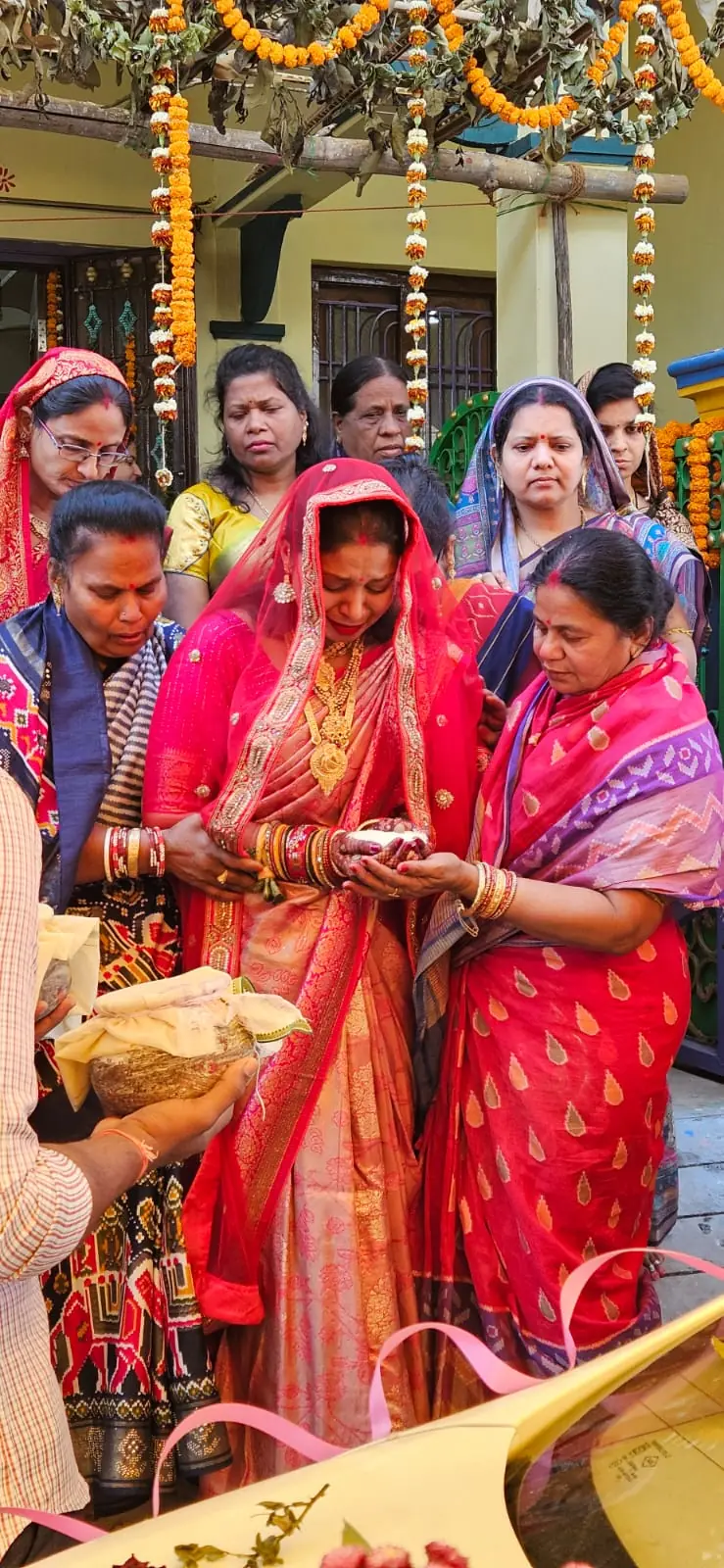
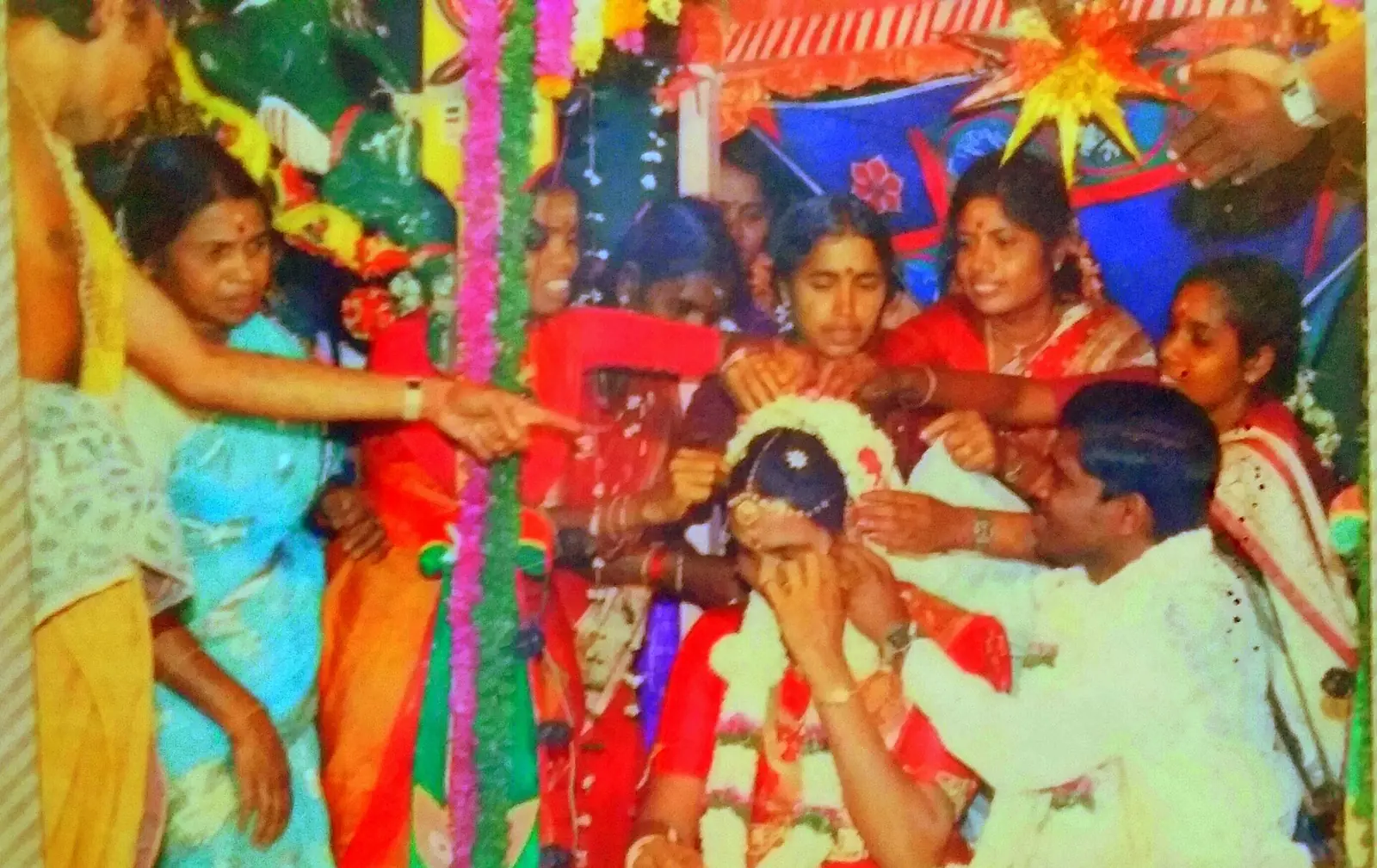
The bride leaves her parents' house, throwing handfuls of rice back over her head without turning. The rice is her thanks to the house that fed her and a wish that it never lacks grain. In Odisha the bride and the women of her family sing kandana, a weeping song.
Rice in the air behind her, a red veil, everyone in tears.
१५गृह प्रवेश · Entering the new homeGriha pravesh
At her new door the bride tips over a kalash of rice with her right foot and steps in right foot first. The mother-in-law meets her with aarti. In many homes she then walks in through a plate of red alta or kumkum water, leaving Lakshmi's footprints on the floor.
Spilled rice on the threshold, red footprints on the floor.
Saptapadi
Seven steps taken together to the north of the fire, and with the seventh they are friends for life.
१२३४५६७
१
One step for sap (strength of food).
२
Two for juice (vigour).
३
Three for the increase of wealth.
४
Four for comfort.
५
Five for cattle.
६
Six for the seasons.
७
Seven: "Friend, be with seven steps united to me."
Paraskara Grihya Sutra 1.8.1, trans. H. Oldenberg (1886)
The mandap
The mandap is a canopy on four posts built for one wedding, with the fire at its centre.
Traditionally it is put up in the courtyard of the bride's home, of wood, bamboo and leaves, and taken down after. Today it may be hired and hung with flowers, but the parts are the same.
Four posts
Four pillars hold up a frame. Families explain them as the four parents, the four Vedas, the four ashramas or the four aims of life; the texts do not fix one meaning.
Banana stems
In much of the south and east, young banana plants with their leaves are tied to the posts, a sign of a household that will keep growing.
Stacked pots
At the corners stand towers of painted clay pots, largest at the bottom. In Gujarat the mandap is called the chori after them.
The canopy
A cloth or leaf roof over the frame, today often a dome of flowers. The couple sit beneath it, out of the open sky.
The fire
A kund at the centre for the sacred fire, the witness of the vows. The couple sit beside it, and walk round it.
The kalasha
A pot of water before the couple, topped with a coconut and five mango leaves, set on a leaf with rice.
Brides of India
BengalBengali bride
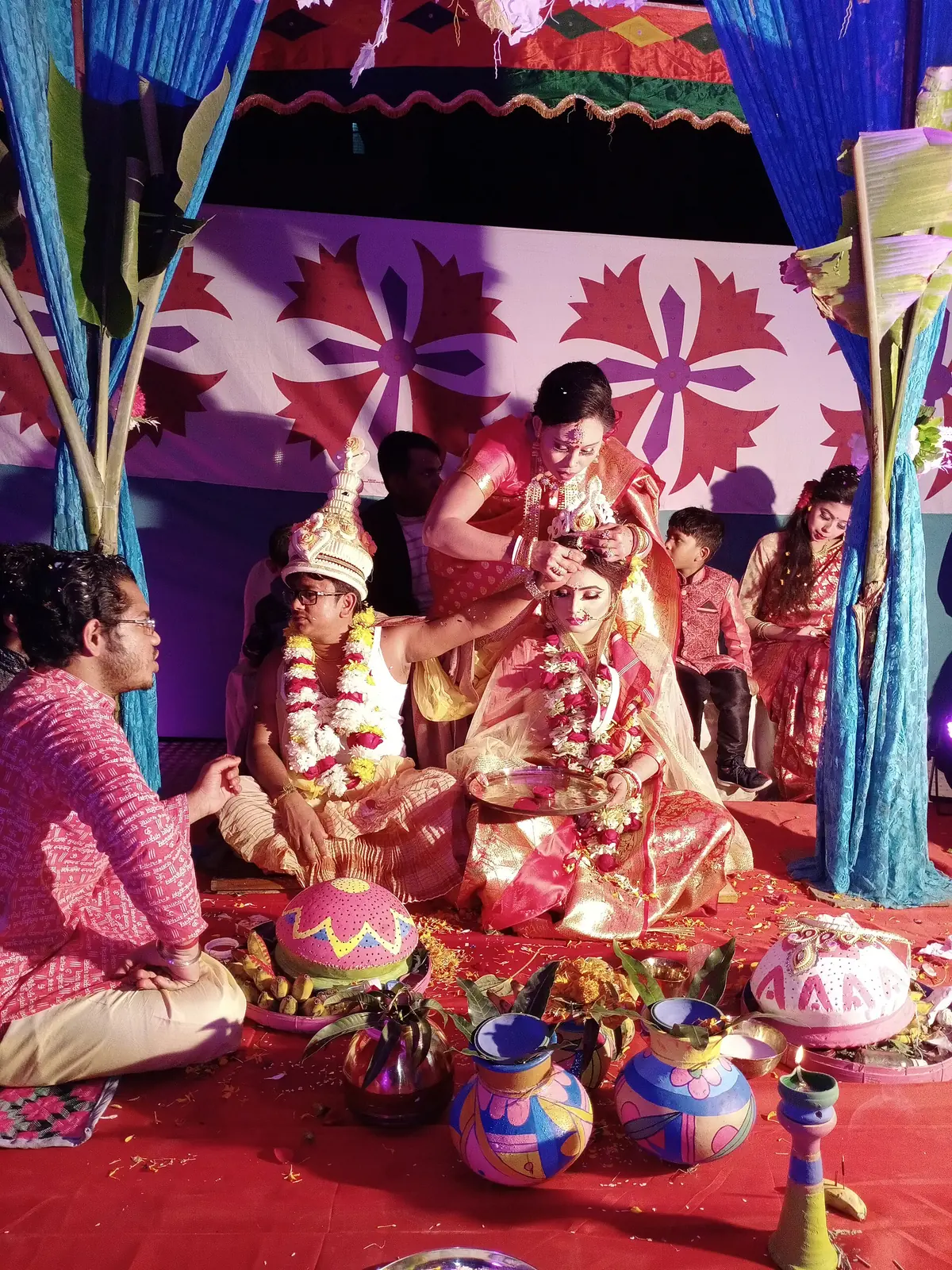
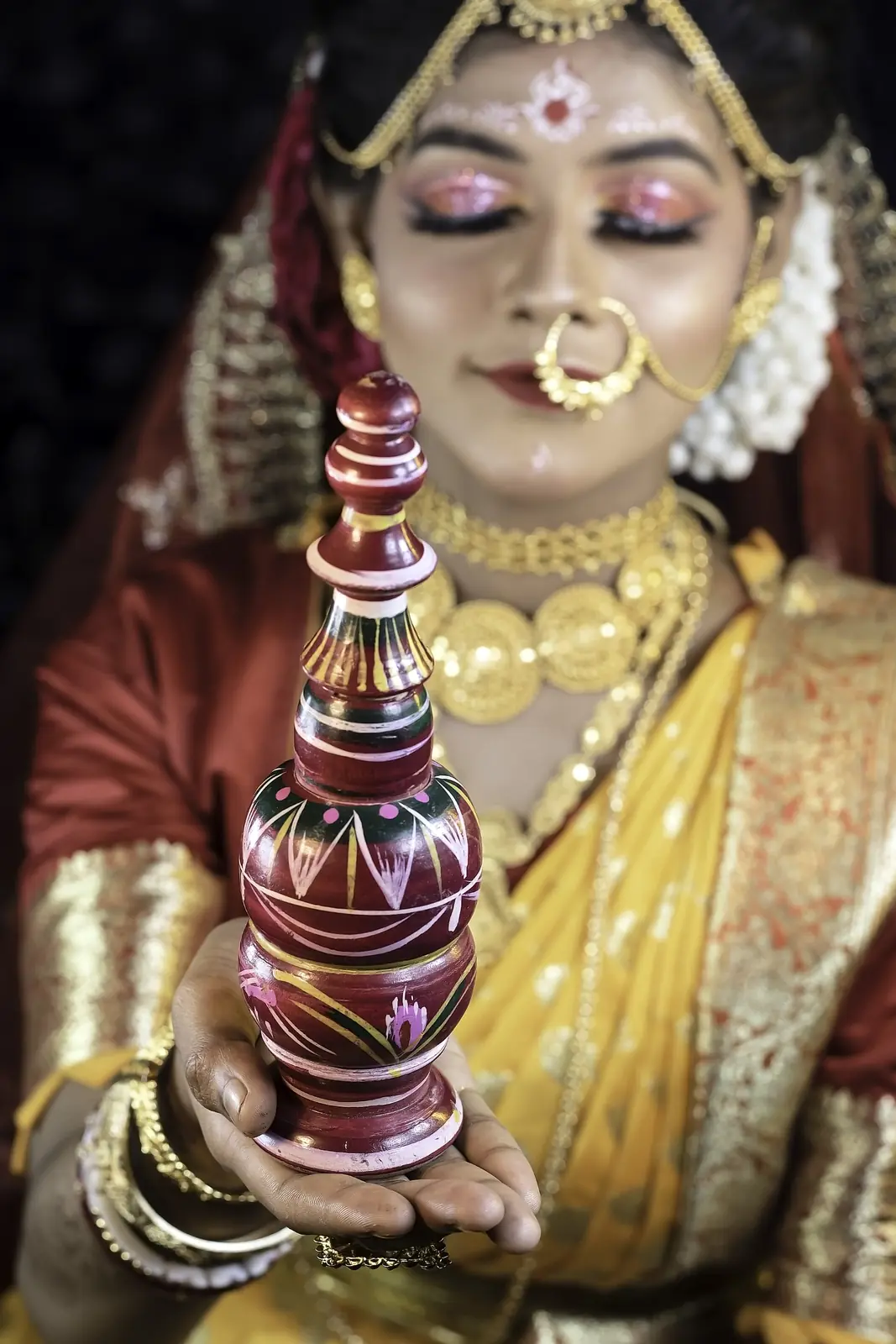
She wears a red Banarasi sari and a white crown of shola pith, the mukut; the groom's conical shola hat is the topor. Her forehead is drawn with dots of sandal paste and kumkum. Shankha-pola bangles go on at the wedding.
shankha-pola bangles of conch and red coral
shola mukut
chandan dots on the brow
red Banarasi sari
gachh kouto sindoor box
Tamil NaduTamil bride
A Kanjeevaram silk in temple colours, with gold from crown to waist. In Tamil Brahmin weddings she changes into the koorai, a nine-yard sari draped madisar style, from the groom's side. The thali is tied as she sits on her father's lap.
Kanjeevaram silk
nine-yard madisar drape
thali tied with three knots
jasmine in the plait
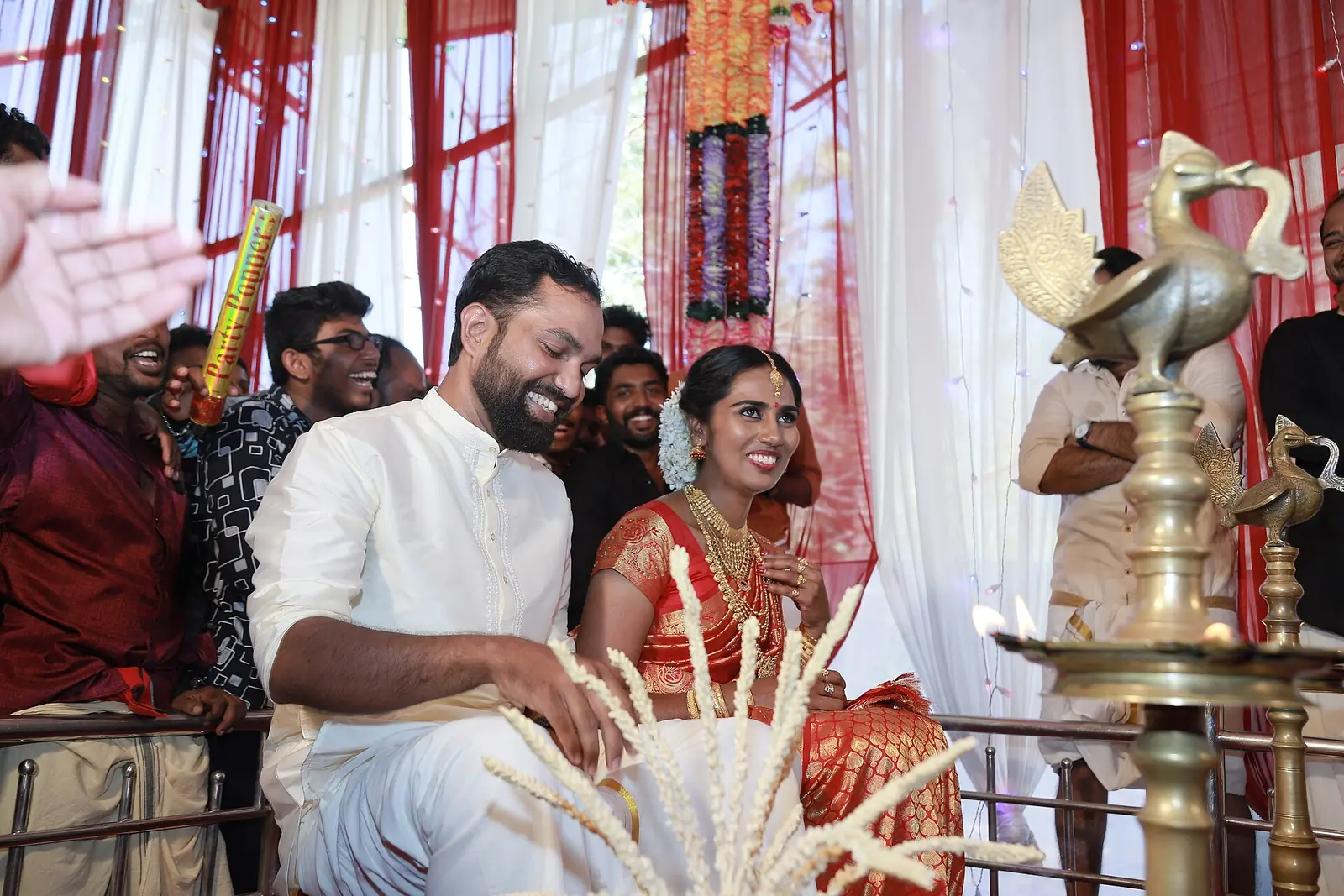
KeralaKerala bride
Off-white kasavu with a broad gold border, and a great deal of gold: coin necklaces, a green-stone palakka mala, a waist belt. Nair weddings are short; the thali is tied and the groom gives her a sari, the pudava.
kasavu sari
kasumala coin necklace
palakka mala
jasmine strings
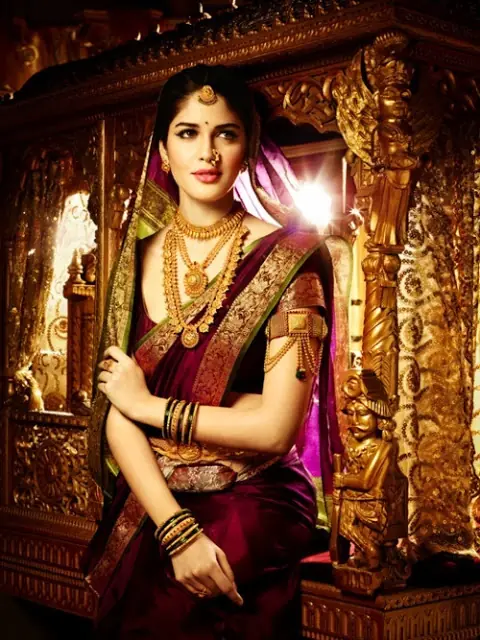
MaharashtraMarathi bride
A nine-yard nauvari sari, often a Paithani, tucked between the legs. A mundavalya of pearl strings is tied across the forehead of both bride and groom, and her wrists fill with green glass bangles.
nauvari sari
mundavalya of pearls
green chuda bangles
nath with pearls
crescent bindi
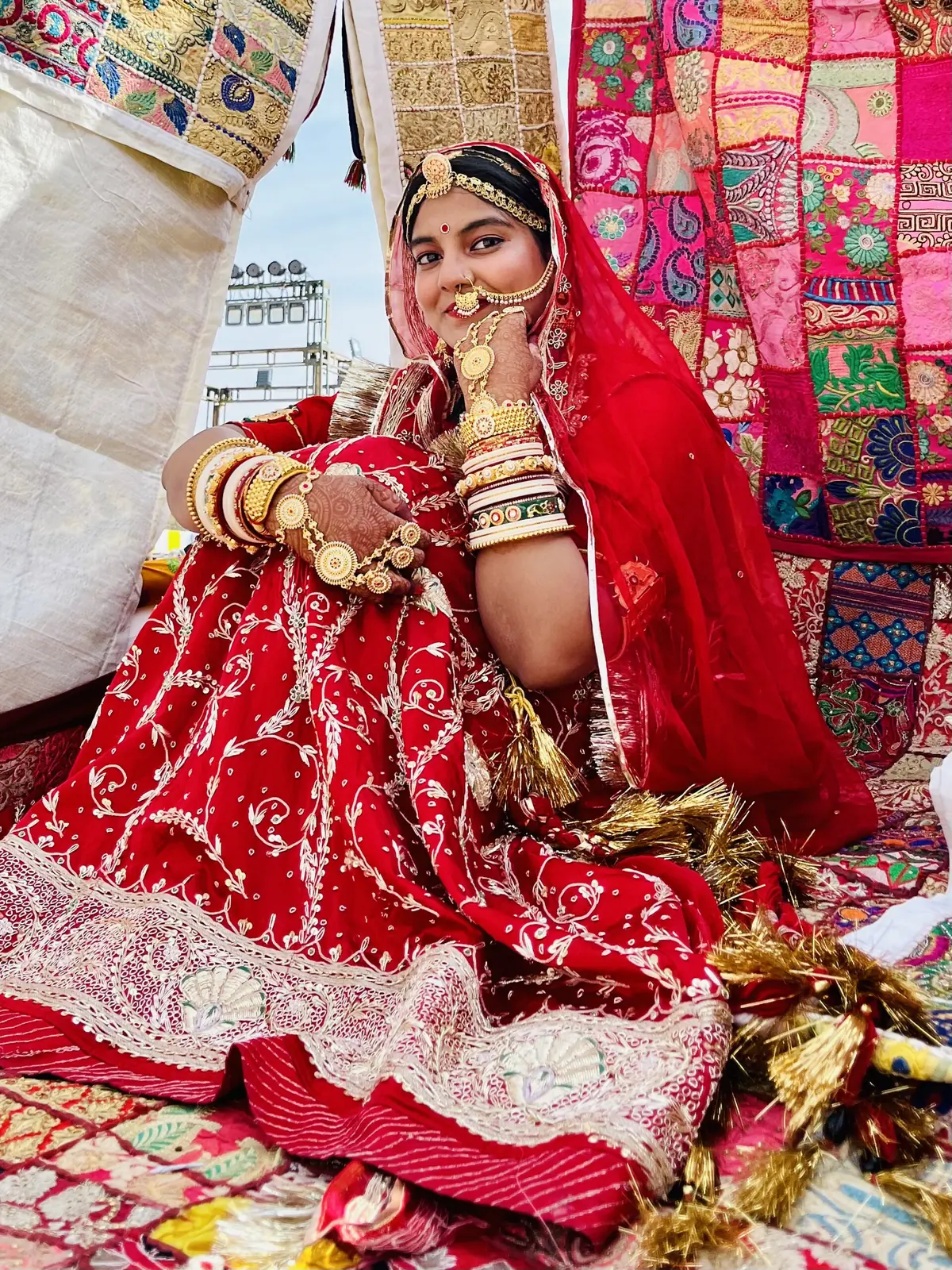
RajasthanRajasthani bride
The poshak in three parts: kanchli blouse, a full ghagra and an odhni large enough to cover the head. A round borla or rakhdi sits at the centre of the brow.
poshak with odhni
borla on the forehead
large nath
bajuband and haathphool
PunjabPunjabi Hindu bride
On the wedding morning her maternal uncle and aunt put the chooda on her wrists, red and ivory bangles, often twenty-one, while she keeps her eyes shut. Kalire, hanging gold or silver ornaments, are tied to them.
red and ivory chooda
kalire hanging from the wrists
phulkari dupatta
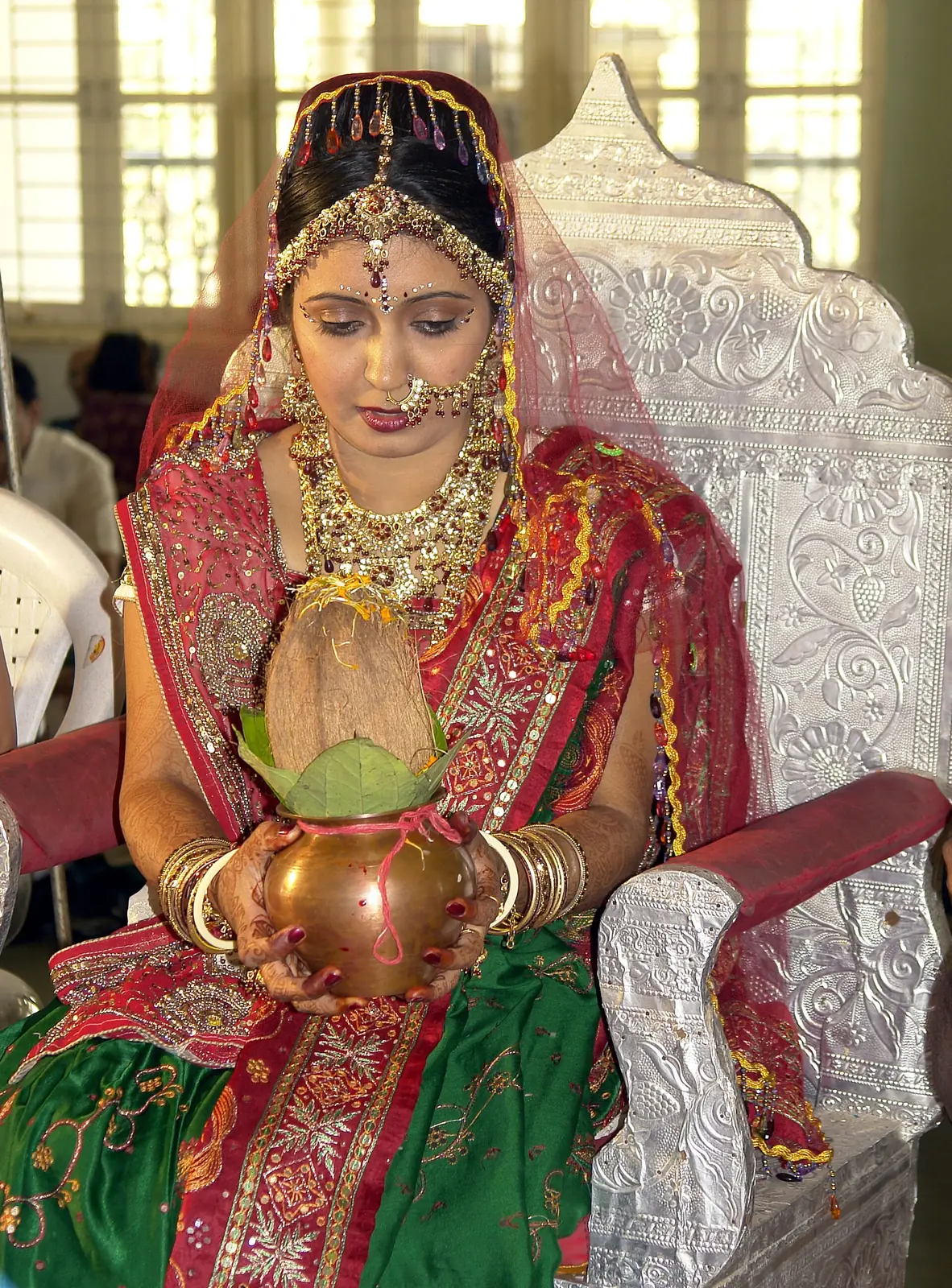
GujaratGujarati bride
She begins in the panetar, a white silk sari with a red border, given by her maternal uncle. Later she wears or is covered with the gharchola, red with gold checks, from her in-laws.
white and red panetar
gharchola with gold checks
chori mandap of stacked pots
OdishaOdia bride
Traditionally a yellow sari with a red border, the boula patta, though red and pink are now common. Gold above the waist and silver below. White and red bangles in some areas, red in others.
boula patta sari
gold above, silver below
hata ganthi of mango leaves
Andhra and TelanganaTelugu bride
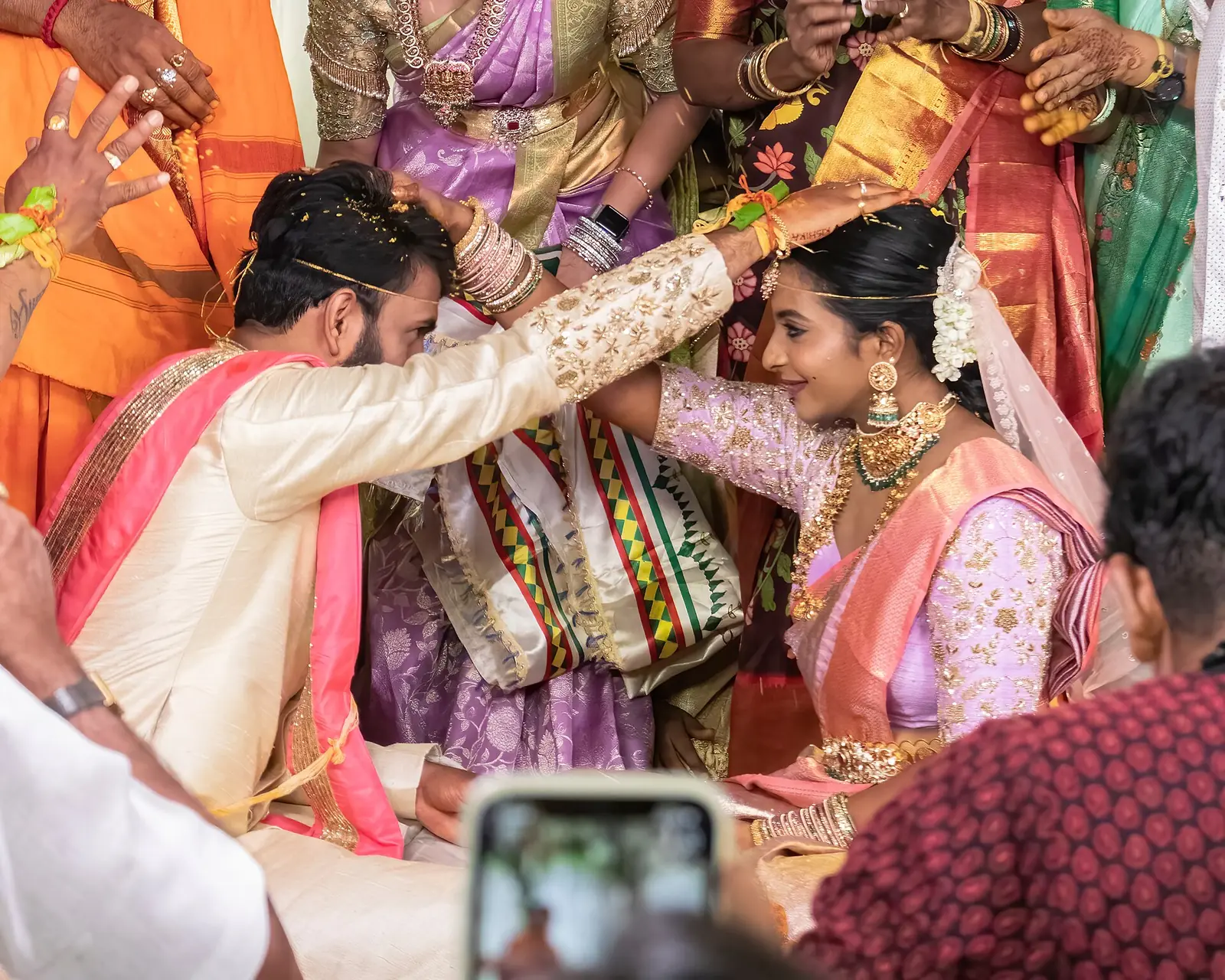
A paste of cumin and jaggery is placed on each other's heads across a screen, the jeelakarra bellam. Then she changes into a white sari with a red border. Bride and groom both wear the basikam at the brow.
basikam on the forehead
jeelakarra bellam
white sari with red border
talambralu rice shower
KashmirKashmiri Pandit bride
Her family hangs the dejhoor through the upper ear on a long red thread, a hexagonal gold pendant she wears for life. At her husband's home a gold chain, the ath, may replace the thread.
dejhoor on red thread
athoor tassels
taranga headdress
AssamAssamese bride
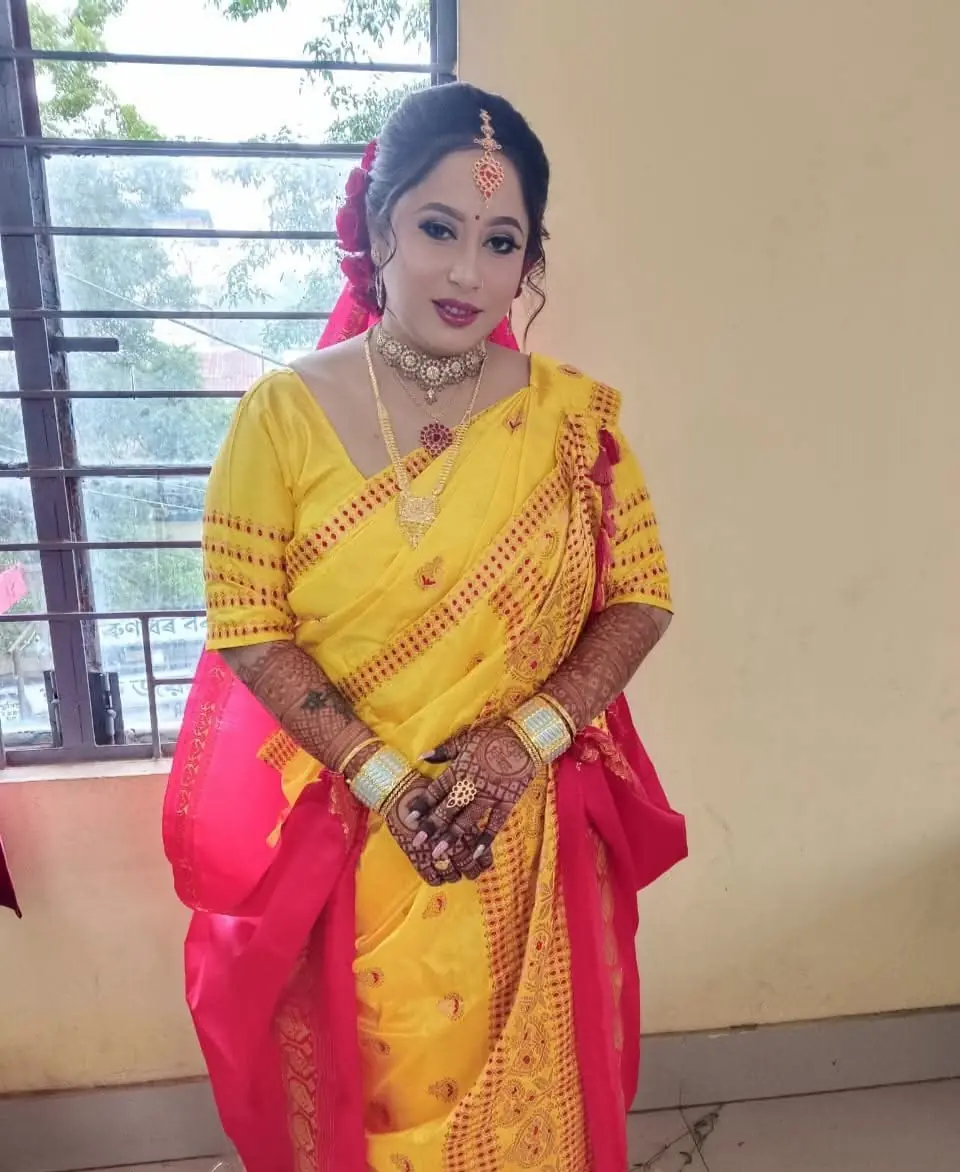
A mekhela chador of muga or pat silk, white and gold, given by the groom's family at the juroon ceremony along with jewellery and cosmetics.
white and gold mekhela chador
muga or pat silk
juroon gifts
Mithila (Bihar)Maithil bride
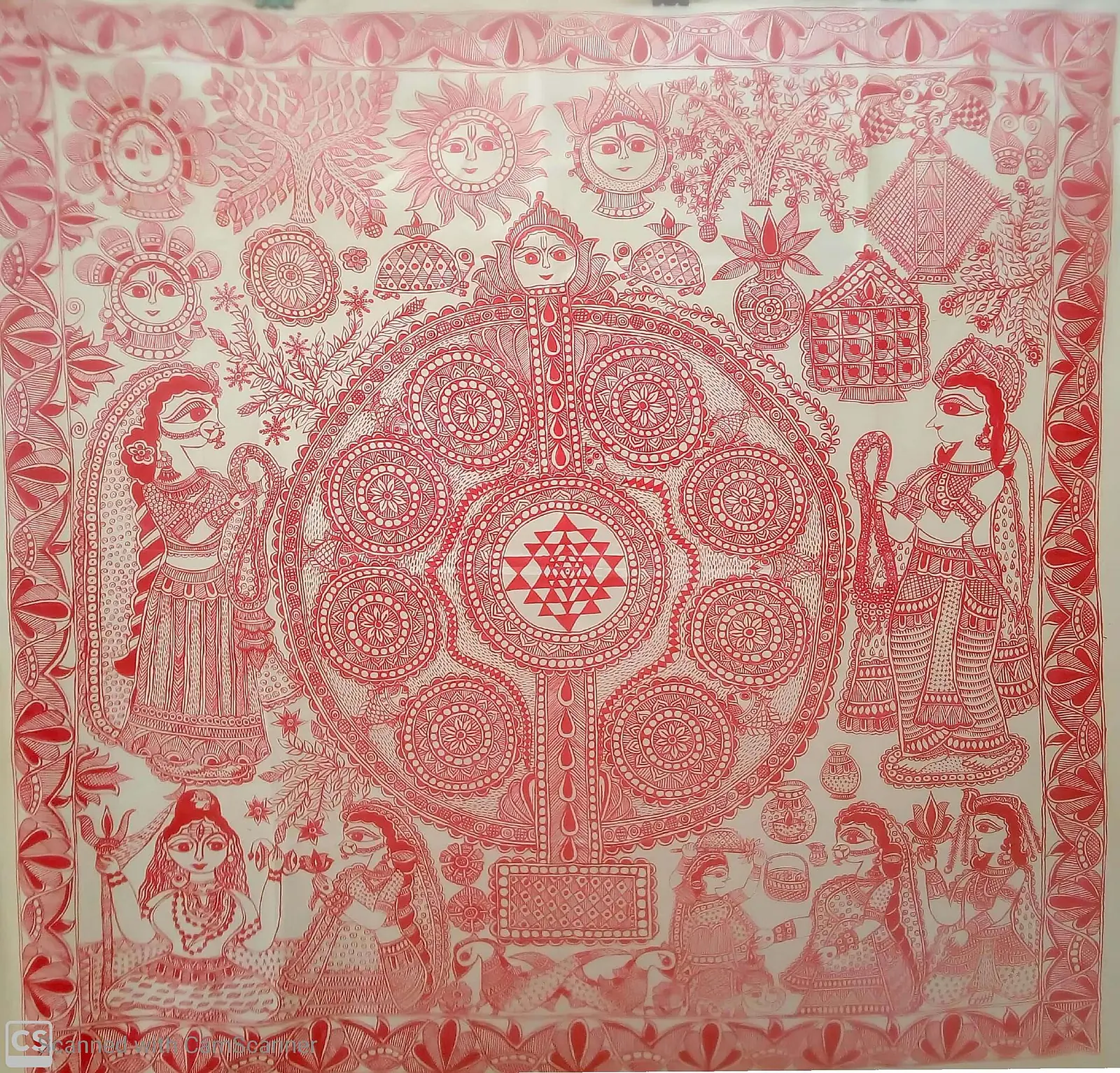
Sindoor daan is the central rite. The couple then spend their first days in the kohbar ghar, a room whose walls the women of the house have painted with lotuses, fish and bamboo. By tradition, King Janaka had the kohbar painted for Sita.