हिंदी

Schools of Hindu sculpture

मूर्तिकला

From Harappa to Vijayanagara, and from Kashmir to Angkor: the great schools of Hindu sculpture, and the signs that tell them apart.

  • 0schools
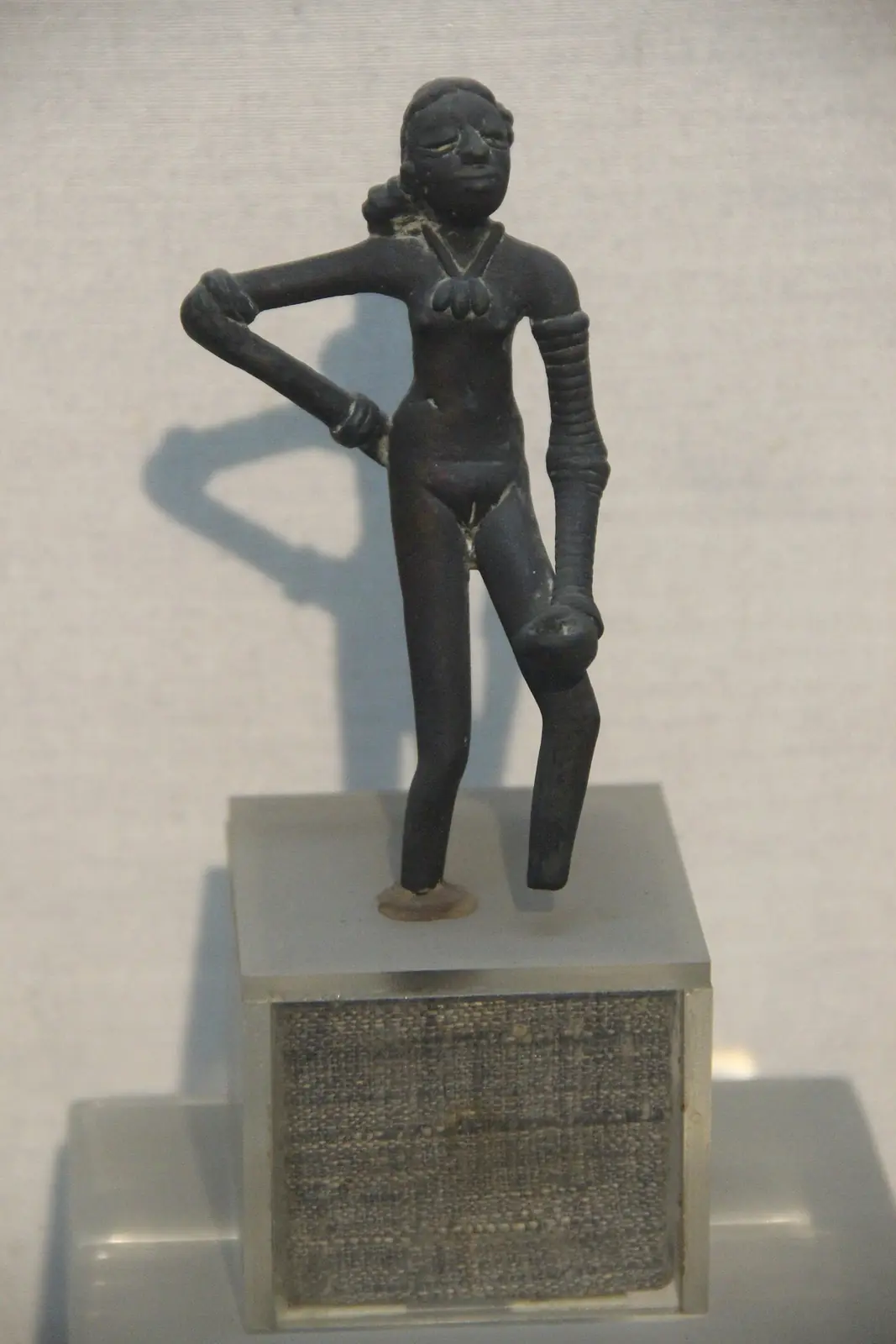
Bronze dancing girl of Mohenjo-daro, National Museum, New Delhi

c. 2600–1900 BCE · Sindhu and Sarasvati valleys, Gujarat

Sindhu-Sarasvati सिंधु-सरस्वती

The oldest figures of the land are small enough to hold in a palm.

At Mohenjo-daro a girl in bronze stands with a hand on her hip and her arm full of bangles, cast by the lost-wax method still used at Swamimalai. Steatite seals carry bulls, elephants and a seated yogi among animals that many see as Pashupati. The script on them is not yet read.

  • Small scale: seals, bronzes, terracottas
  • Steatite seals with animals and script
  • Bangles stacked to the shoulder
  • Trefoil pattern on the "priest-king" shawl
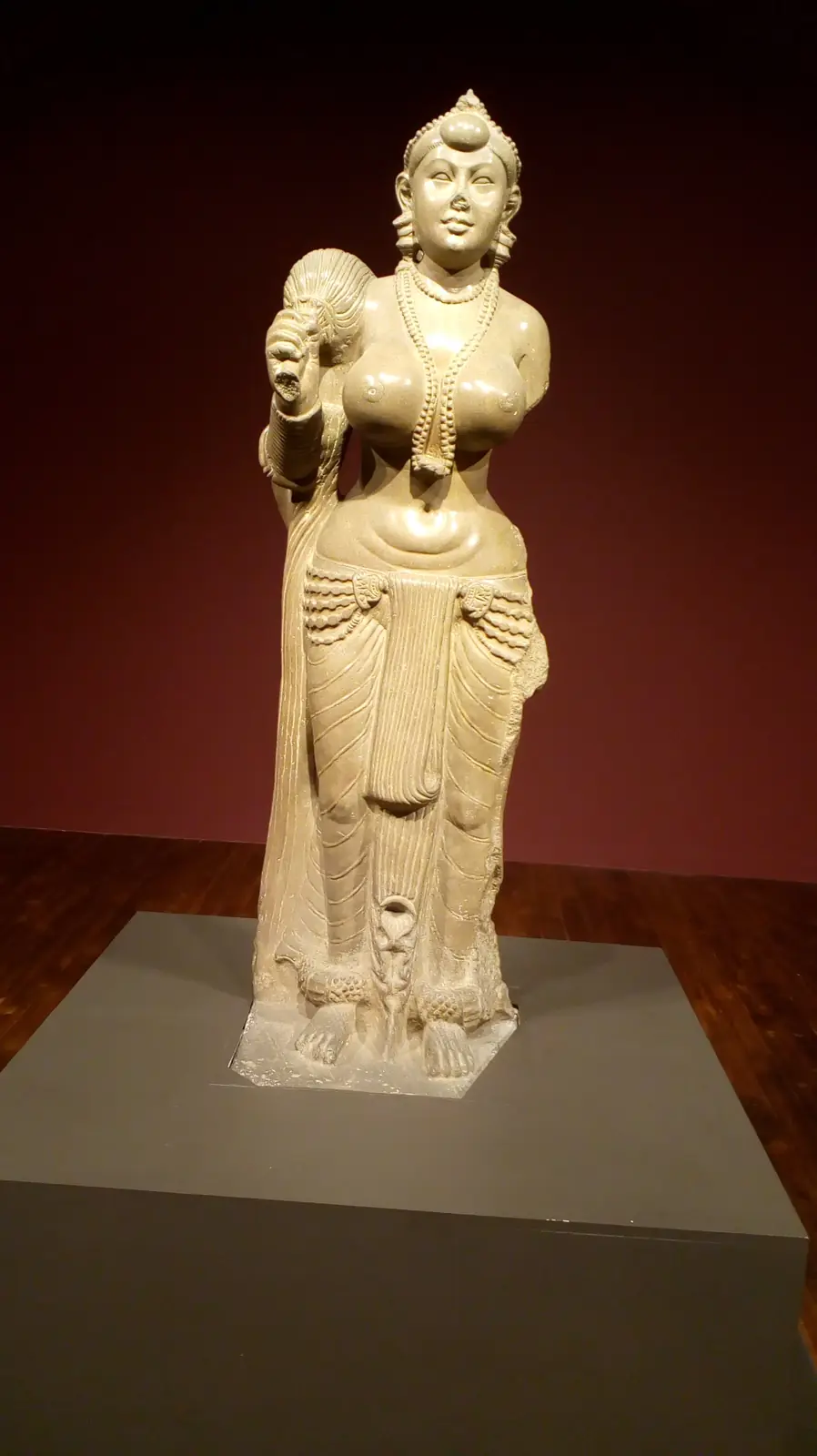
The Didarganj Yakshi in the Bihar Museum

3rd century BCE · Magadha and across the empire

Mauryan मौर्य

Stone takes a mirror shine, and the lions of Sarnath face the four directions.

Chunar sandstone was ground until it shone like glass. The Lion Capital at Sarnath is now the national emblem. The Didarganj chamara-bearer, dug up on the Ganga bank at Patna in 1917, carries the same polish, though some scholars place her a few centuries later.

  • Glass-like polish on buff Chunar sandstone
  • Animal capitals on single-stone pillars
  • Full, rounded yaksha and yakshi figures
  • Bell-shaped lotus capital
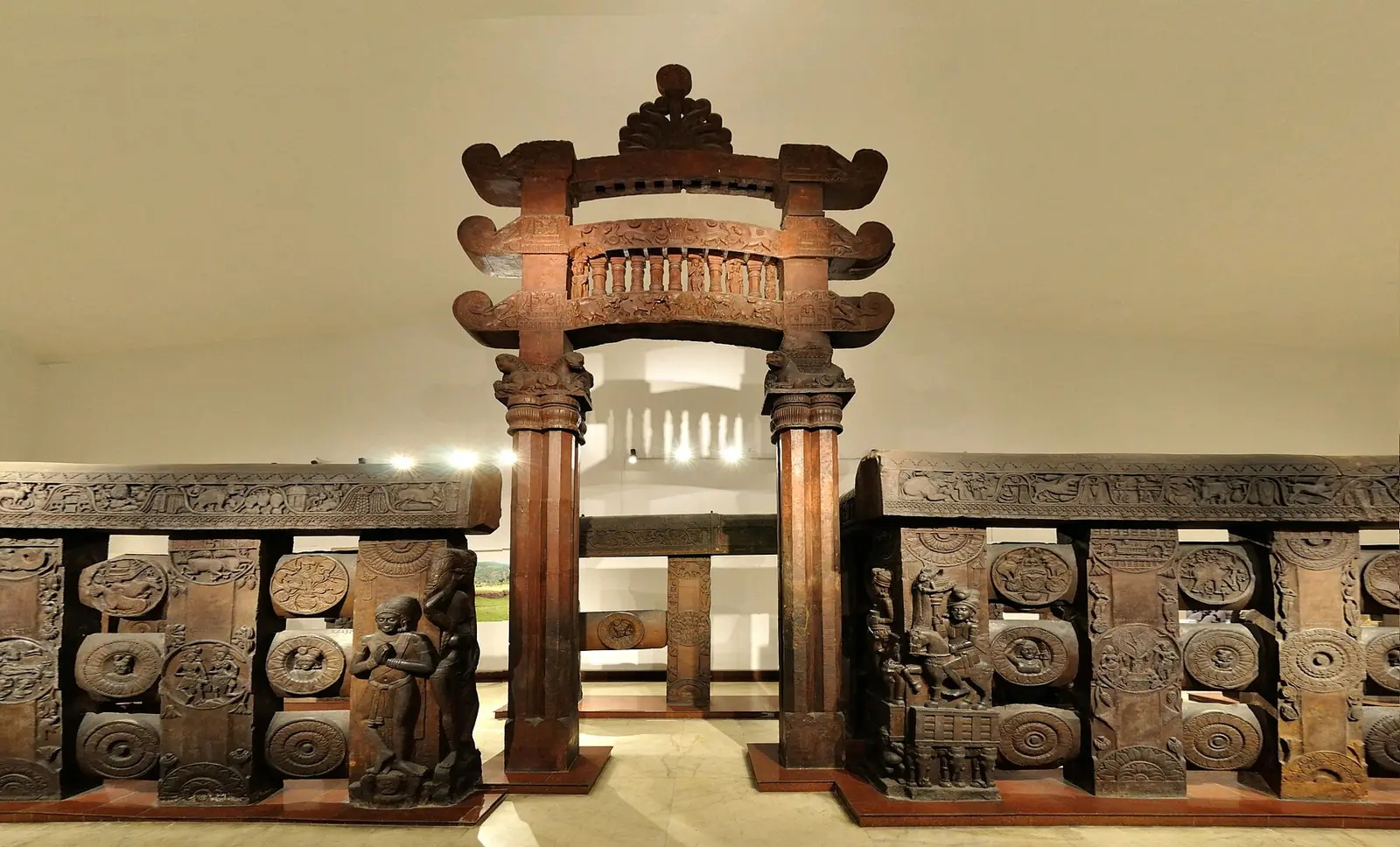
East gateway and railings of the Bharhut stupa, built in the reign of the Shungas

2nd–1st century BCE · Central India, Gangetic plain

Shunga शुंग

Railings of a stupa become a picture book, each figure named in Brahmi beside it.

At Bharhut the carvers lined the railing posts with yakshas, yakshis and devatas, many with their names cut beside them. Figures stand square to the viewer, the relief kept shallow and the detail crisp. Lakshmi seated on a lotus, bathed by two elephants, is already here.

  • Frontal, upright figures in low relief
  • Name labels in Brahmi
  • Yakshis holding a tree branch
  • Gaja-Lakshmi on roundels
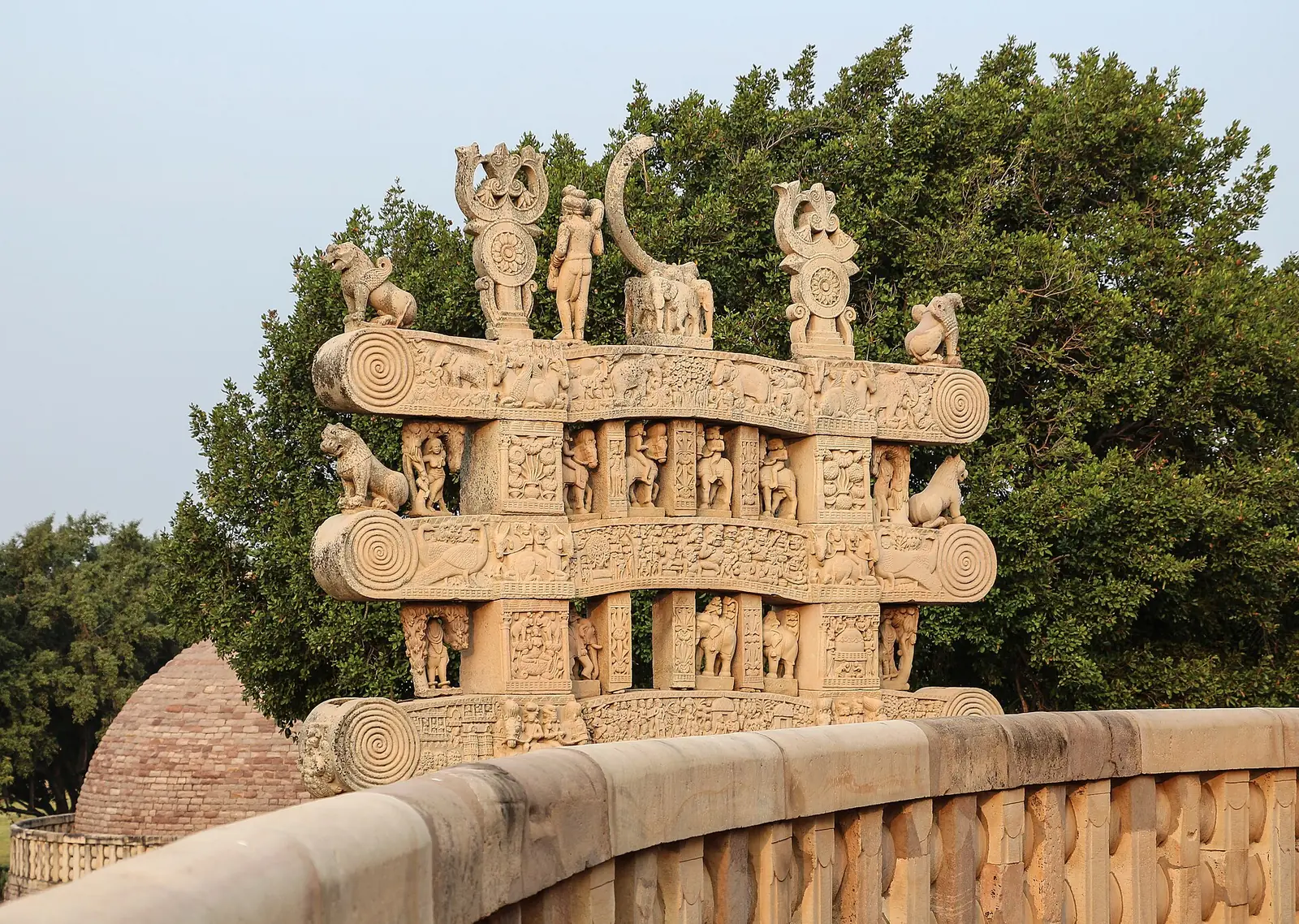
North gateway of the Great Stupa, Sanchi, carved in the Satavahana age

1st century BCE–2nd century CE · Deccan, Central India

Satavahana सातवाहन

The Sanchi gateways, crowded with life, were carved in the Satavahana age.

An inscription on the south gateway at Sanchi names a foreman of the artisans of King Satakarni. The crossbars teem with elephants, peacocks and city scenes. At the corners a woman hangs from a flowering tree, the shalabhanjika who would stand on temple brackets for the next thousand years.

  • Deep, crowded relief on gateway crossbars
  • Shalabhanjika bracket figures
  • Gaja-Lakshmi on posts
  • Ivory-carver fineness in stone
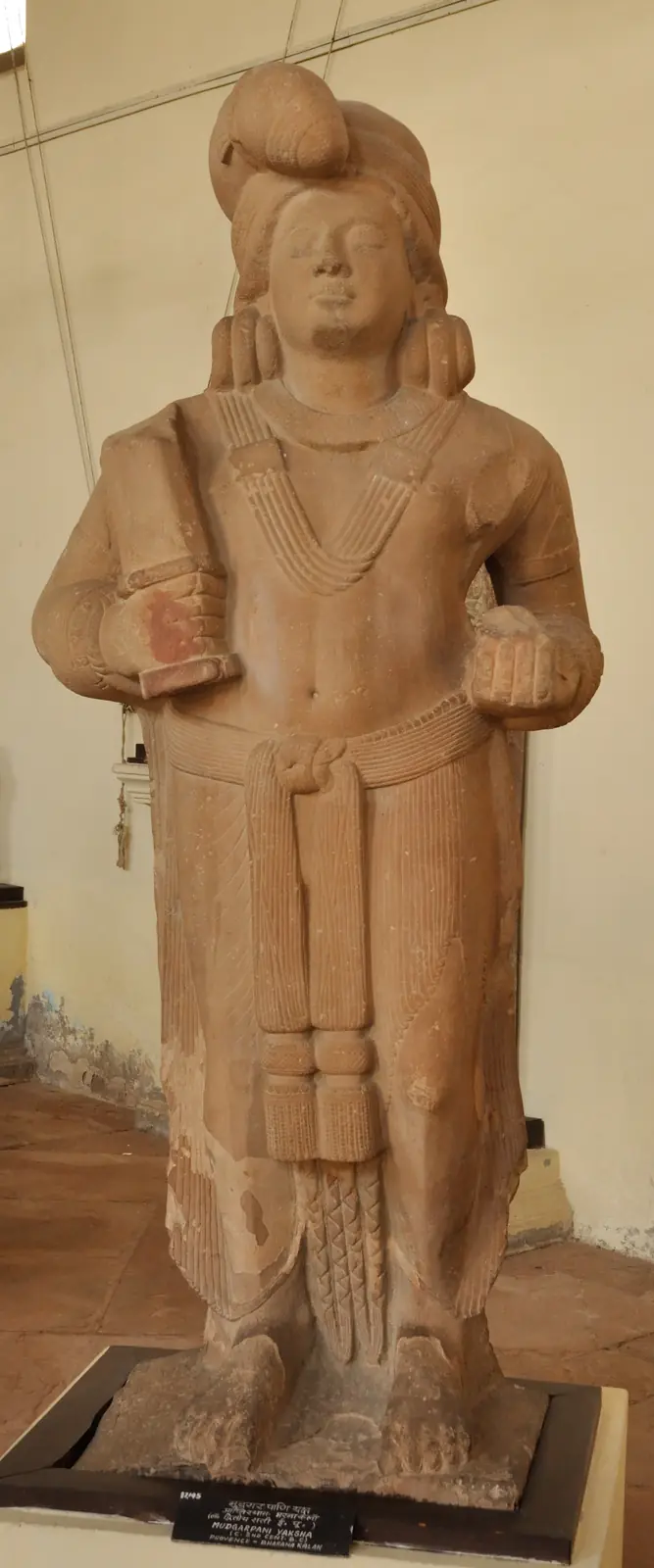
Mudgarpani Yaksha, c. 2nd century BCE, Government Museum, Mathura

2nd century BCE–6th century CE · Braj, Uttar Pradesh

Mathura मथुरा शैली

Red sandstone with cream spots: the stone of Krishna's own city.

Mathura's workshops carved in mottled red sandstone for centuries, from great standing yakshas to the first images of many devatas. Early Balarama under a serpent hood, Shiva lingas with a face, and Ganga on her makara all come from here. The Kushan and Gupta phases are both Mathura.

  • Mottled red sandstone with pale spots
  • Broad shoulders, open eyes, smile
  • Early Balarama, Vasudeva, ekamukha linga
  • Thin drapery clinging to the body
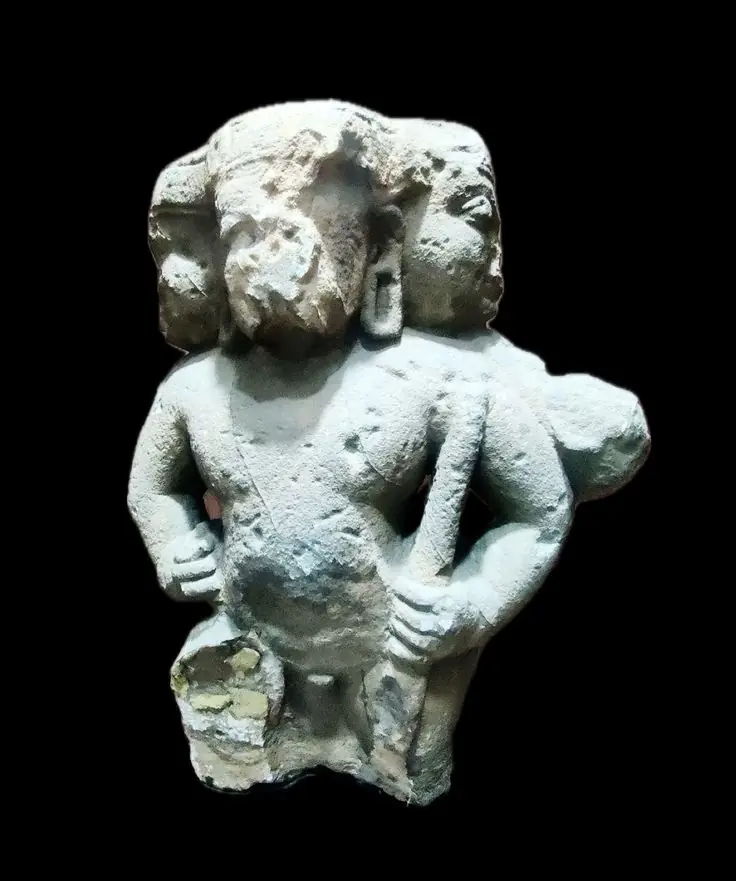
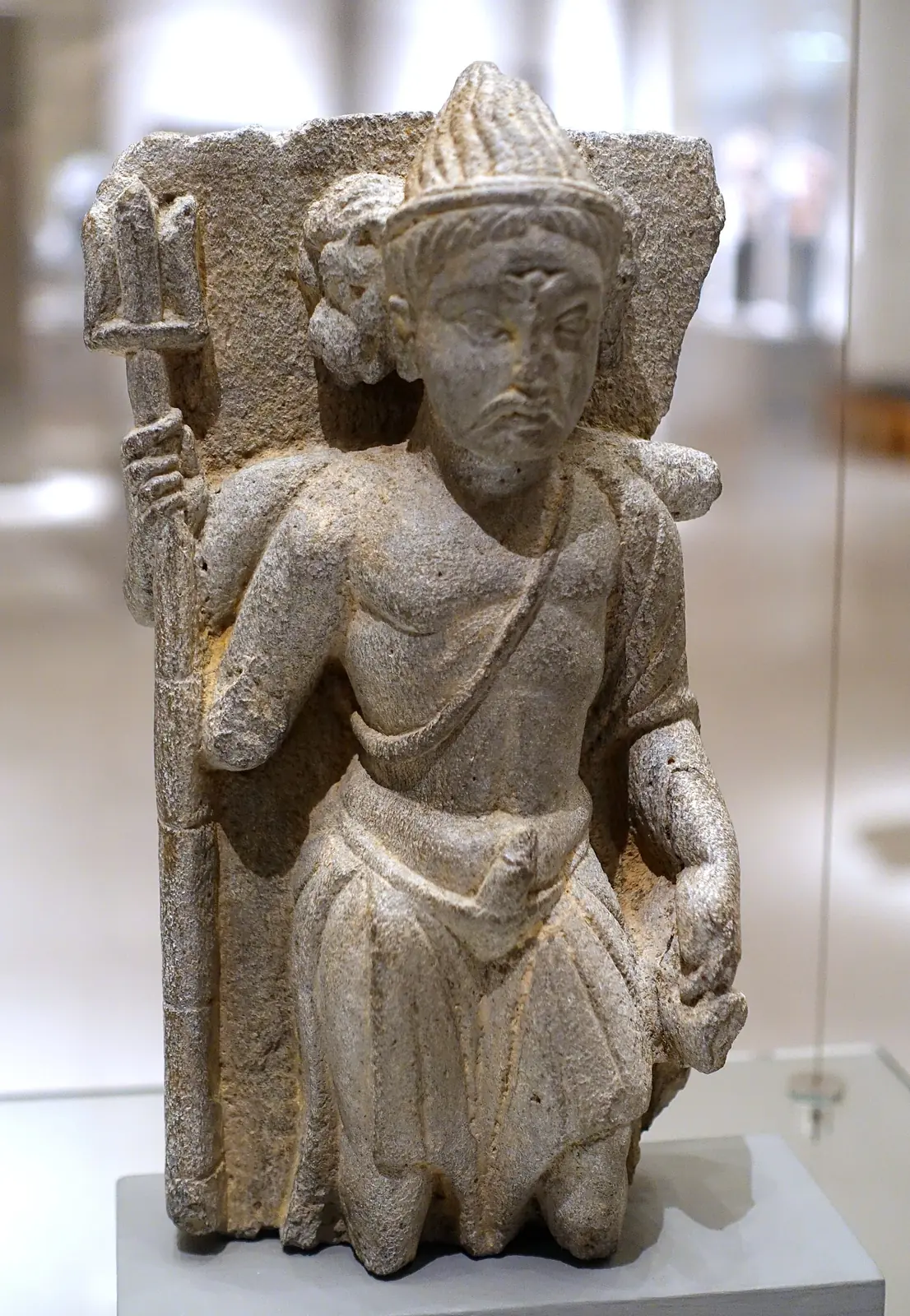
Three-headed Shiva, Gandhara schist, Ethnological Museum, Berlin

1st–5th century CE · Peshawar valley, Swat, eastern Afghanistan

Gandhara गांधार

Grey schist and deep-folded robes in the north-west, with Shiva among the images.

Gandhara is best known for Buddhist work in grey-blue schist, with drapery carved in heavy folds. Its workshops also made Hindu images, three-headed Shiva and Kartikeya among them. Kushan coins of the same age show Shiva standing beside Nandi.

  • Grey-blue schist or stucco
  • Deep, rope-like drapery folds
  • Wavy hair, moulded faces
  • Three-headed Shiva, Kartikeya
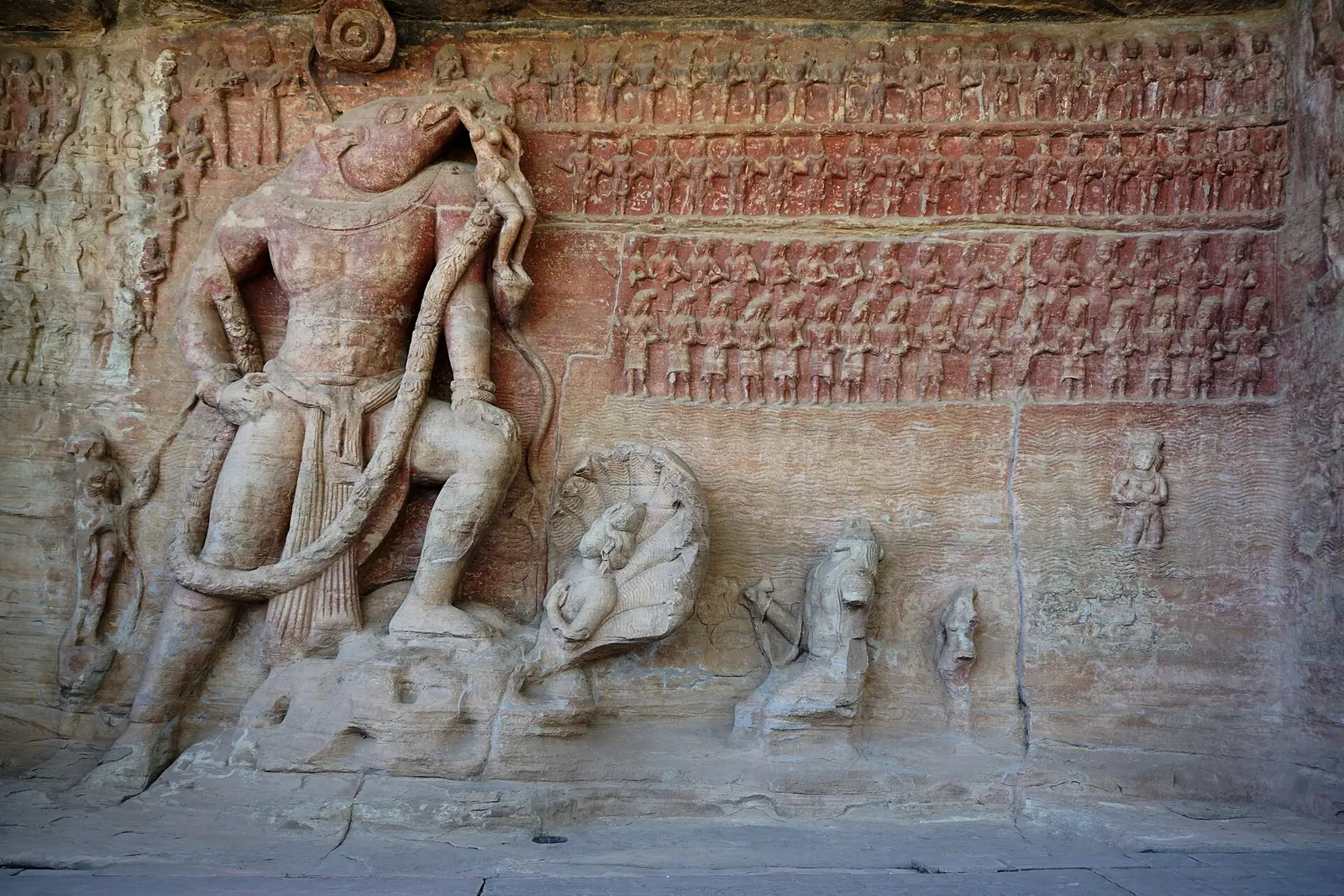
Varaha relief, Udayagiri, 401 CE

c. 320–550 CE · North and Central India

Gupta गुप्त

Calm faces, half-closed eyes, and Varaha lifting Bhudevi out of the waters at Udayagiri.

The Varaha panel at Udayagiri, cut in 401 CE, fills a whole cliff with the boar-faced Bhagwan rising from the ocean. At Deogarh, Vishnu sleeps on Shesha and Gajendra is saved. Bodies are smooth, drapery almost transparent, and the face turned inward.

  • Inward, meditative face; downcast eyes
  • Smooth body planes, see-through drapery
  • Large carved halo
  • Ganga and Yamuna at temple doorways
Four-faced Shiva from Mandhal, Vakataka period, Central Museum, Nagpur

4th–5th century CE · Vidarbha, Maharashtra

Vakataka वाकाटक

The Gupta sister-court in the Deccan, carving heavy, powerful devatas around Ramtek.

Pravarasena II built his capital Pravarapura at Mansar, near Ramtek hill, where excavation has found Shiva images of the 5th century. Ramtek hill keeps early shrines to Narasimha and Varaha. A four-faced Shiva from Mandhal is now in the Central Museum, Nagpur.

  • Thick-set, muscular figures
  • Short, broad faces
  • Narasimha and Varaha shrines
  • Close kin to Gupta work
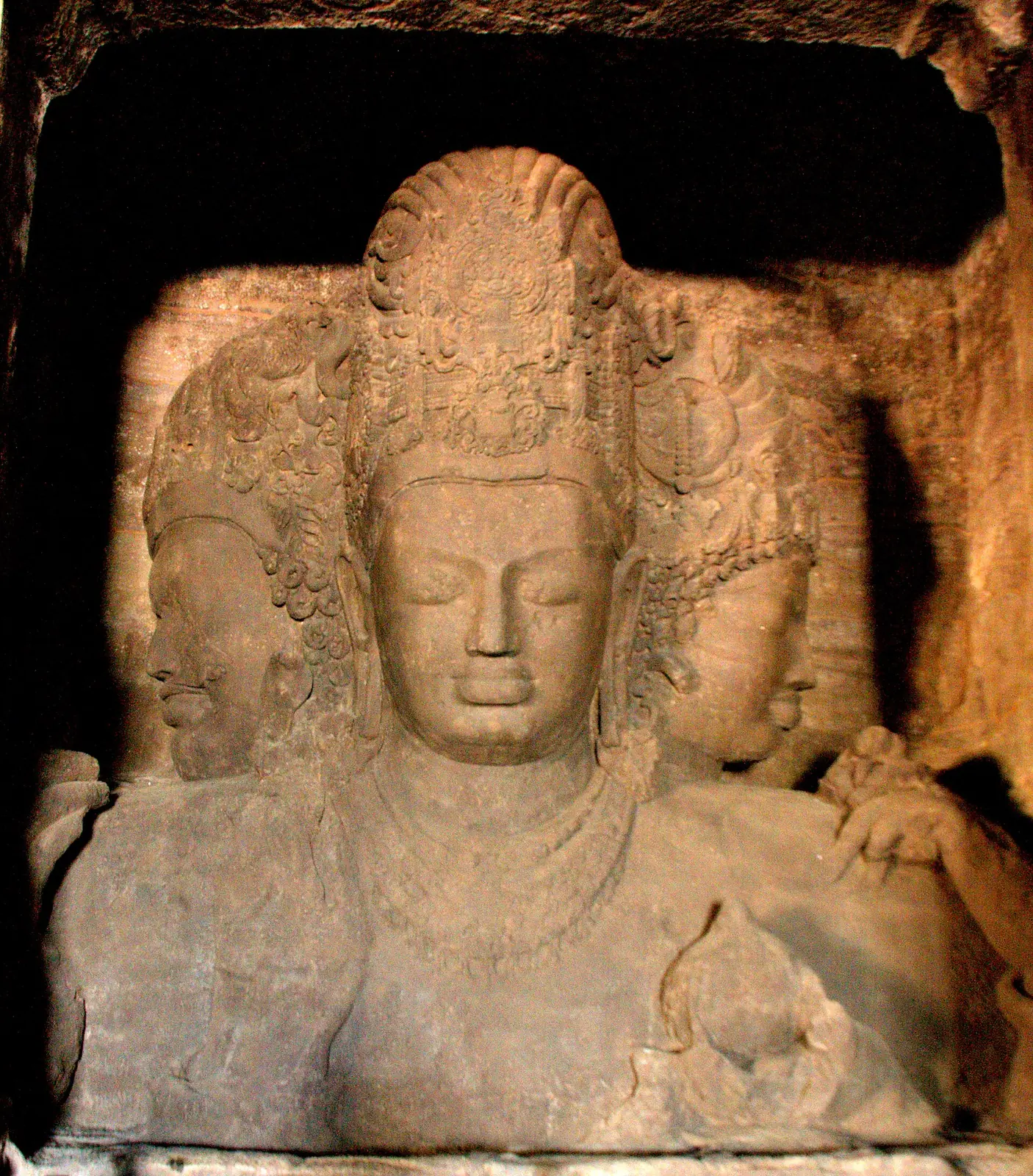
Sadashiva (Mahesamurti), Elephanta

c. 6th century CE · Island in Mumbai harbour

Elephanta घारापुरी

Sadashiva rises out of the rock, three faces in one bust about five and a half metres high.

In the great cave on Gharapuri island, Sadashiva looks out with three faces: calm in the centre, fierce on one side, gentle on the other. Around him are Ardhanarishvara, Gangadhara and the wedding of Shiva and Parvati. Many scholars link the cave to the Kalachuri kings.

  • Colossal figures cut from basalt
  • Panels the height of the cave wall
  • Deep shadow, soft modelling
  • Shiva kathas in sequence
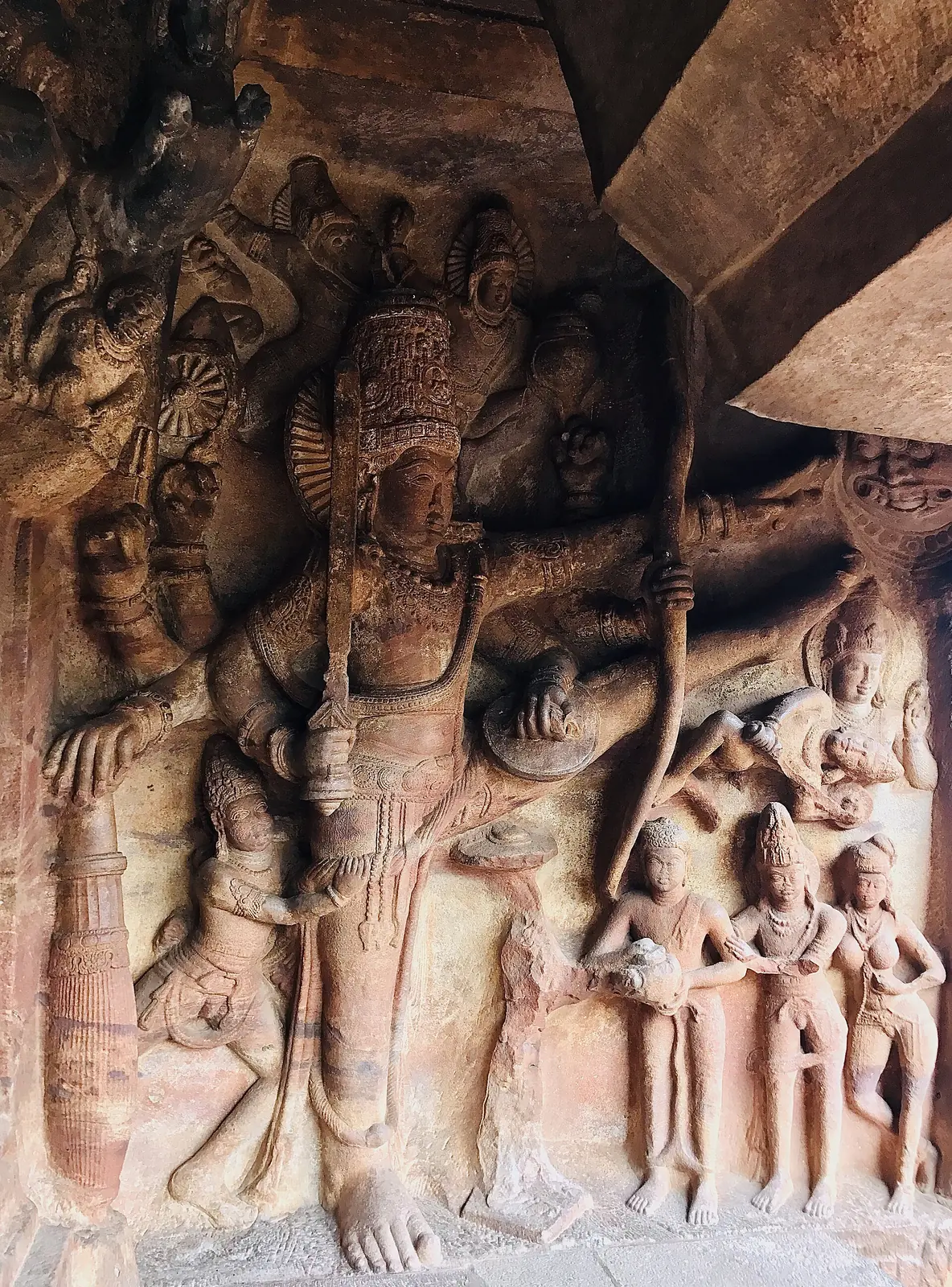
Trivikrama, Badami cave 3, 578 CE

6th–8th century CE · Badami, Aihole, Pattadakal (Karnataka)

Early Chalukya प्रारंभिक चालुक्य

Red sandstone caves at Badami, where Trivikrama strides across the worlds.

Cave 3 at Badami was cut in 578 CE under Mangalesha and dedicated to Vishnu. Trivikrama, Narasimha and Harihara fill its walls. At Aihole and Pattadakal the carvers moved out of caves into free-standing temples, with Mahishasuramardini and Nataraja in the niches.

  • Soft red-gold sandstone
  • Tall figures with high crowns
  • Many-armed Nataraja, Trivikrama
  • Dwarf ganas along plinths
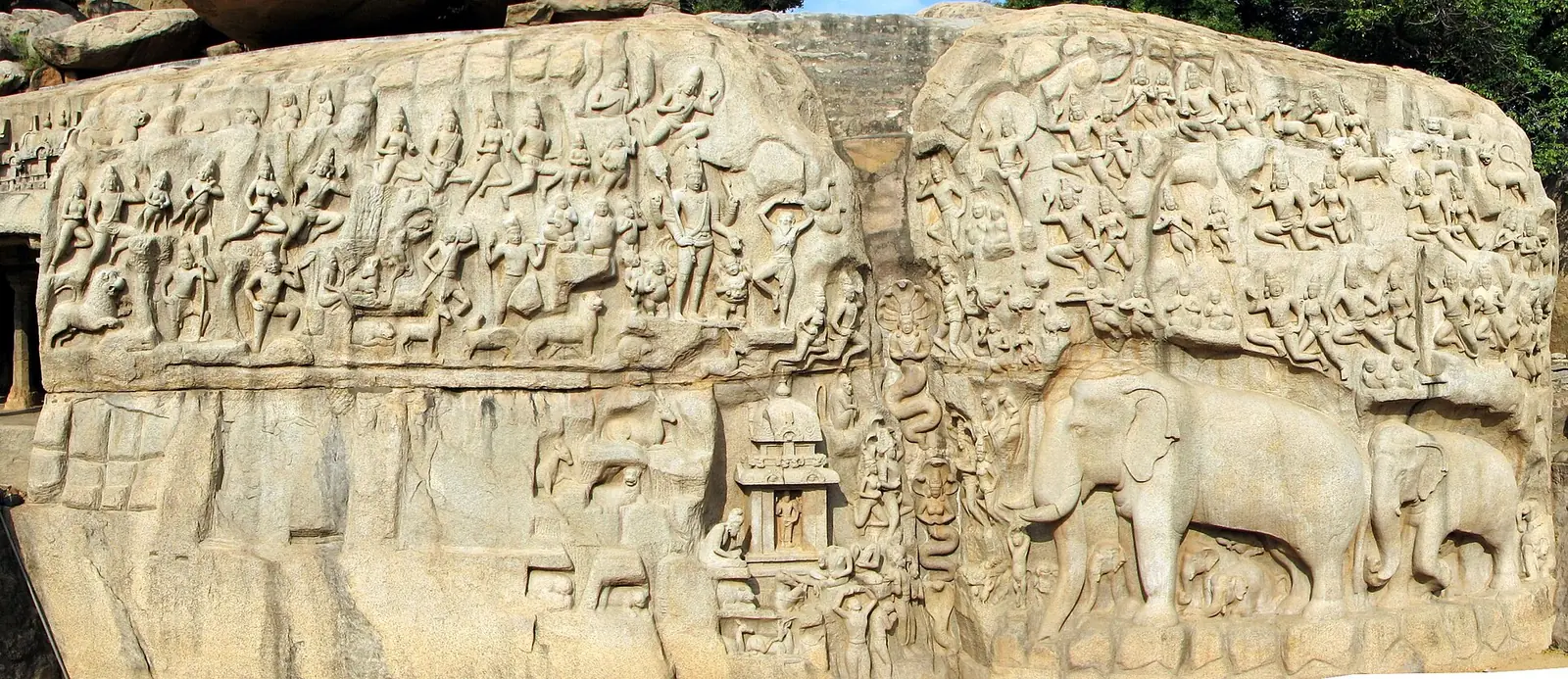
The Descent of the Ganga relief, Mamallapuram

7th–9th century CE · Mamallapuram, Kanchipuram (Tamil Nadu)

Pallava पल्लव

A whole granite cliff at Mamallapuram becomes Ganga descending from the sky.

The great relief at Mamallapuram shows Ganga coming down, with Bhagiratha (or Arjuna) in tapas, elephants life-size and a cat mimicking an ascetic. Pallava figures are slender and long-limbed. Durga battles Mahishasura in a nearby cave, and lions rear at the foot of pillars.

  • Slim, elongated figures in granite
  • Tall cylindrical crowns
  • Seated lions at pillar bases
  • Shallow, airy relief
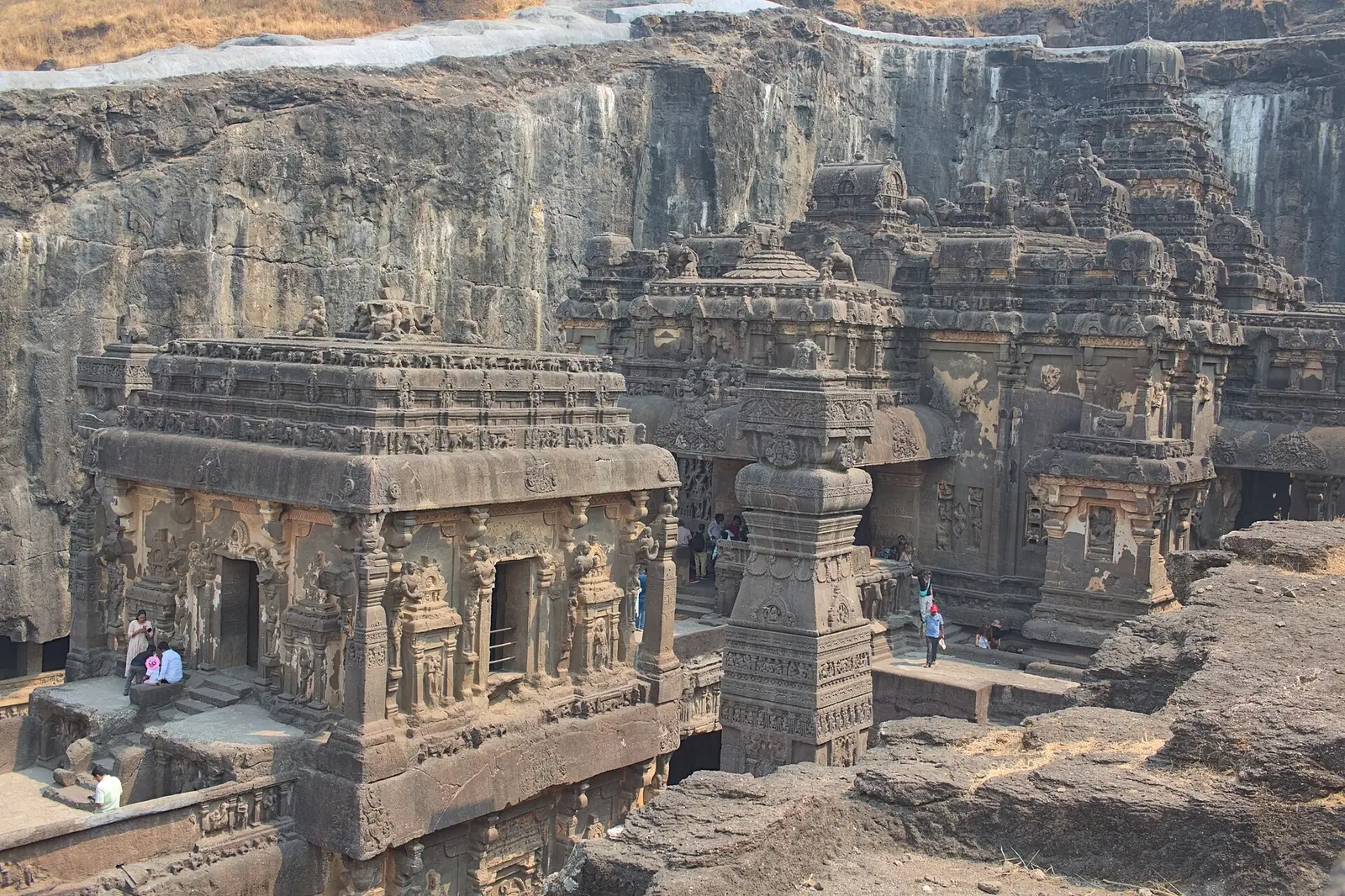
Kailasa temple, Ellora Cave 16

8th–10th century CE · Ellora, Maharashtra

Rashtrakuta राष्ट्रकूट

They cut a temple downward out of a hill, and carved Kailasa itself.

The Kailasa temple at Ellora, cave 16, was begun under Krishna I in the 8th century and cut from the top of a basalt hill. On its side Ravana shakes Kailasa and Shiva steadies it with one toe. Figures lean out of deep-cut panels as if alive.

  • Monolithic, rock-cut on a huge scale
  • Dramatic, deep-cut basalt panels
  • Figures in motion, flying ganas
  • Ravananugraha, Dashavatara panels
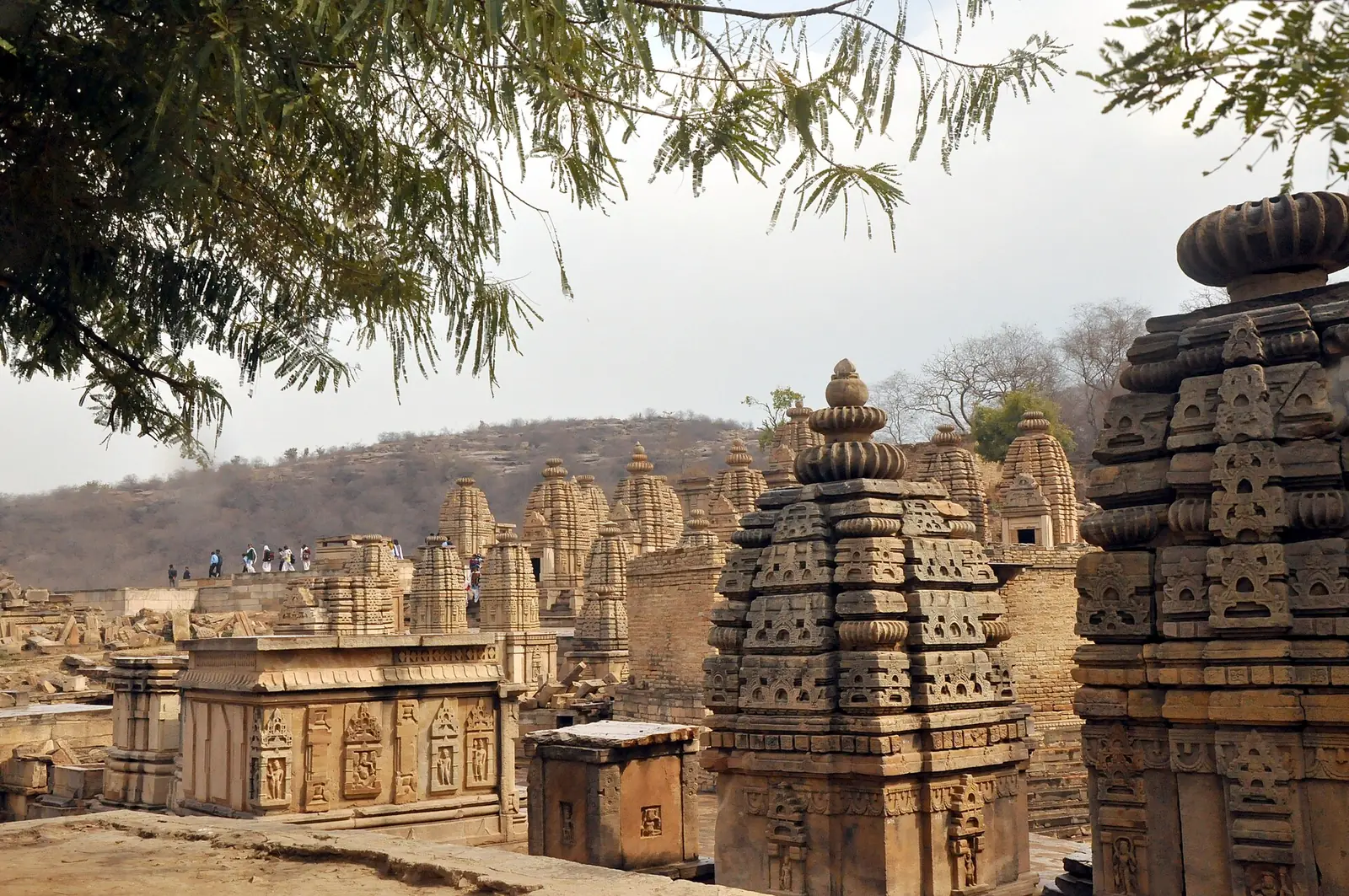
Bateshwar temples near Morena, Pratihara period

8th–10th century CE · Rajasthan, Gwalior, Malwa

Gurjara-Pratihara गुर्जर-प्रतिहार

Rows of small sandstone shrines at Bateshwar and Osian set the grammar of the north.

Pratihara carvers at Osian, Gwalior and Bateshwar framed every niche with pilasters and a little shikhara of its own. Surasundaris twist on the walls, and river goddesses guard the doors. Their sharp, clean style fed the Chandela and Solanki workshops that followed.

  • Buff or pink sandstone, crisp edges
  • Miniature shrine motifs in niches
  • Slender, swaying surasundaris
  • Ganga and Yamuna at door jambs
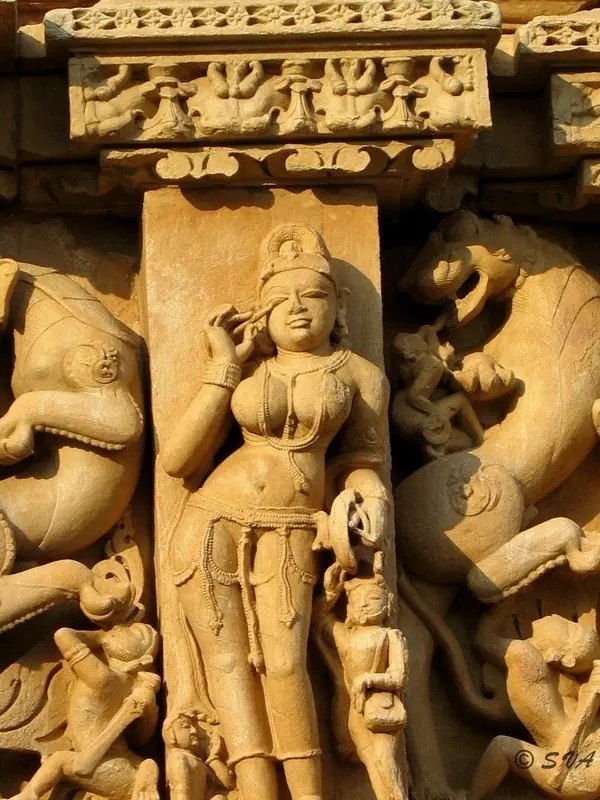
An apsara on a Khajuraho temple wall

c. 950–1050 CE · Khajuraho, Bundelkhand

Chandela चंदेल

At Khajuraho the walls are banded with apsaras who write letters, line their eyes and pull thorns.

The Kandariya Mahadeva and Lakshmana temples carry hundreds of figures in two or three bands around the walls. The surasundaris are the delight: a girl looking in a mirror, another bending to take a thorn from her foot. Devatas and dikpalas keep their places at the corners.

  • Two or three bands of figures on walls
  • Deeply twisted, three-bend poses
  • Pale buff sandstone
  • Everyday gestures of surasundaris
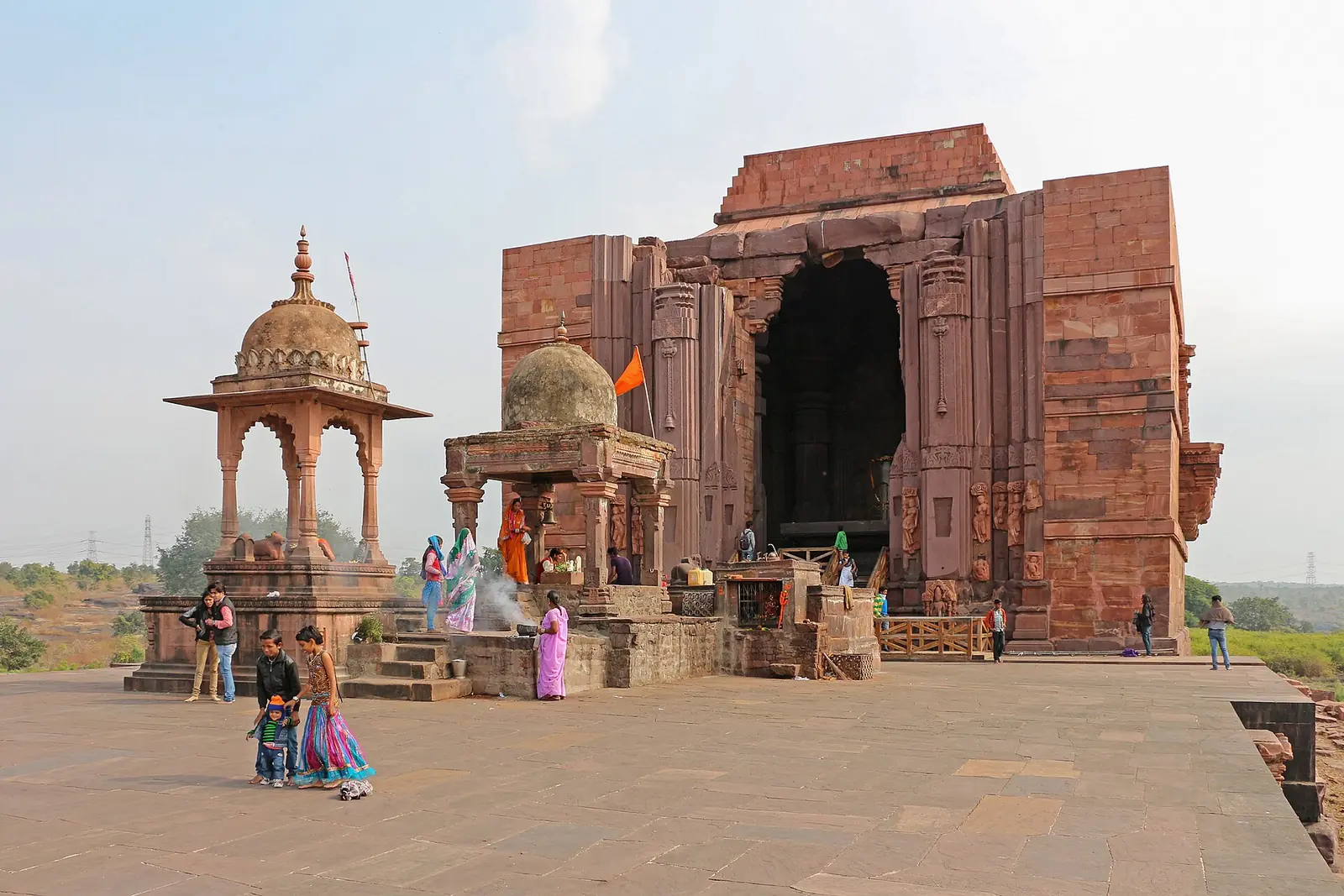
Bhojeshwar temple, Bhojpur

10th–13th century CE · Malwa, Madhya Pradesh

Paramara परमार

Raja Bhoja's Malwa: a vast linga at Bhojpur and the bhumija spire at Udayapur.

The Bhojeshwar temple at Bhojpur holds one of the largest lingas in India, its shrine left unfinished with the building ramp still in place. At Udayapur, the Udayeshwara temple was raised under Udayaditya between about 1059 and 1080, its spire covered in rows of small spirelets.

  • Bhumija spire of stacked miniature shikharas
  • Dense, lace-like surface carving
  • Pale sandstone
  • Huge stone linga at Bhojpur
Kalki, Rani ki Vav, Patan

11th–13th century CE · Gujarat, southern Rajasthan

Solanki (Chaulukya) सोलंकी

The Sun Temple at Modhera and the Rani ki Vav, where Vishnu's avatars line a stepwell.

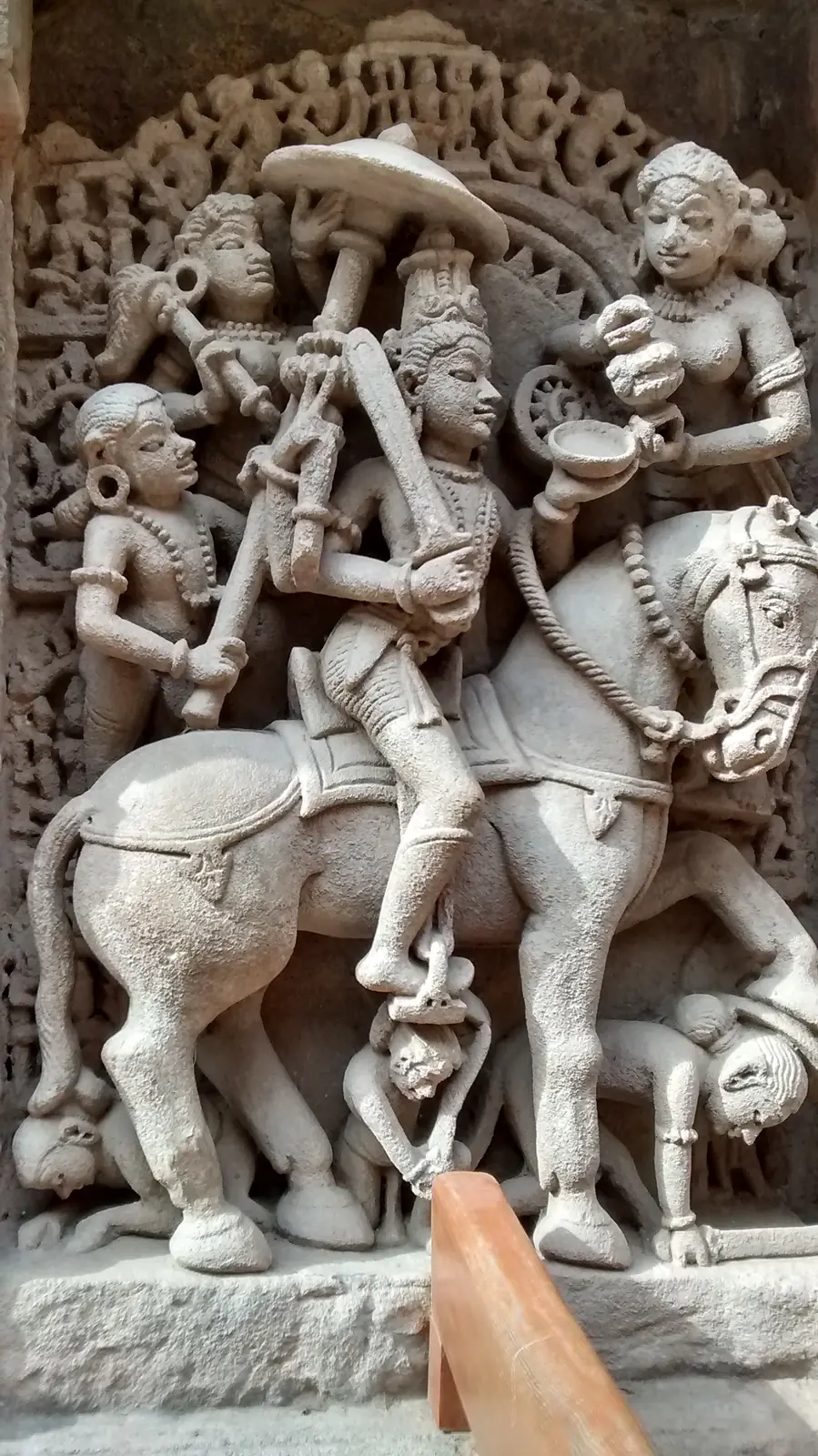
Modhera's Sun Temple was built in 1026–27 under Bhima I. Rani ki Vav at Patan, raised in his memory by Queen Udayamati, holds more than 500 principal sculptures, Vishnu outnumbering every other devata. The carving is crisp and jewelled, figures crowded shoulder to shoulder.

  • Crowded, jewel-heavy figures
  • Toranas with looping arches
  • Dashavatara sets in rows
  • Fine sandstone, almost metallic edges
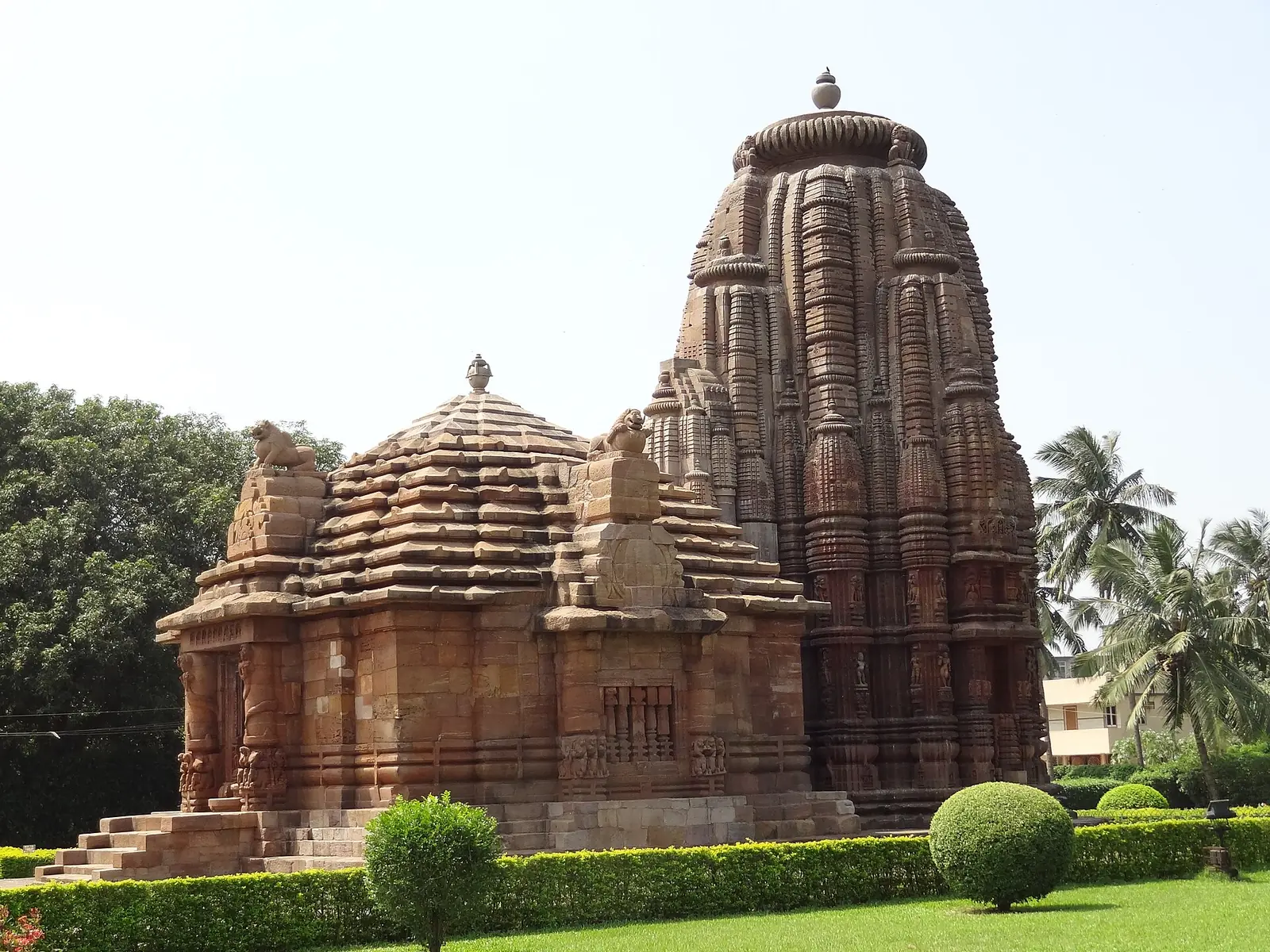
Rajarani temple, Bhubaneswar

9th–12th century CE · Bhubaneswar, Odisha

Kalinga (Somavamshi) कलिंग

The temple city of Bhubaneswar, where nayikas lean in every niche of soft orange stone.

The Mukteshwar temple, around 950 CE, stands behind an arched torana carved with women reclining along its curve. At Rajarani the nayikas hold mirrors, children and branches. Lingaraja crowns the city. Odisha calls its craft deula, and the sculptors still work in the same stone.

  • Orange-grey sandstone and khondalite
  • Nayikas in every wall recess
  • Arched torana at Mukteshwar
  • Rekha deula with ribbed spire
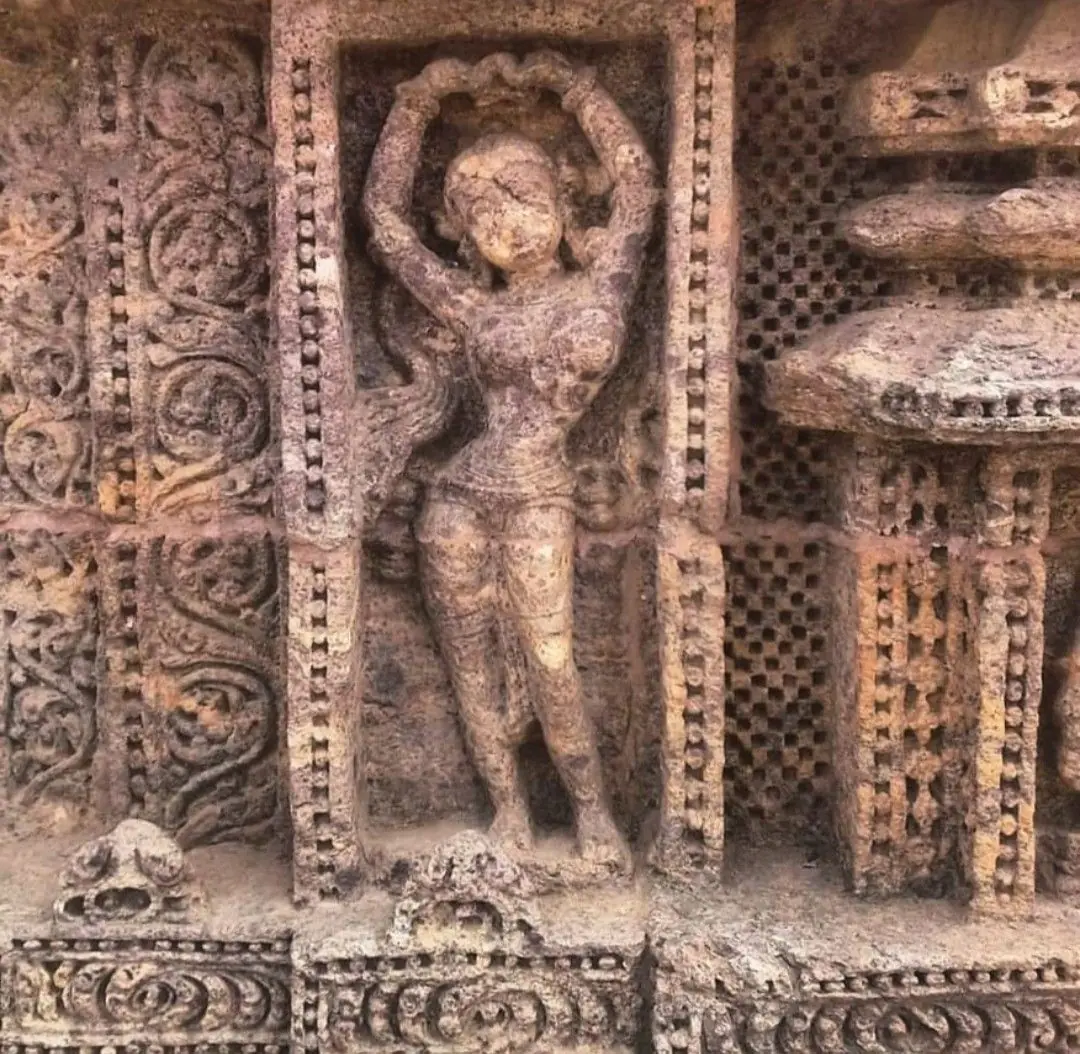
Alasa kanya from the Natya mandapa, Konark, 13th century

11th–15th century CE · Puri, Konark (Odisha)

Eastern Ganga (Konark) पूर्वी गंग

Surya's chariot in stone at Konark, with twenty-four wheels and musicians on the roof.

The Konark Sun Temple was built in the 13th century under Narasimhadeva I as the chariot of Surya, drawn by seven horses on twenty-four carved wheels. On the terraces of the roof, women play drums and cymbals for the Sun. Below, the alasa kanya stretches at the end of the dance.

  • Carved wheels with spokes and medallions
  • Life-size musicians on the roof
  • Alasa kanya, the languid maiden
  • Elephants and war horses at the base
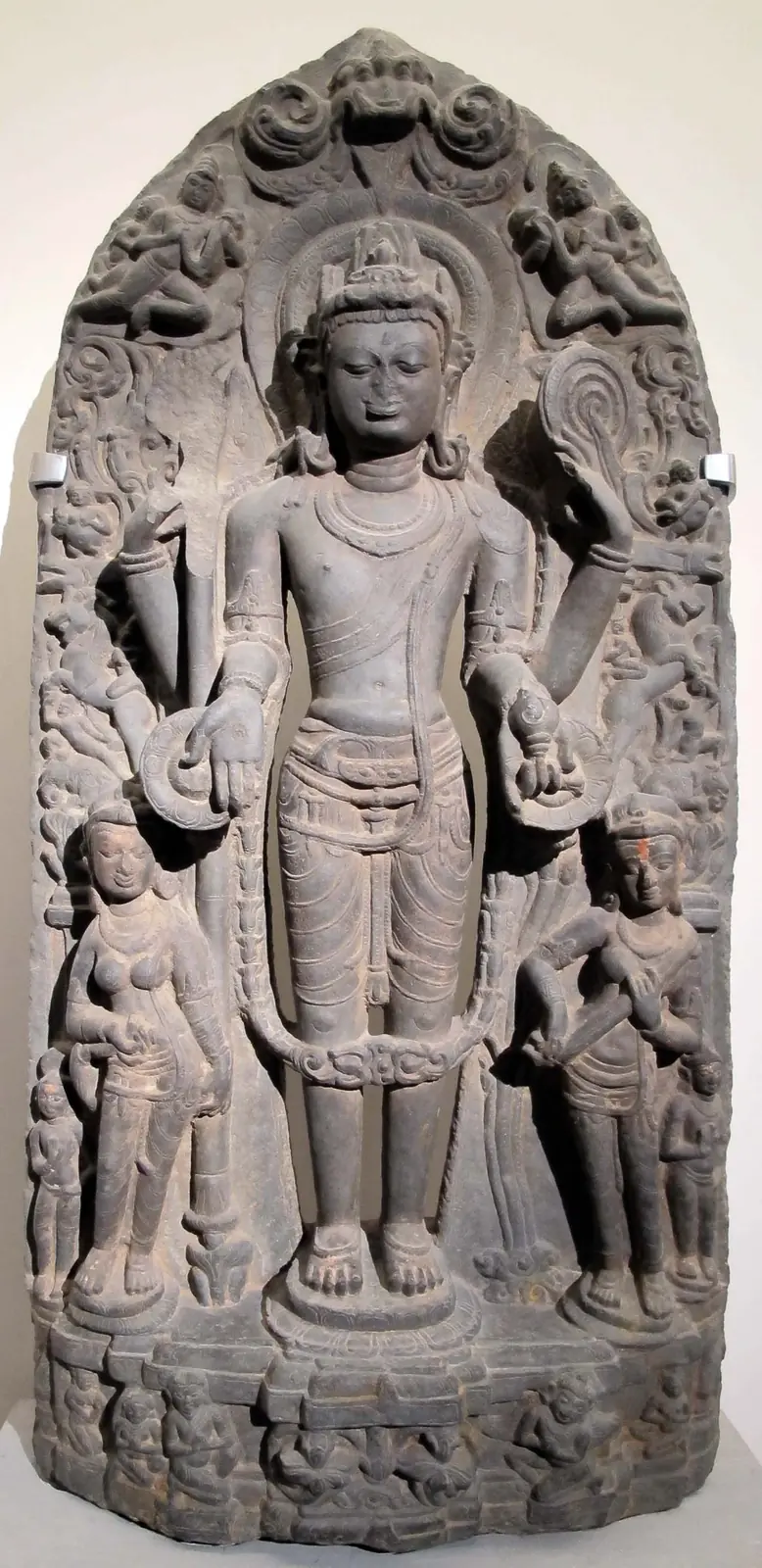
Vishnu Vasudeva, Bengal, 12th century

8th–12th century CE · Bengal, Bihar

Pala-Sena पाल-सेन

Black stone polished to a dark sheen, Vishnu standing between Lakshmi and Saraswati.

Eastern Indian carvers worked in black stone, setting each devata on a stele with a pointed top and a lotus pedestal. Vishnu stands straight with Lakshmi and Saraswati at his sides. Bronzes from these workshops carried the style to Nepal and Tibet.

  • Black basalt or phyllite stele
  • Pointed, leaf-shaped back slab
  • Rigid frontal stance, many attendants
  • Heavy jewellery, sharp features
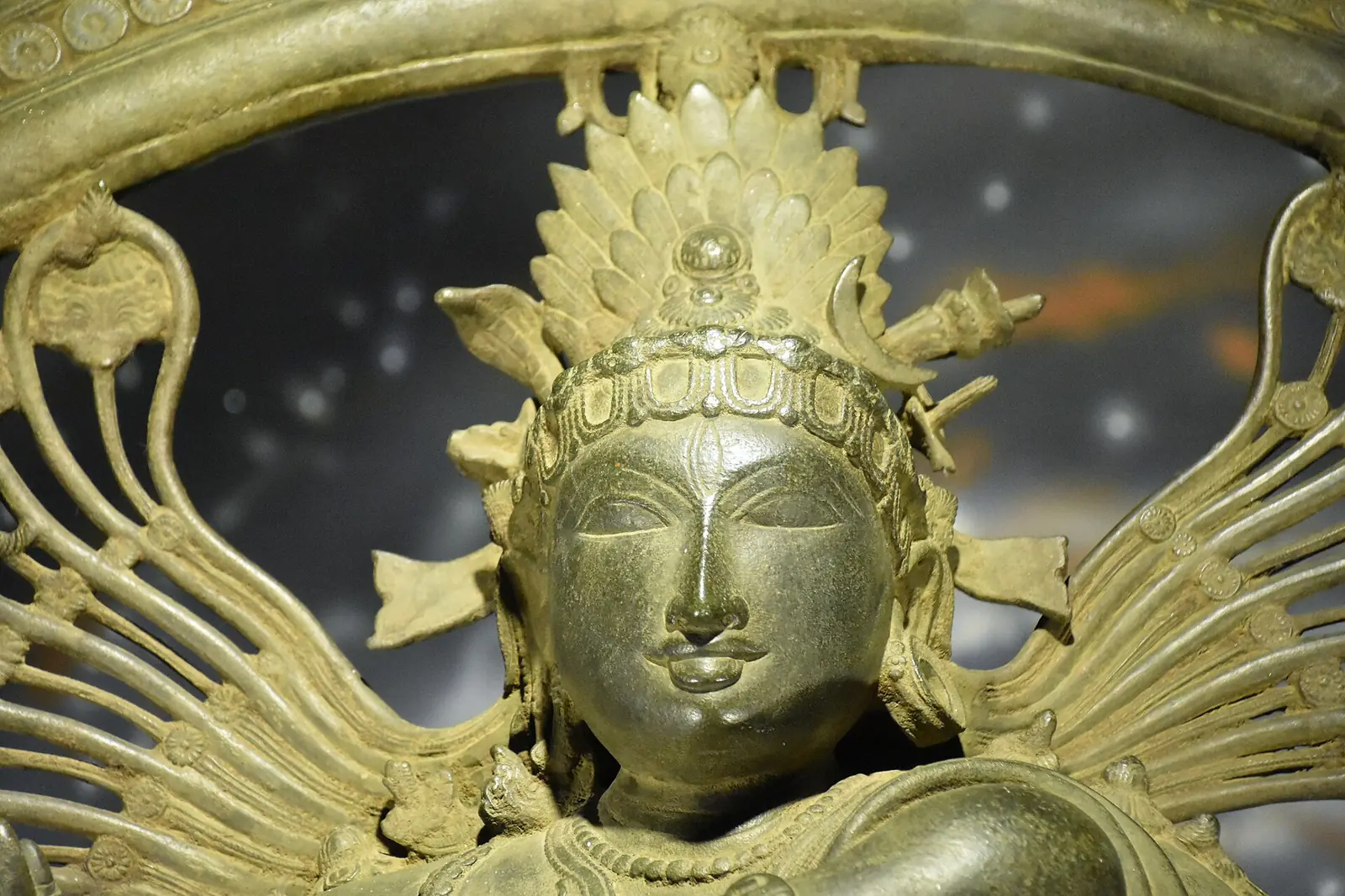
Nataraja, Chola bronze, 11th century, Government Museum, Chennai

c. 850–1250 CE · Kaveri delta, Tamil Nadu

Chola bronzes चोल कांस्य

Nataraja in a ring of fire, cast in metal to be carried through the streets.

Chola bronzes were cast by the lost-wax method in a clay mould, then finished by hand. Most are about half life-size and have lugs on the base for carrying poles, because they go out on festival days. Nataraja dances on Apasmara inside a ring of flame, his drum raised.

  • Lost-wax cast, panchaloha alloy
  • Lugs or holes at the base for poles
  • Nataraja in the ring of fire
  • Slim waist, soft, swaying stance
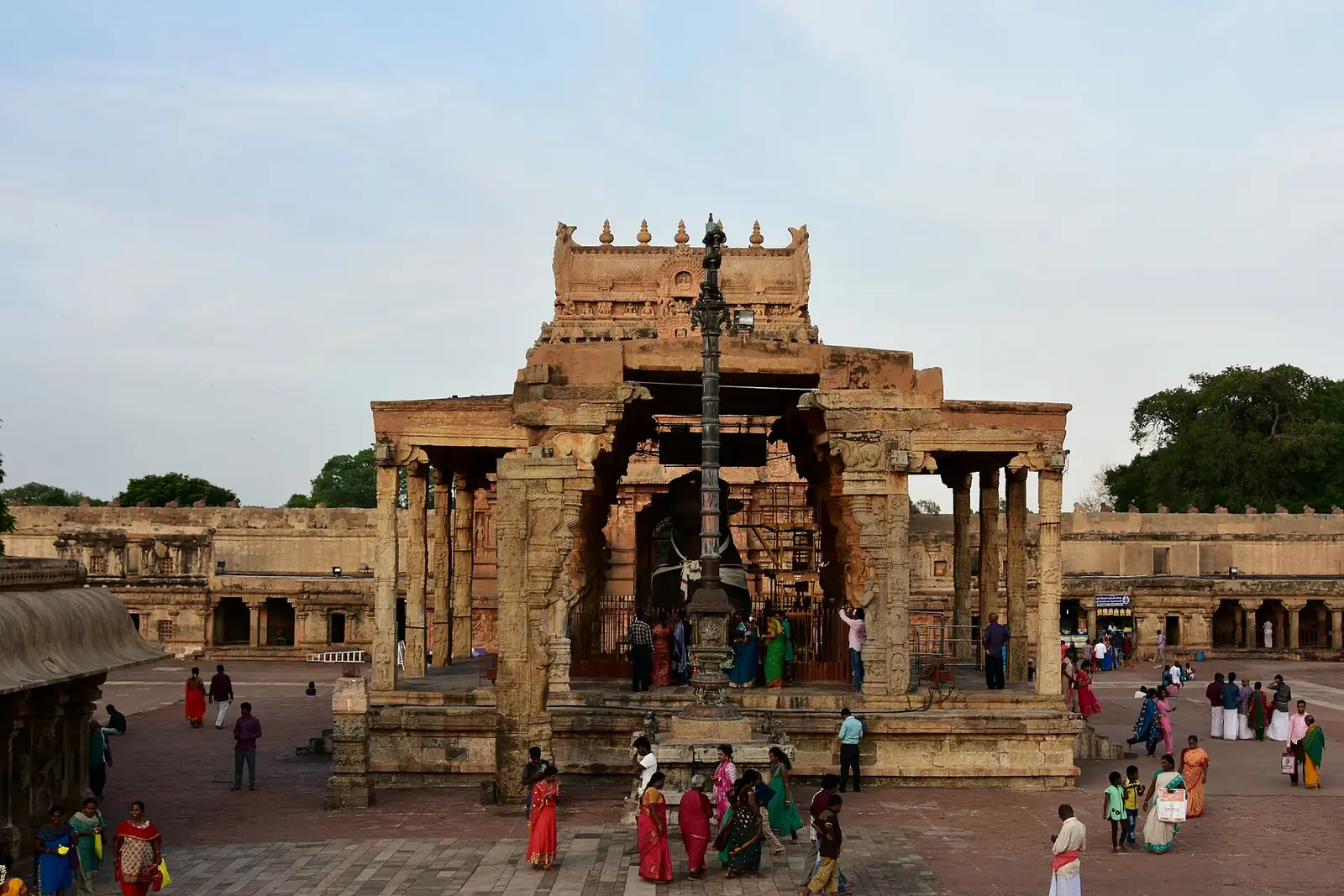
The Nandi mandapam

c. 850–1250 CE · Thanjavur, Gangaikonda Cholapuram, Darasuram

Chola stone चोल शिल्प

In the wall niches of Thanjavur, Dakshinamurti teaches in silence under his tree.

Rajaraja I completed the Brihadeeswara temple in 1010. Chola temples keep a fixed set of niche images: Dakshinamurti on the south, Lingodbhava on the west, Brahma on the north, Durga on her buffalo head. The figures are calm and spare, with long limbs.

  • Few, large niche figures
  • Dakshinamurti on the south wall
  • Lingodbhava at the back of the shrine
  • Granite, quiet surfaces
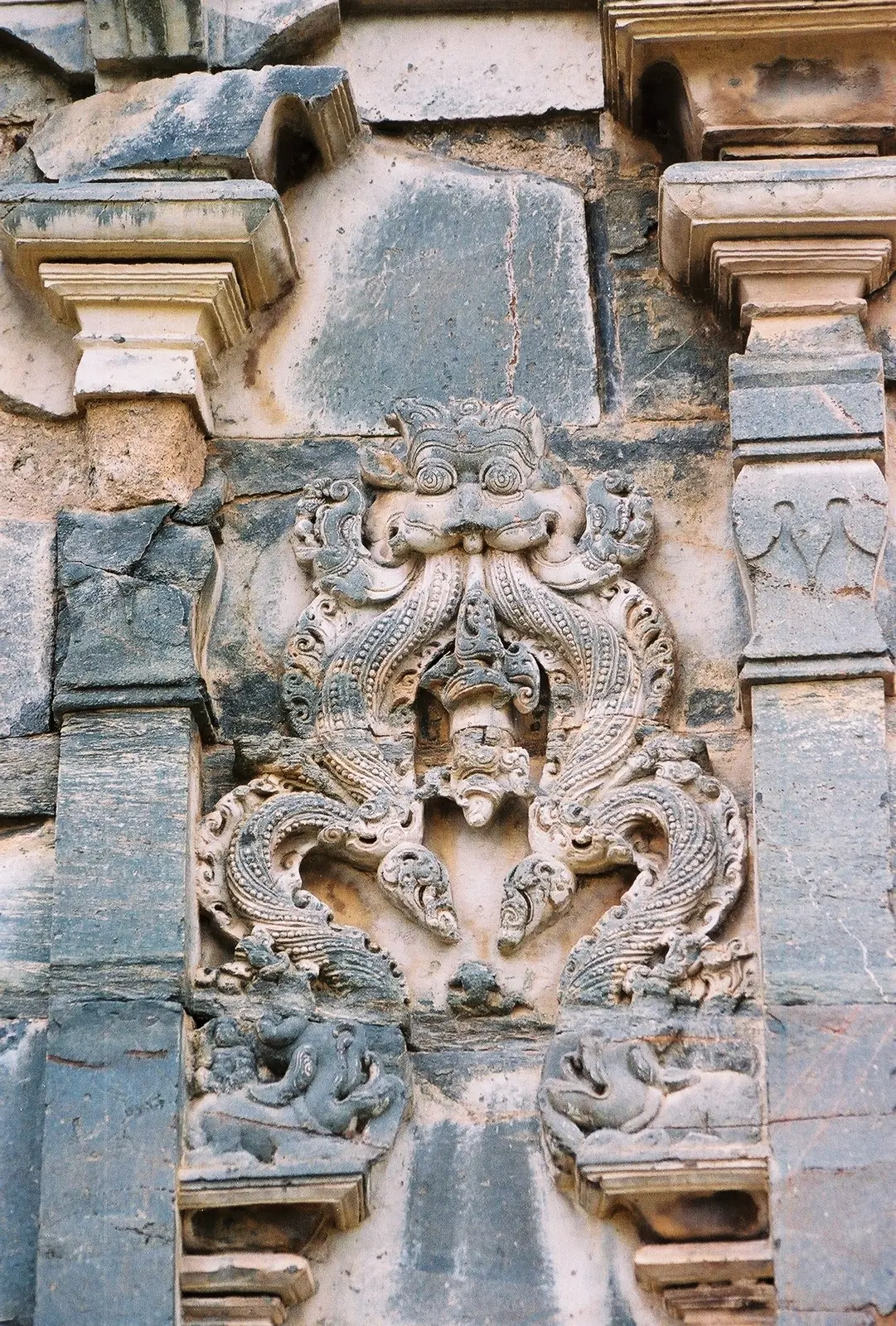
Kirtimukha, Kasi Vishveshvara temple, Lakkundi

11th–12th century CE · Lakkundi, Itagi, Dambal (Karnataka)

Kalyani Chalukya कल्याणी चालुक्य

Lathe-turned pillars and a kirtimukha over every door, just before the Hoysalas.

The Western Chalukyas of Kalyani moved to soft green-grey schist and carved it with the precision of metal. An inscription of 1112 at Itagi calls its Mahadeva temple the emperor among temples. Lakkundi's doorways open beneath snarling kirtimukha faces.

  • Lathe-turned, bell-shaped pillars
  • Grey-green schist
  • Kirtimukha over doorways
  • Doorframes with many carved bands
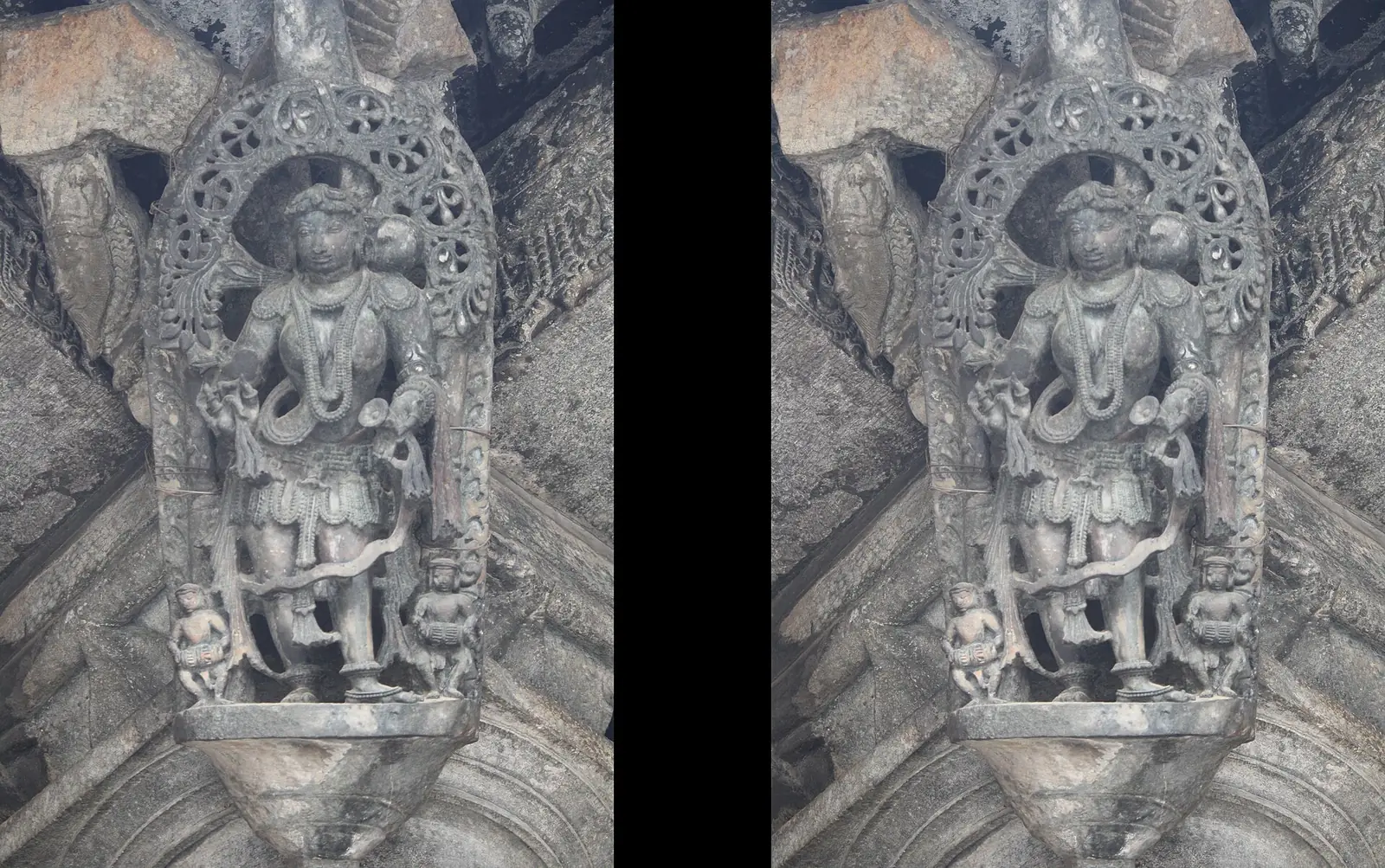
Madanika, Chennakeshava temple, Belur

12th–13th century CE · Belur, Halebidu, Somanathapura (Karnataka)

Hoysala होयसल

Soapstone carved like ivory, and maidens on the brackets signed by their sculptors.

Belur's Chennakeshava was consecrated in 1117 under Vishnuvardhana. Of its roughly forty madanika bracket figures, thirty-eight survive, some signed by Dasoja and his son Chavana. Below them run friezes of elephants, lions and horsemen, each band its own height. Halebidu adds the Ramayana and Mahabharata.

  • Soft chloritic schist, ivory-fine detail
  • Madanika bracket maidens
  • Stacked friezes: elephants, horses, kathas
  • Star-shaped plans, jewelled figures
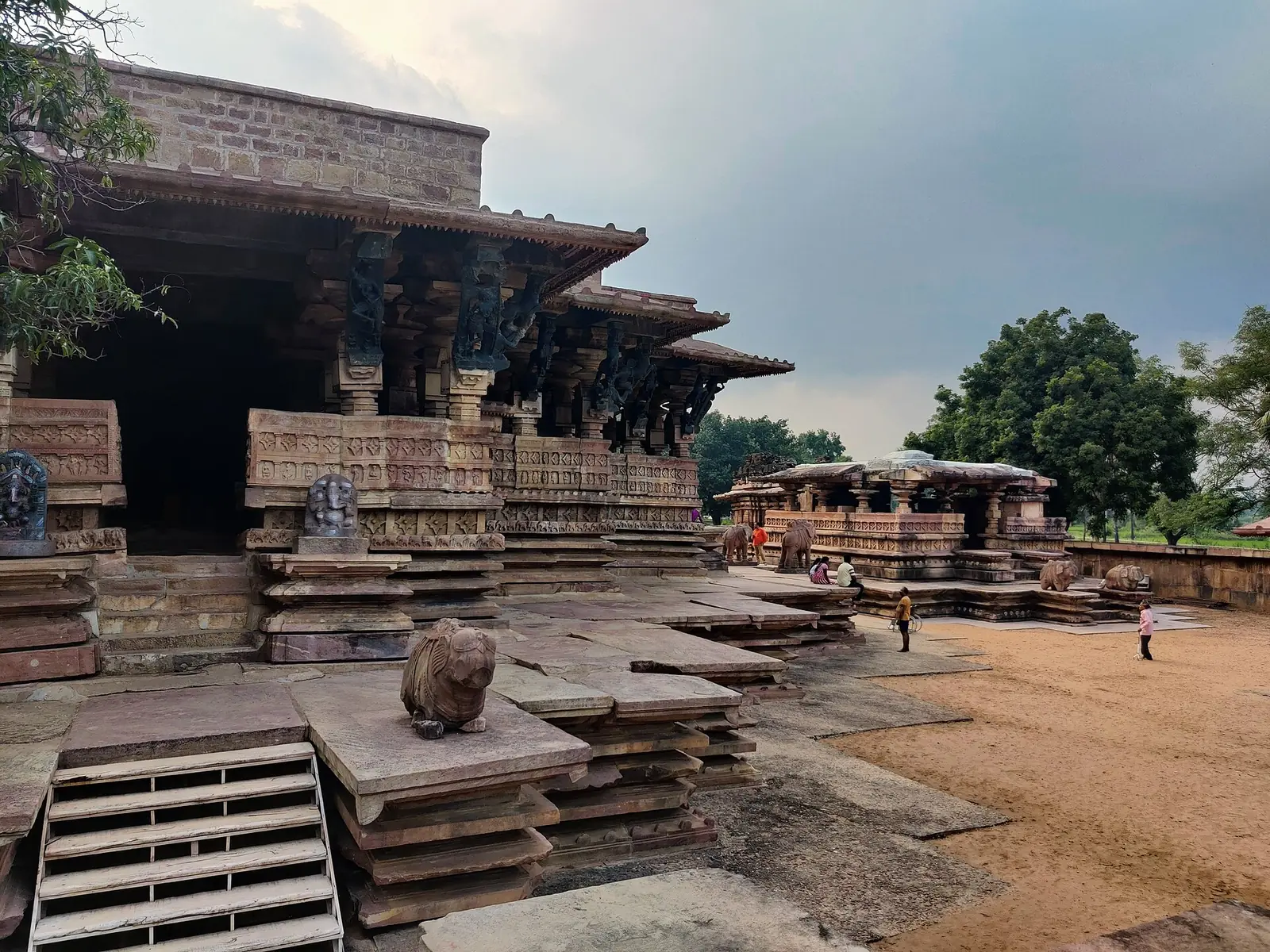
Ramappa temple, Palampet

12th–14th century CE · Warangal, Palampet (Telangana)

Kakatiya काकतीय

Black dolerite dancers lean out from the pillars of Ramappa, named for its sculptor.

The Ramappa temple was begun in 1213 by the general Recherla Rudra under Ganapati Deva, and carries the name of its master craftsman. Its bracket maidens are carved in black dolerite polished to a shine. The temple became a World Heritage Site in 2021.

  • Polished black dolerite brackets
  • Dancers and musicians on pillars
  • Lightweight bricks in the spire
  • Kirti torana gateways at Warangal
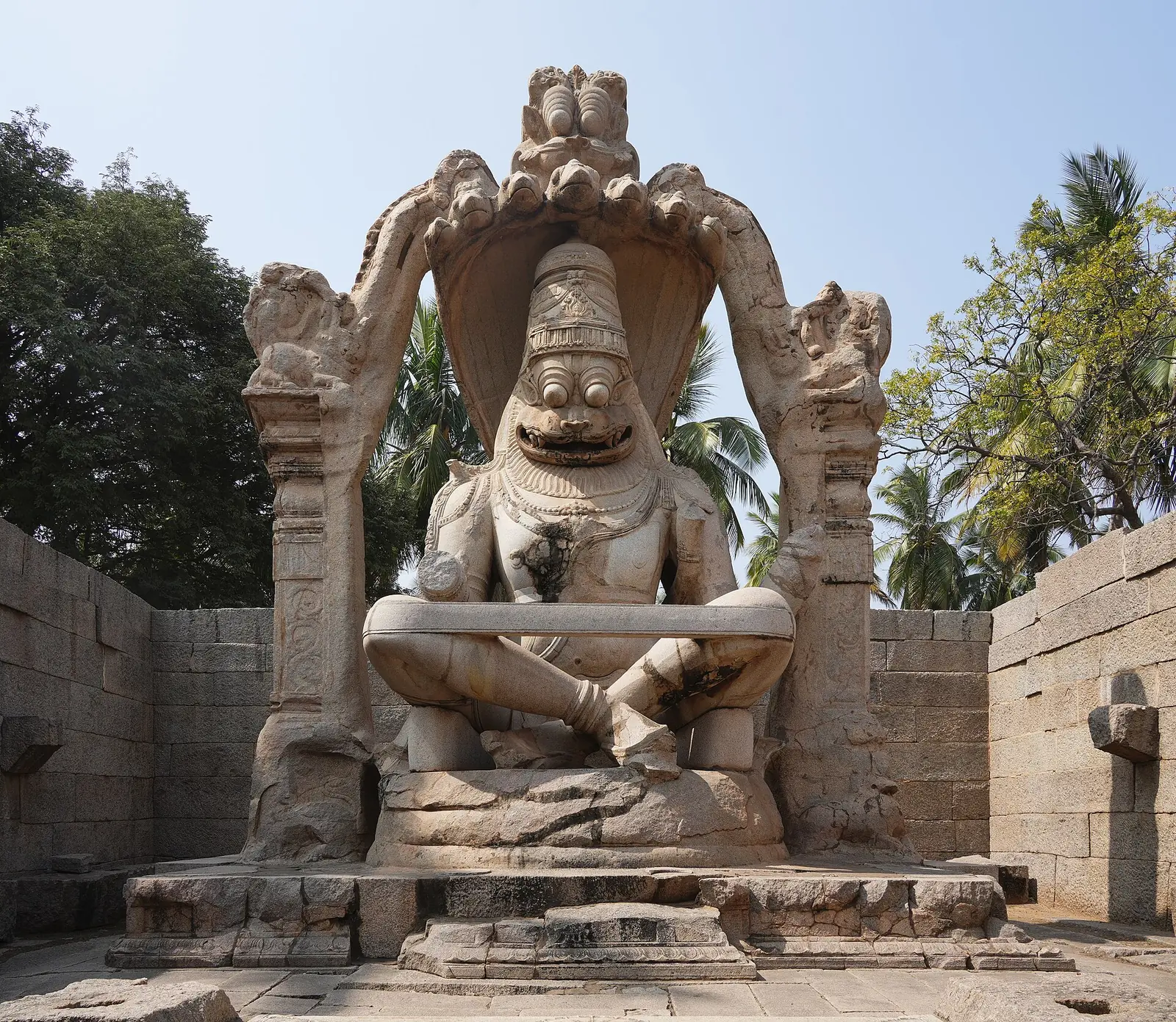
Lakshmi Narasimha monolith, Hampi

14th–16th century CE · Hampi and the south

Vijayanagara विजयनगर

Granite boulders become Narasimha, horses rear from pillars, and the Ramayana runs round a wall.

At Hampi the Lakshmi Narasimha monolith, about 6.7 m high, was consecrated in 1528 in Krishnadevaraya's reign. Mandapa pillars sprout rearing yalis and horses with riders. The Hazara Rama temple wraps its walls in Ramayana panels, scene after scene.

  • Granite, often cut from boulders in place
  • Rearing yali and horse pillars
  • Continuous Ramayana panels
  • Musical and composite pillars
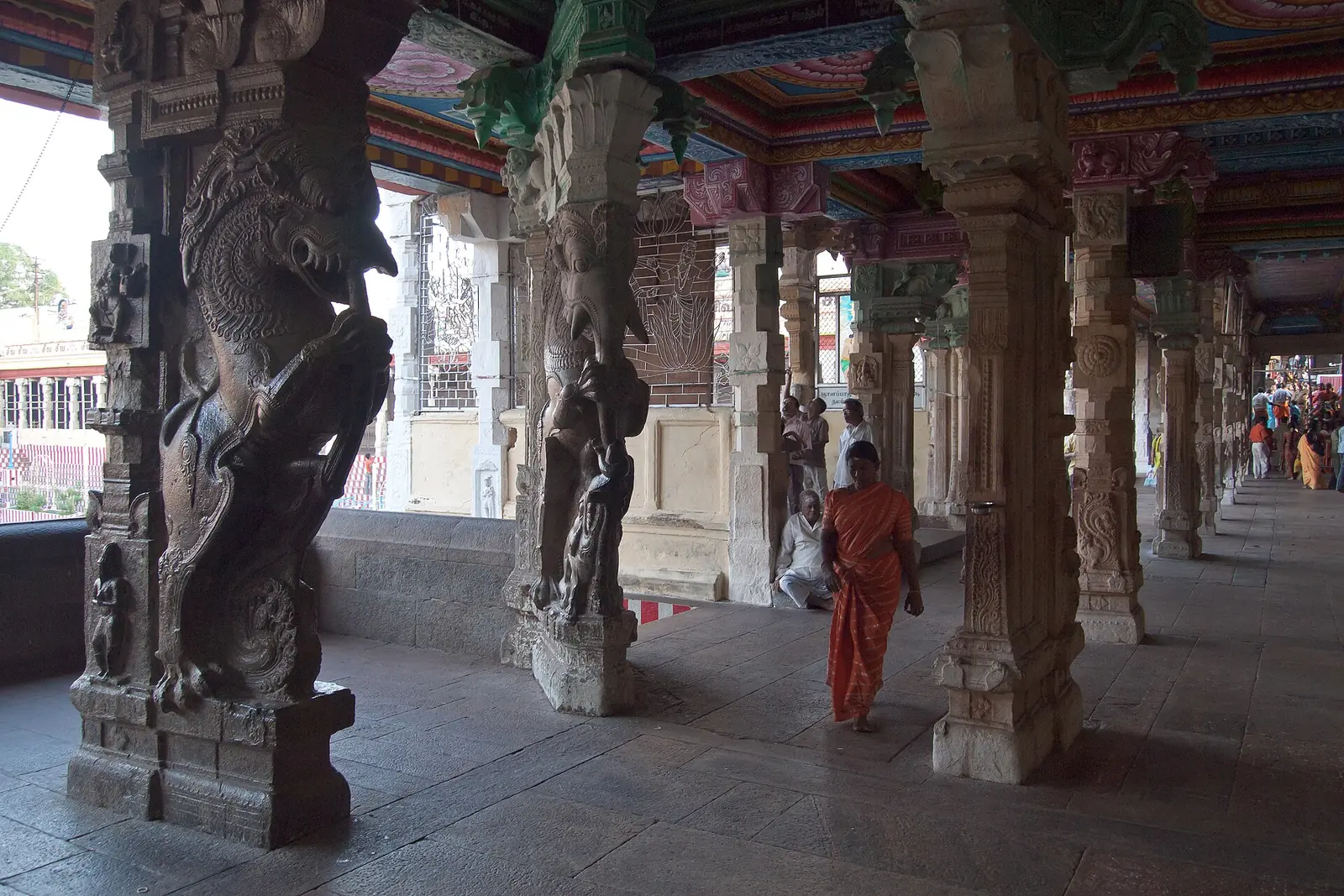
Carved pillars of a mandapa

16th–18th century CE · Madurai, Thanjavur, Srirangam

Nayaka नायक

Pillars carved into life-size figures, and gopurams crowded with painted stucco devatas.

The Nayakas of Madurai and Thanjavur carved whole pillars into figures: yalis, warriors on horseback, the donors themselves with folded hands. Tirumala Nayaka's Pudu Mandapam at Madurai is lined with them. On the gopurams, hundreds of stucco figures are repainted whenever the temple is renewed.

  • Figure pillars, often life-size
  • Portrait statues of royal donors
  • Painted stucco on gopurams
  • Long pillared corridors
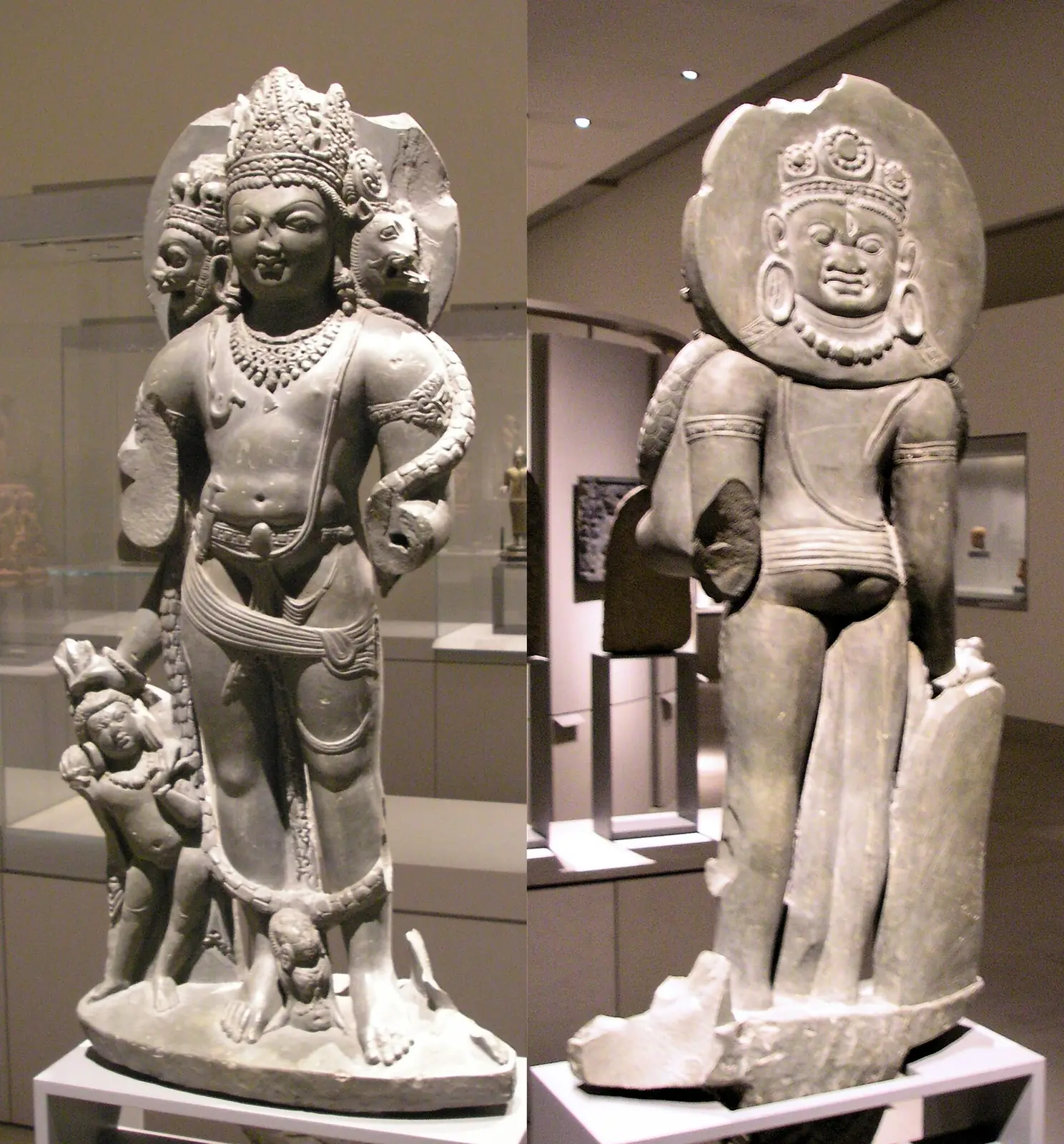
Vaikuntha Chaturmurti, Kashmir, 9th century

7th–11th century CE · Kashmir valley

Kashmir कश्मीर

Vishnu with four faces: man, lion, boar, and a fierce face behind.

Kashmir's great icon is Vaikuntha Chaturmurti: a human face in front, Narasimha and Varaha at the sides, a fierce face at the back. The Karkota and Utpala kings honoured it; Avantivarman's temples at Avantipur show it often. Bodies are sturdy and full of breath.

  • Grey stone or brass, strong bodies
  • Four-faced Vishnu
  • Small dagger tucked at the hip
  • Personified weapons beside the legs
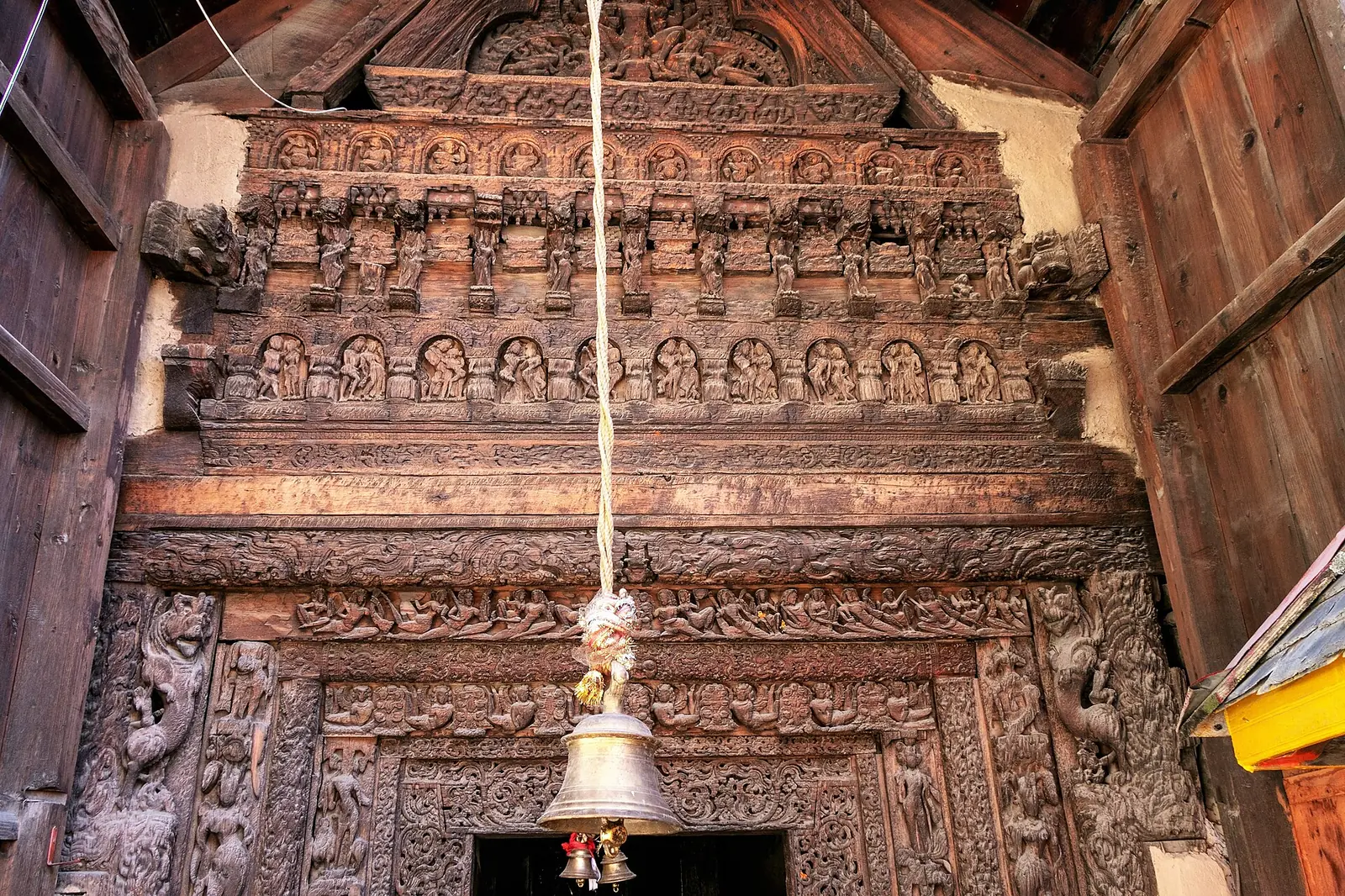
Carved wooden facade of the Lakshana Devi temple, Bharmour

7th–11th century CE · Chamba and Bharmour (Himachal Pradesh)

Chamba and the hills चंबा

Brass devis behind carved deodar doorways, high in the Ravi valley.

At Bharmour the Lakshana Devi temple keeps its carved wooden facade and a brass Mahishasuramardini with an inscription of Meruvarman, usually dated to about 700 CE. Metal images of the same school survive at Chhatrari and in Chamba's Bhuri Singh Museum.

  • Cast brass images with inscriptions
  • Carved deodar doorframes
  • Wooden temple facades
  • Kashmiri and Gupta echoes
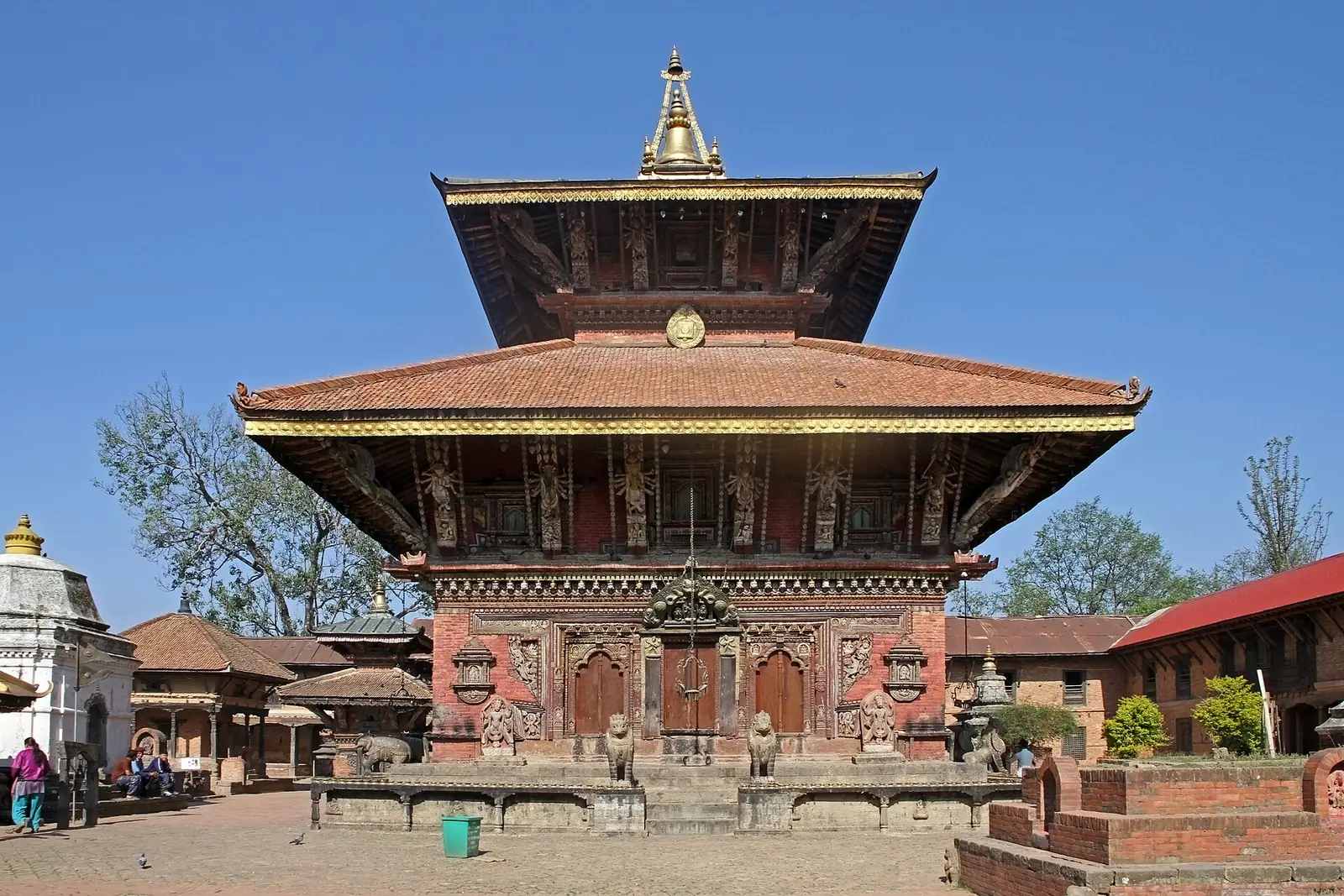
Garuda Narayana at Changu Narayan

5th–18th century CE · Kathmandu valley

Nepal (Licchavi and Malla) नेपाल

Garuda kneels before Changu Narayan, and gilded copper devatas glow in Patan.

Licchavi kings set up stone images that still receive puja: the kneeling Garuda at Changu Narayan, Vishnu sleeping on the water at Budhanilkantha. The Malla centuries added gilded copper, carved roof struts with devatas, and stone water spouts in the form of makaras.

  • Stone Vishnus of the Licchavi age
  • Gilded copper repoussé
  • Carved wooden roof struts
  • Makara-mouth water spouts
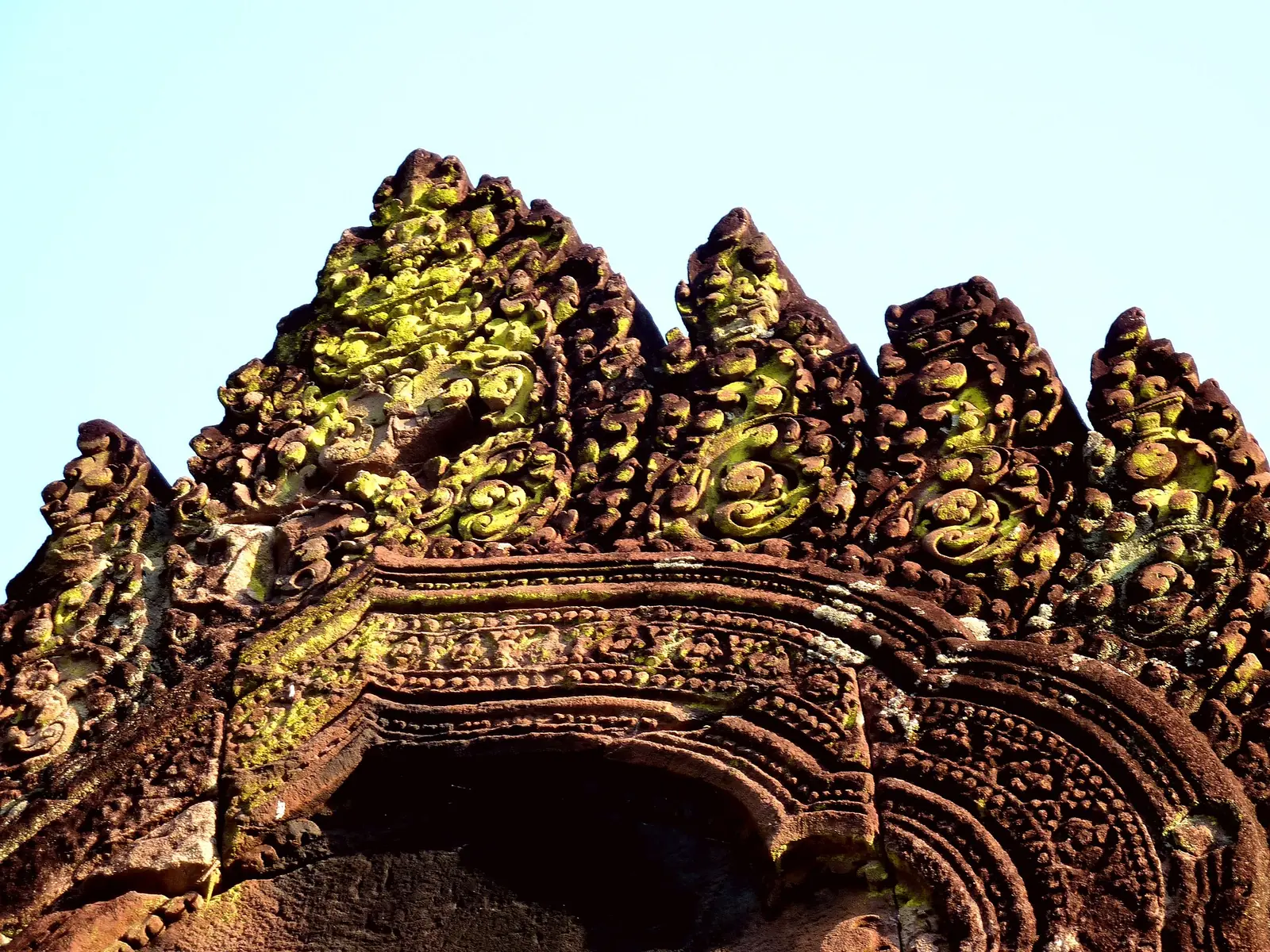
A carved pediment at Banteay Srei, Cambodia

7th–13th century CE · Cambodia

Khmer ख्मेर

Pink sandstone at Banteay Srei, carved so finely it looks like woodwork.

Banteay Srei was consecrated on 22 April 967 for Shiva, built by the counsellor Yajnavaraha. Its pediments carry full kathas, among them Ravana shaking Kailasa. Two centuries later, Angkor Wat's gallery showed the churning of the ocean along one long wall.

  • Red-pink sandstone
  • Narrative pediments over doorways
  • Devatas with tall, layered crowns
  • Long bas-relief galleries at Angkor
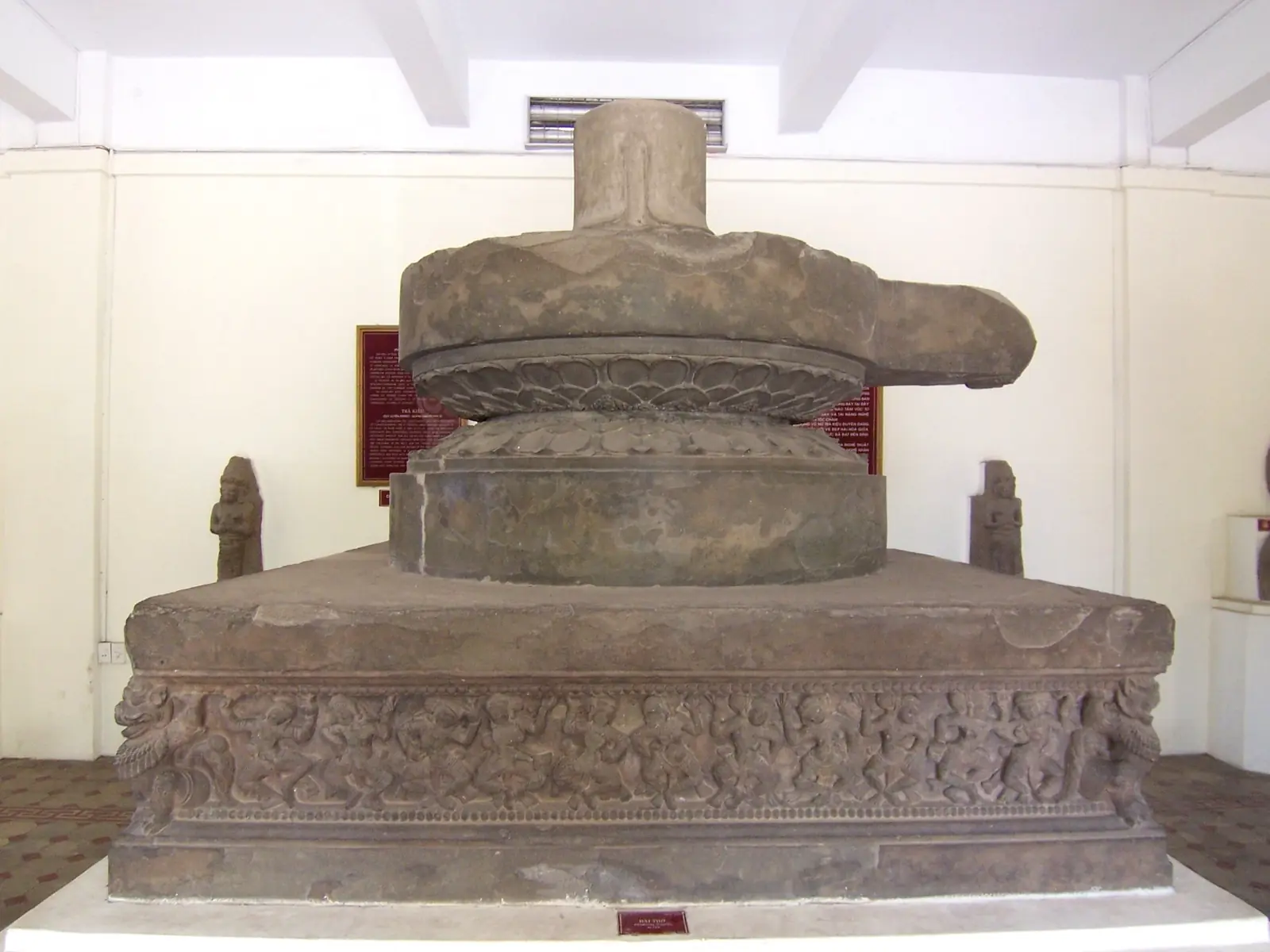
The Tra Kieu pedestal, Museum of Cham Sculpture, Da Nang

7th–13th century CE · Central Vietnam

Champa चम्पा

Brick towers to Shiva at My Son, and dancing apsaras round a pedestal at Tra Kieu.

The Cham kings built brick temples to Bhadreshvara, Shiva of their land, in the valley of My Son. Their sculptors worked sandstone into lingas on square pedestals and lively friezes. The Tra Kieu pedestal, now in the Da Nang Museum of Cham Sculpture, rings with dancers and musicians.

  • Linga on a square, spouted pedestal
  • Dancers and musicians on pedestal sides
  • Fired-brick towers
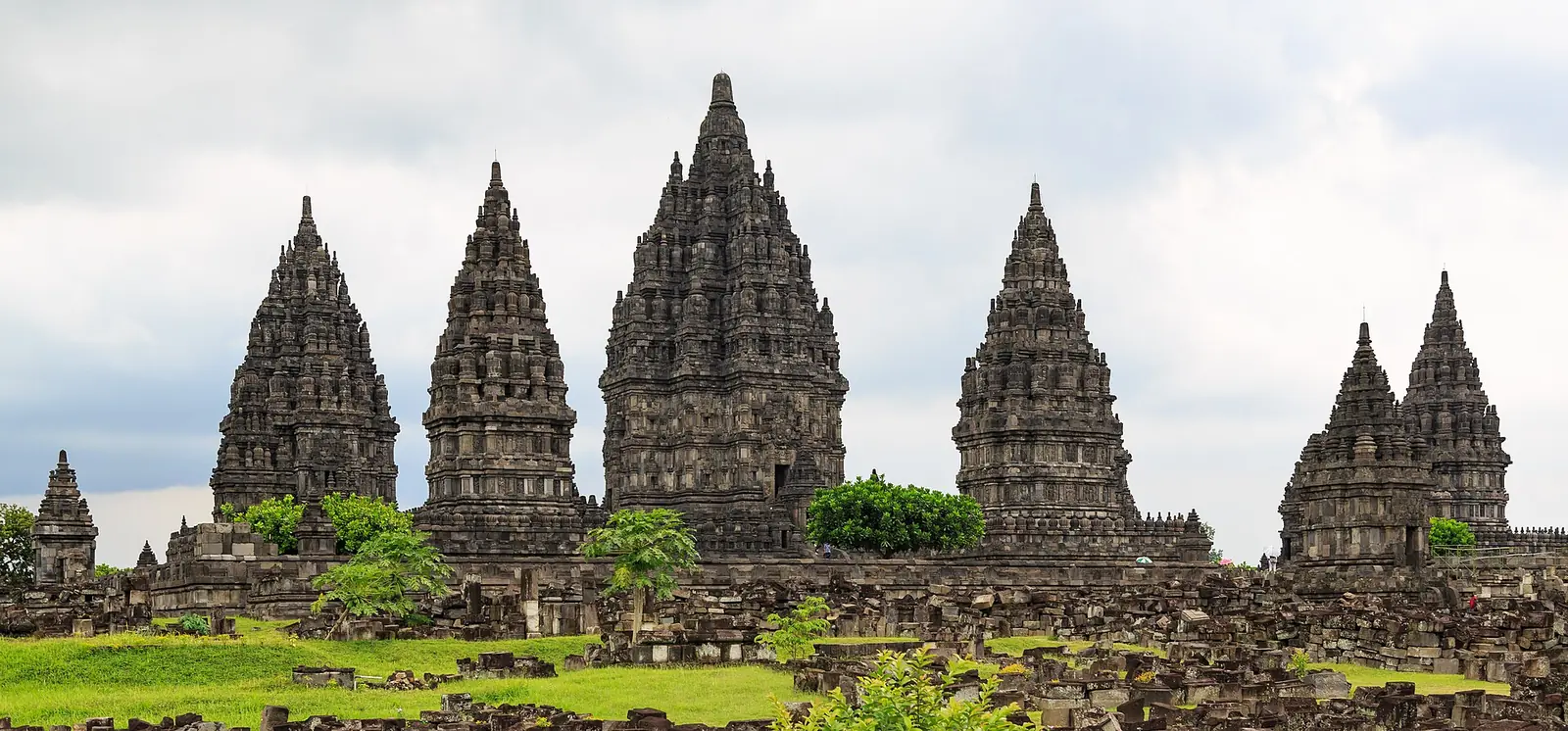
The Trimurti shrines of Prambanan

8th–15th century CE · Central and East Java

Java जावा

At Prambanan the Ramayana is carved round Shiva's temple for pilgrims walking the parikrama.

Prambanan, the Shivagrha, was inaugurated in 856 with shrines to Shiva, Vishnu and Brahma. The Ramayana runs along the balustrade of the Shiva temple and continues on Brahma's; Krishna's kathas run round Vishnu's. You read them walking clockwise.

  • Volcanic andesite stone
  • Narrative panels on balustrades
  • Kala faces over doorways
  • Trimurti shrines with vahana temples