
Step 1 of 7 · Nagara (north Indian), at Khajuraho
The jagati, the platform
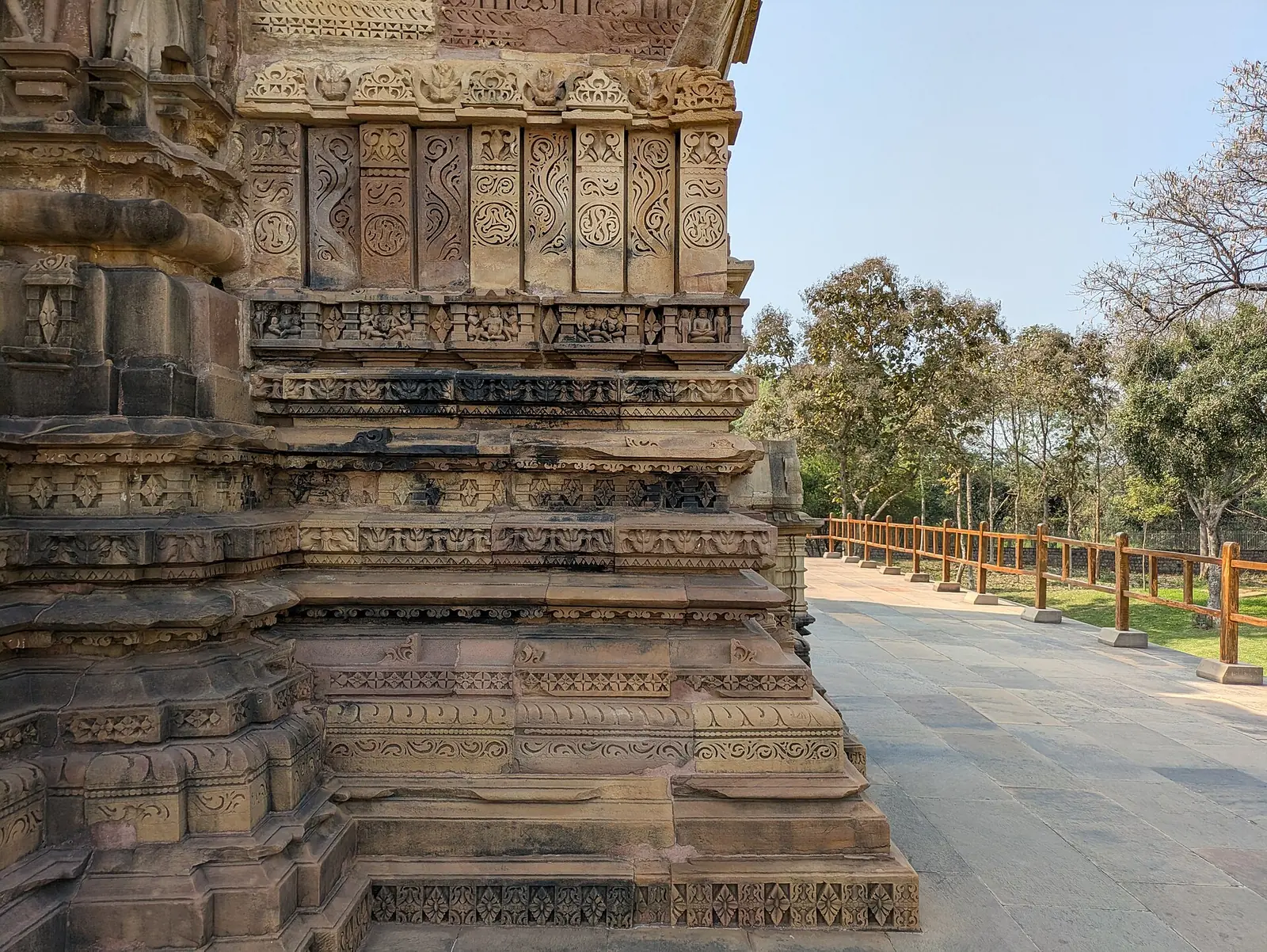
The jagati is the raised terrace on which the whole temple stands. At Khajuraho it is a high platform reached by steps, and its top is the path for walking round the shrine. In Hoysala temples the jagati follows the star-shaped plan of the shrine.
Look for: Follow the stacked bands of carving from the paving up to the foot of the wall.
Quick question. What is the top of the jagati used for at Khajuraho?
- Storing the festival chariot
- Walking round the shrine
- Seating the musicians
Show the answer
Walking round the shrine. At Khajuraho the top of the jagati is the path for walking round.
Step 2 of 7 · A simple schematic plan, not tied to one style
Sanctum, vestibule and hall
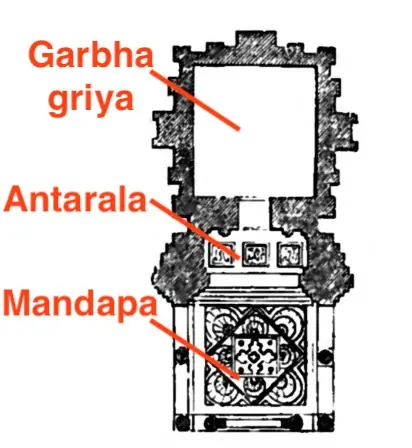
The garbhagriha is the sanctum where the murti dwells, usually a plain square room with thick walls and a single door. The antarala, a short passage where devotees stand for darshan, joins it to the mandapa, the pillared hall. So much is structure; for the meaning, Kramrisch notes that the darkness of the sanctum is intended, the seed from which the whole temple grows. No single plan fits every temple.
Look for: Find the three labelled spaces in a row: garbhagriha, antarala, mandapa.
Quick question. Which space joins the sanctum to the hall, and is where devotees stand for darshan?
- The antarala
- The jagati
- The gopuram
Show the answer
The antarala. The antarala is the short passage between garbhagriha and mandapa, and devotees stand there for darshan.
Step 3 of 7 · Nagara (north Indian), at Khajuraho
The jangha, the wall
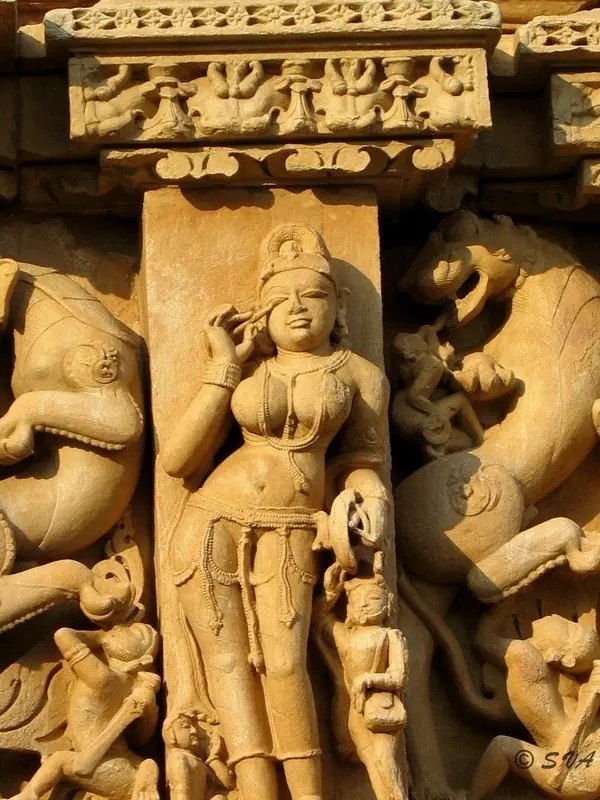
The jangha, a word that means shin, is the wall of the sanctum. In northern temples it carries niches for dikpalas, apsaras and forms of the main deity, often in two or three registers. Above it a cornice zone, the varandika, marks where the wall ends and the tower begins. The walls of Kandariya Mahadeva at Khajuraho hold close to nine hundred figures.
Look for: See how the apsara stands in her own upright panel, with a carved band running above her head.
Step 4 of 7 · Nagara (north Indian), Shekhari form
The shikhara, the northern tower
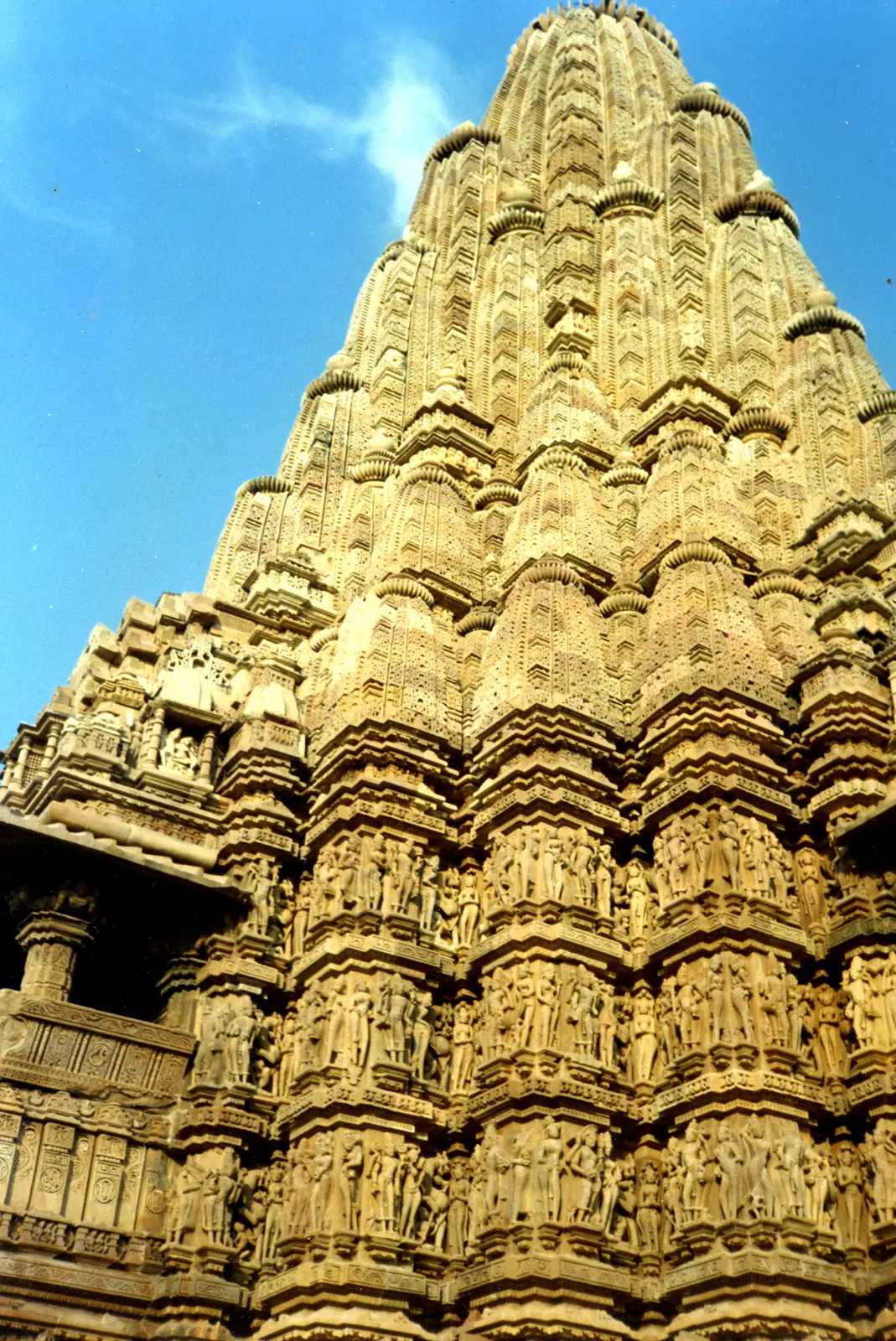
In a Nagara temple the shikhara is the whole curved spire, rising directly above the garbhagriha so that the highest point of the temple stands over the murti. On Kandariya Mahadeva, half-spires called urushringas lean against the main tower in tiers. In tradition the word means mountain peak, and the tower is read as Meru, the axis of the world.
Look for: Count the smaller spires that cling to the sides of the main one and repeat its shape.
Quick question. What are urushringas?
- Guardian figures at the door
- Bands of moulding at the base
- Half-spires leaning against the main tower
Show the answer
Half-spires leaning against the main tower. Urushringas are half-spires that lean against the main tower and repeat its form, clustered in tiers on Shekhari temples.
Step 5 of 7 · Nagara (northern) tower, standing at Pattadakal in Karnataka
Amalaka and kalasha, the crown
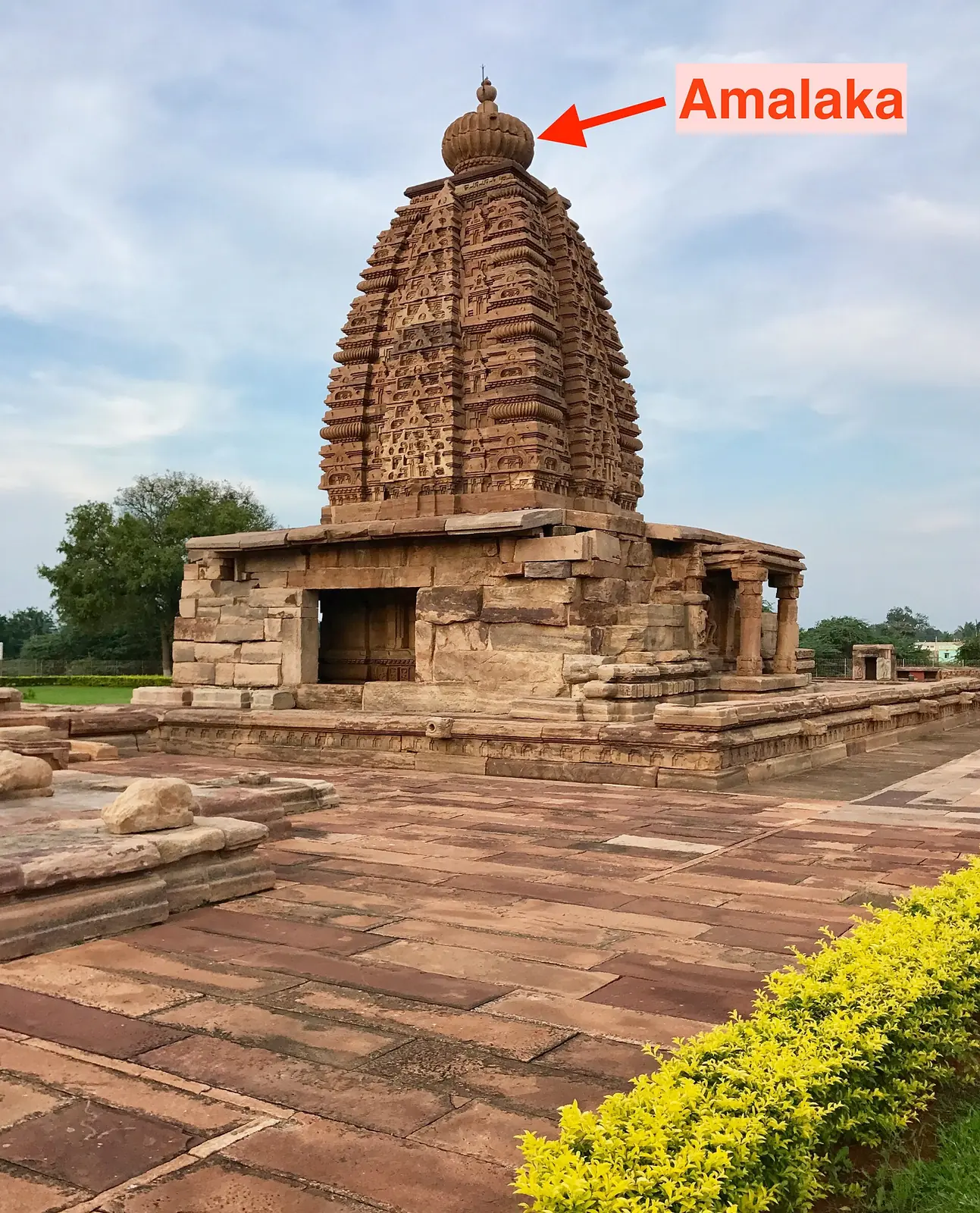
A northern tower ends in the amalaka, a flat ribbed stone shaped like the amla fruit. It sits on the griva, the narrow neck of the tower, and carries the kalasha, the pot-shaped finial. So much is structure. Tradition names the kalasha the purna-kalasha, the full vessel of auspicious waters, and it is anointed when the temple is consecrated.
Look for: Follow the arrow to the ribbed stone at the top of the tower, then find the small finial above it.
Quick question. Which fruit gives the amalaka its shape?
- Mango
- Amla
- Coconut
Show the answer
Amla. The amalaka is shaped like the amla fruit, Emblica officinalis.
Step 6 of 7 · Dravida (south Indian), Chola
The vimana, the southern tower
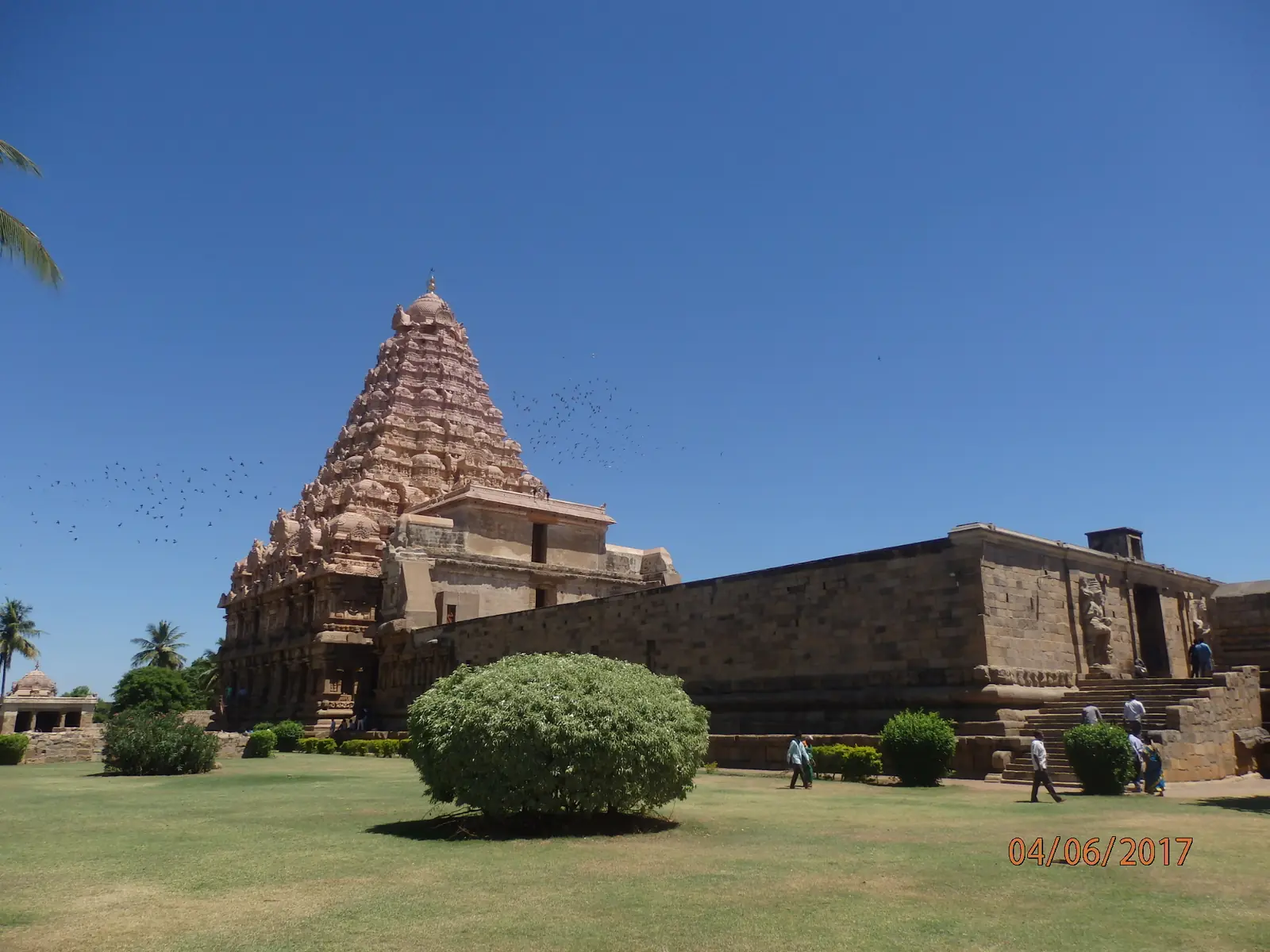
In the south the sanctum and its tower together are the vimana, measured in storeys called talas. Each tala carries a parapet of miniature shrines, the hara, so the tower reads as a stack of temples. Here the word shikhara means only the dome at the top. Gangaikonda Cholapuram, built by Rajendra Chola I, has a softer, concave curve than the vimana at Thanjavur.
Look for: Count the stepped storeys of the tower and find the dome that caps them.
Quick question. In a Dravida temple, what does the word shikhara name?
- The gateway tower
- The whole stepped tower
- Only the crowning dome
Show the answer
Only the crowning dome. In Nagara temples the shikhara is the whole curved spire; in Dravida temples it is only the top dome.
Step 7 of 7 · Dravida (south Indian), laid out by the Nayakas
The gopuram, the gateway
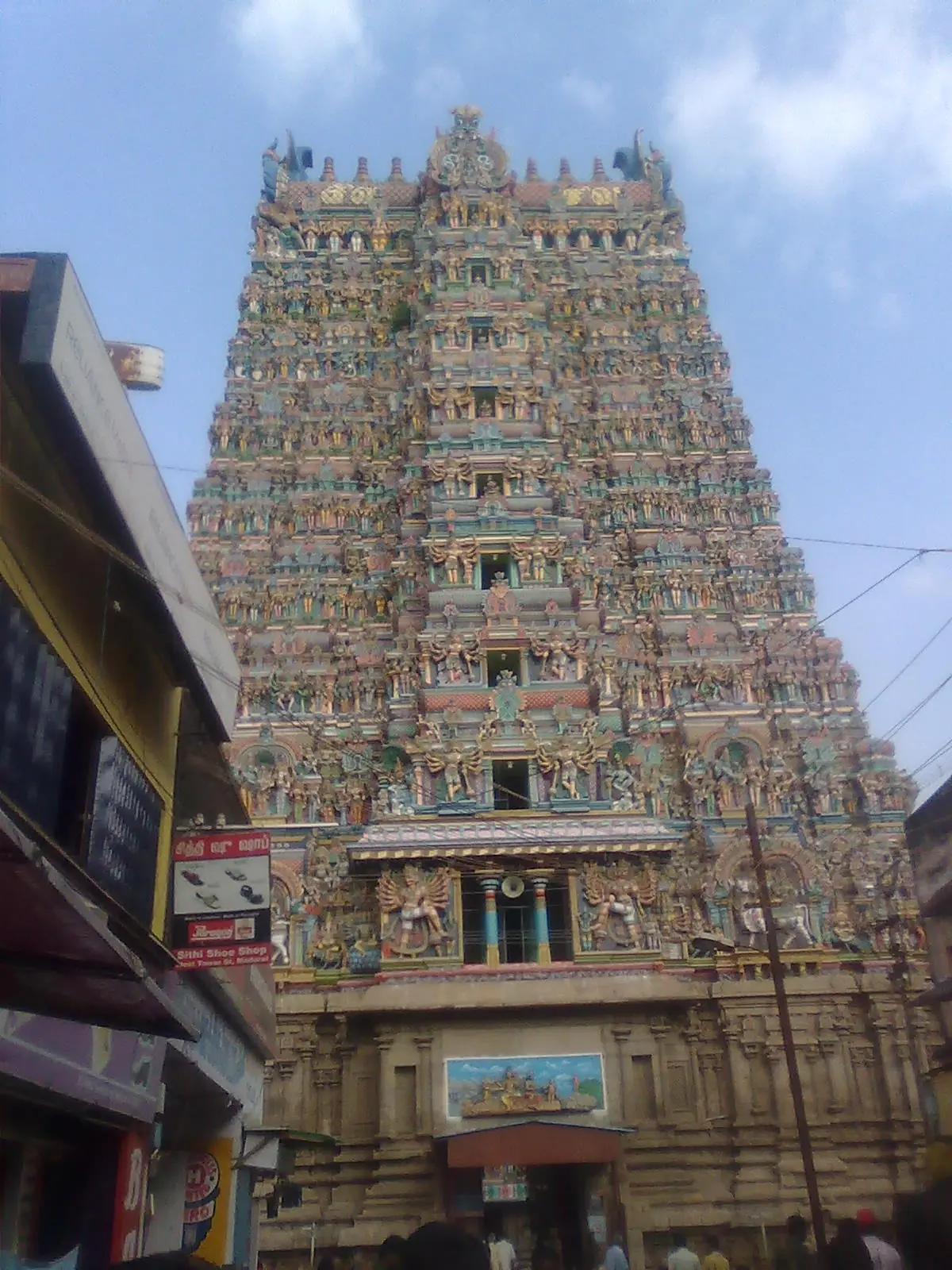
A gopuram is the towered gateway in the enclosure wall, the prakara, of a southern temple. A stone base carries a brick and plaster tower in tiers, ending in a barrel roof with a row of stupis. From the 12th century the gopurams grew taller than the vimana itself. Meenakshi Amman at Madurai has fourteen, covered in painted figures.
Look for: Find the doorway at the foot, then follow the tiers of painted figures up to the roof.
Quick question. From the 12th century, which tower of a southern temple grew the tallest?
- The gopuram at the gate
- The vimana over the sanctum
- The flagstaff
Show the answer
The gopuram at the gate. From the 12th century the gateway towers in the enclosure walls grew taller than the vimana itself.
Recap
- From the ground up, a northern temple reads jagati, jangha, shikhara, amalaka, kalasha.
- Inside, the line runs mandapa, antarala, garbhagriha.
- A Nagara tower is one curved spire over the sanctum. A Dravida vimana climbs in storeys to a dome.
- In the later south the tallest tower is the gopuram at the gate, and the vimana over the sanctum is lower.
- No single plan fits every Hindu temple. A Kerala sanctum may be square, round or oblong, and Odisha sets its buildings in a line.
Keep in mind: The examples here are Nagara temples, mostly at Khajuraho, and Dravida temples of Tamil Nadu. Kalinga, Kerala, Bengal, Himalayan, Hoysala and other styles arrange and name the same ideas differently. No single plan fits every Hindu temple. The plan in step 2 is a simple diagram. The Chausath Yogini temple at Hirapur is circular and roofless, and the Shiva shrine at Vadakkunnathan is circular too. Readings such as the tower as Meru, or the dark sanctum as a seed, are meanings given by tradition and by scholars. They are kept apart here from the account of how the building stands.
hinduaesthetics.com · Read a temple, part by part
Label a temple
A sheet for a child or a class, to do with a printed photograph of a temple or on a visit.
You need: pencil, eraser, plain paper, a printed photograph of a temple.
- Draw the outline of a northern temple from the side and label five parts: jagati, jangha, shikhara, amalaka, kalasha.
- Draw three boxes in a row for the plan and label them garbhagriha, antarala, mandapa.
- Beside the shikhara write two things: what it does in the building, and what tradition says it means.
- Look at a photograph of a southern temple. Mark the vimana and the gopuram, and write which is taller.
- Visit a temple near you, or find a photograph of one. Note which parts from this trail you can see and which you cannot.